


June 7, 2021 in Hillier-Lieberman Textbook
The Remarkable Ongoing Story of the Birth and Longevity of the Classic Hillier-Lieberman Textbook
SHARE: PRINT ARTICLE: https://doi.org/10.1287/orms.2021.03.04

It is widely acknowledged that the Hillier-Lieberman textbook, “Introduction to Operations Research” [1], has made an exceptional contribution to the field of operations research (O.R.) by introducing O.R. to more than a million students worldwide (including through translations into more than 15 other languages) and attracting many of these students to enter the field. However, this book was almost never written and later endured a crisis that threatened the continuation of new editions. Nevertheless, the textbook (as well as a popular spinoff) is still going strong after 54 years. I tell this personal story here for the first time.
Once Upon a Time
My story begins in 1954 when I unexpectedly won two scholarships that enabled me to enter Stanford University as a freshman. Assuming I did well enough to keep my scholarships, my plan was to major in industrial engineering (and perhaps obtain an M.S. degree if my grades were good enough) and then work in that interesting field.
Immediately after my arrival at Stanford, fate intervened with a life-changing event. Of all the Stanford professors who could have been assigned as my freshman advisor, I got Jerry Lieberman!
My first meeting with Jerry to work out my initial course schedule made a big impression. He was a very congenial individual who heartily welcomed me. I learned that we had almost identical academic interests. Jerry took me under his wing and made sure I took the best available course program to prepare for my career. After taking some engineering requirements, I took the “Introduction to Operations Research” course taught by Jerry at the beginning of my junior year. (I also later audited Harvey Wagner’s version of the course.) This was the point I knew that O.R. was the field I wanted to enter.
Rather than heading into industry in 1958, Jerry guided me in a very different direction. He was convinced that I should earn a Ph.D. degree with a specialization in O.R., and then work in academia. He also felt that Stanford was heading toward becoming a real leader in this field, so naturally I should fulfill this vision at Stanford.
This advice was a new concept for me. However, I surprised myself with how well I had done as an undergraduate. I won a few awards, including being chosen as a member of the Stanford Woodwind Quintet my freshman year and then winning the Outstanding Sophomore Debater Award the next year. I also won the McKinsey Prize for technical writing my junior year and the Hamilton Watch Award my senior year for “combining excellence in engineering with notable achievements in the humanities and social sciences.” Additionally, I was about to graduate as the top-ranked student of the approximately 325 in my engineering class. Jerry’s proposal now seemed both realistic and exciting.
My three years (1958-1961) in the Ph.D. program under Jerry’s guidance was a wonderful experience. I took numerous courses in statistics, mathematics and economics in addition to industrial engineering. I took every O.R.-related course I could. Particularly memorable were “Inventory Theory” given by Herbert Scarf and “Mathematical Economics” given by Kenneth Arrow (a Nobel Laureate). I also taught the Introduction to Operations Research course myself during my third year (and an engineering economy course earlier). I worked particularly hard on the O.R. course (which paid dividends later when I started working on the Hillier-Lieberman textbook). Jerry also guided me very well through my Ph.D. dissertation.
I had expected that (like most academics) I would join the faculty at another university when I finished my graduate program. However, I received an attractive offer to join the Stanford faculty, which Jerry urged me to accept. He emphasized that Stanford was on the verge of developing a nationally prominent program in operations research and that I should be a part of it. I am so grateful that I accepted Jerry’s sage advice.
From Professor to Textbook Author
Upon joining the Stanford faculty in September 1961, Jerry invited me to be his co-author on a path-breaking “Introduction to Operations Research” textbook. We soon signed a contract to develop the book with the publisher Holden-Day. The plan was that I would take a leave after one year to spend my second year as a visiting professor at Cornell University to gain some experience elsewhere. I then would start my part of the book as soon as I returned in June 1963.
Delaying the launch for two years was a wise decision because it gave me the opportunity to focus on research first. I had very broad interests and started ongoing research on a broad range of areas, including queueing theory and its applications, integer programming, other areas of mathematical programming, statistical quality control, operations management and risk analysis in capital budgeting. I published 18 papers in these areas prior to the publication of our book. The breadth of these research areas would prove very helpful in enabling me to authoritatively develop chapters in the Hillier-Lieberman textbook across the spectrum of the field.
When I returned from my year-long leave at Cornell in June 1963, I was eager to jump into my part of the book. Having been away, I had no committee assignments and no Ph.D. students to advise, so I was able to work full time on the book for the remaining 10 weeks of the summer. I spent nine hours at the office every day writing nonstop (except for a lunch break). I spent considerable time in the evening reviewing my lecture notes and references to get ready to jump right into writing the next morning. I made sure that I completed at least 12 hand-written pages every day before I could quit. I completed drafts of four chapters that summer. This provided great momentum for then stealing small blocks of time thereafter to work on the book. As we added problem sets and drafts of more chapters, Jerry and I started to distribute our material to the students in our introductory courses to try it out. We finished compiling the book in 1966, and the first edition was published in 1967.
Perfect Timing
Our timing was perfect. Operations research had become a hot topic in academia, and numerous colleges started offering an “Introduction to Operations Research” course in various departments, but there were few reasonable options available for a textbook. We were surprised by how quickly our book dominated the market. (My royalties actually exceeded my Stanford salary for a few years!)
What is perhaps even more surprising is how little has changed in the following 54 years. While operations research is no longer such a hot topic (compared to analytics or data science), a few more excellent textbooks of this type have come along (e.g., the Wagner and Winston O.R. textbooks), and business schools started going their own way (with management science textbooks increasingly based on spreadsheets). However, the Hillier-Lieberman textbook has managed to lead the way ever since for introduction to O.R. courses aimed at STEM students, and a spinoff has had substantial success in business schools.
The great success of the first edition led us to publish a second edition in 1974 (which included a prototype example in almost every chapter to better illustrate the material), a third edition in 1980 and a fourth edition in 1986. Sales continued to thrive, especially domestically. Then came a major change. Our small publisher (Holden-Day) struggled due to inadequate sales from other books, so they sold the rights to our book to McGraw-Hill. Fortunately, McGraw-Hill has a very major international operation, which led to huge numbers of international students using our book and its many translations. McGraw-Hill published our fifth edition in 1990. The major change this time was the addition of an interactive O.R. tutorial software package.
Bad News
Three years later, in 1993, I received the tragic news that my beloved mentor and co-author, Jerry Lieberman, had been diagnosed with ALS (Lou Gehrig’s disease). This terrible progressive disease meant that Jerry would become more and more incapacitated until his inevitable demise (which occurred in 1999). I was devastated.
In addition, losing Jerry had dire implications for the future of my textbook writing. At the time, we had an overwhelming set of writing obligations. Somewhat earlier, we had contracted with McGraw-Hill to develop a more applied version of our textbook to be entitled “Introduction to Management Science” and aimed directly at business school students. I had made some progress on this very major project, but Jerry had not. Furthermore, we began publishing two spinoff versions of our textbook with some additional material. In particular, both “Introduction to Mathematical Programming” and “Introduction to Stochastic Models in Operations Research” published in 1990 [2], with the expectation of completing future editions.
More Bad News
Another problem was that “Introduction to Operations Research” had grown to nearly a thousand pages, so how was I going to have the time in the midst of my faculty responsibilities to revise all of this (including Jerry’s chapters) for the upcoming sixth edition and subsequent editions? It was overwhelming. Perhaps the only realistic path forward was for me to drop all of my book projects, including any new editions of the Hillier-Lieberman textbook.
However, I felt a responsibility to somehow keep the textbook going, because of the importance of the book to the field. I agonized over this issue and finally concluded that there was only one feasible solution: I needed to take early retirement from my faculty responsibilities! I somehow managed to make the revisions needed to publish the sixth edition of “Introduction to Operations Research” and the second edition of “Introduction to Mathematical Programming” in 1995 [3]. I took leave for the 1995-1996 academic year (when I finished supervising my final three Ph.D. students and made some progress on the new “Introduction to Management Science” textbook). I then officially “retired” to become a full-time textbook writer as of Sept. 1, 1996. This continues to be my status now, 25 years later. I have full responsibility for additional editions of “Introduction to Operations Research,” in addition to working on the management science textbook. To make this feasible, I dropped doing new editions of “Introduction to Mathematical Programming” and “Introduction to Stochastic Models in Operations Research.”
Putting My O.R. Eggs in a Business School Basket
During the late 1990s, my main focus was on how to strongly reorient “Introduction to Operations Research” to fit a business school audience while retaining the quality of the original textbook. The title of the new textbook would be “Introduction to Management Science: A Modeling and Case Studies Approach with Spreadsheets,” with the subtitle summarizing the new emphases [4]. I needed a co-author, preferably a gifted teacher employing these emphases in a business school. Very fortunately, I didn’t need to look any further than within my own family.
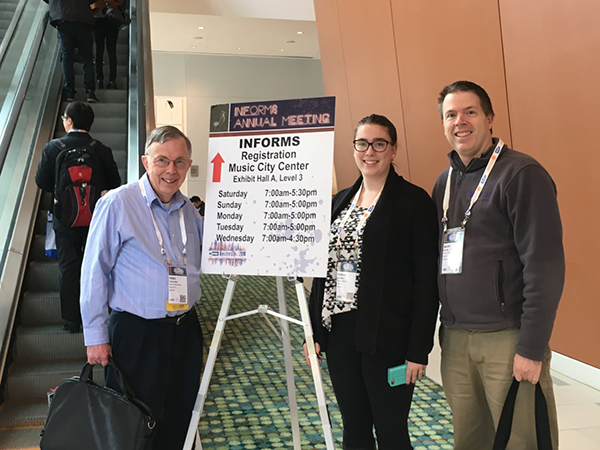
My son, Mark Hillier, was then (and still is) a faculty member in the Foster School of Business at the University of Washington. He mainly teaches management science and spreadsheet modeling courses. He is indeed a gifted teacher, having won more than 30 teaching awards to date (including the very top teaching award in the Foster School of Business twice). He is intimately familiar with “Introduction to Operations Research,” having used it as a student and then developing the interactive O.R. tutorial software package for the fifth and sixth editions. He completed his graduate work at Stanford with an M.S. degree in operations research and a Ph.D. in industrial engineering and engineering management. (Margaret Brandeau was his dissertation advisor.) I was most happy to add him as a co-author for this new textbook.
We published the first edition of this new management science textbook in late 1999. Although the market already included several excellent textbooks that had been well entrenched for many years, ours was well received. New editions regularly followed – the sixth edition published in 2018.
The international reception has also been gratifying with four widely-used translations, and English-language international student editions have also been popular.
When considering all versions of the book, it has been used by more than a quarter million students (including approximately 22,000 in 2020), compared with approximately a million students for the Hillier-Lieberman textbook (including roughly 41,000 in 2020).
This textbook is, in fact, another spinoff of Jerry’s and my “Introduction to Operations Research” textbook, albeit with a very different orientation. It could not have been written without the guidance provided by our O.R. textbook. When it became time to add new topics (e.g., the impact of analytics, simulation optimization, robust optimization and chance constraints) to a new edition of the O.R. book, a modified treatment often would follow in the next edition of the management science book. The two books share about 30 application vignettes based on dramatic applications described in articles in the journal now called INFORMS Journal on Applied Analytics, along with links to those same articles. They also share dozens of end-of-chapter cases, as well as many examples and problems (with revisions to fit the new audience). However, the management science book has a much stronger emphasis on basing chapters on case studies and using spreadsheet modeling. For example, Mark wrote a chapter for the management science book entitled “The Art of Modeling with Spreadsheets.” When I received the 2017 INFORMS Kimball Medal (essentially a lifetime achievement award), I was pleased that it was largely for both this book and the O.R. textbook.
What’s Next?
Because of the analytics revolution, Mark and I are busy adding nearly 100 new pages on analytics (mainly predictive analytics) to the upcoming seventh edition, which will have the revised title, “Introduction to Management Science and Business Analytics: A Modeling and Case Studies Approach with Spreadsheets” and is scheduled for publication in late 2022 [5].
Meanwhile, I have also been busy developing even more new editions of “Introduction to Operations Research” since Jerry’s death in 1999. The book is now slightly less than a thousand pages, but also has about 300 more pages of supplements and additional chapters on the book’s website. I emphasize keeping everything up to date. In recent editions, I added a chapter on metaheuristics, three sections on analytics, and individual sections on robust optimization, chance constraints, branch-and-cut integer programming, constraint programming, the practical application of decision analysis, multiple-criteria decision analysis, behavioral queueing theory, multi-echelon inventory systems, revenue management, Markov decision processes in practice and simulation optimization.
The seventh edition of the O.R. textbook was published in 2000. Several more editions followed, including the 11th edition published in early 2020 [6]. I was gratified to receive the Saul Gass Expository Writing Award from INFORMS in 2004 for the eighth edition.
Lessons Learned
From my undergraduate days to choosing my profession, to putting my professorship on hold to serve academia in a different way, I’ve learned many professional and personal lessons.
- An outstanding mentor can have a great impact on one’s future.
- Pay it forward and attempt to be an impactful mentor to others.
- Writing a good textbook is a huge task, so be careful about taking this on.
- Writing a good textbook requires many attributes – writing skills, depth and breadth of knowledge in the topic, empathy with students encountering the topic for the first time, great drive and perseverance, etc., so carefully assess whether you should take this on.
- There is great satisfaction with extending your teaching far beyond the students in your classes.
Author’s note. In the next issue of OR/MS Today, I will give my 67-year eyewitness account of the overall history of operations research at Stanford University.
References
- Hillier, F., and G. Lieberman, 1967, “Introduction to Operations Research,” 1st ed., Holden-Day.
- Hillier, F., and G. Lieberman, 1990, “Introduction to Stochastic Models in Operations Research,” 1st ed., McGraw-Hill.
- Hillier, F., and G. Lieberman, 1995, “Introduction to Mathematical Programming,” 2nd ed., McGraw-Hill.
- Hillier, F., and M. Hillier, 2019, “Introduction to Management Science: A Modeling and Case Studies Approach with Spreadsheets,” 6th , McGraw-Hill.
- Hillier, F., and M. Hillier, 2022, “Introduction to Management Science and Business Analytics: A Modeling and Case Studies Approach with Spreadsheets,” 7th ed., McGraw-Hill, forthcoming.
- Hillier, F., and G. Lieberman, 2021, “Introduction to Operations Research,” 11th ed., McGraw-Hill.
Frederick S. Hillier is professor emeritus of operations research at Stanford University.