


June 7, 2021 in Student Perspectives
The Passion and Potential of Collegiate Esports
SHARE: PRINT ARTICLE: https://doi.org/10.1287/orms.2021.03.14
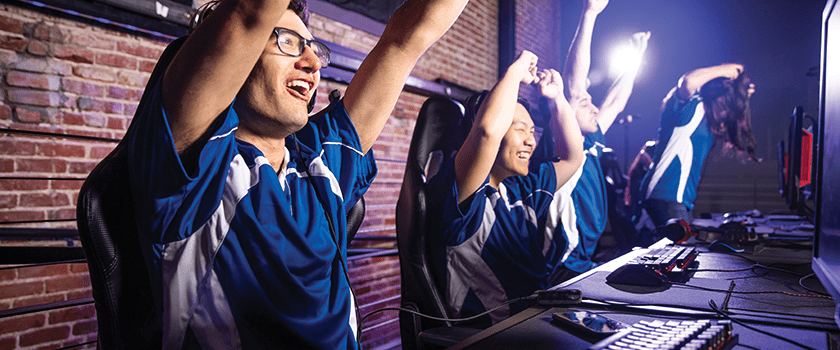
No longer an activity relegated to the sidelines, video games are gaining traction as not only a meaningful pastime, but also a profitable field. On college campuses, students around the world are forming esports teams to collaborate with one another and compete against other teams in grand video game competitions. To learn more about this burgeoning competitive gaming world, OR/MS Tomorrow lead editor Amira Hijazi and staff writer Abigail Lindner spoke with several passionate players and supporters of collegiate esports at the University of Washington, Oregon State University and the University of Southern California.
An Esports Community
Like traditional sports, esports connects a live audience – usually joining through a platform like Discord – to teams of skilled players. Decades of skepticism about the health of gaming may incur doubts about the viability of its competitive sports league. Explosive growth in the 21st century, facilitated by technological improvements in the 2000s and multiplayer online battle arena game development in the 2010s, however, has demonstrated otherwise [1]. With a market revenue of $957.5 million in 2019, esports is projected to reach $1 billion in 2021 and exceed $1.5 billion in 2024 [2]. At the collegiate level, esports has generated more than $15 million in scholarships across approximately 200 universities in North America [3].
The chance to reap rewards beyond personal satisfaction in the esports realm is certainly appealing. Joe Jacko, head coach of the League of Legends team at the University of Southern California (USC) and a former collegiate esports player, shared his proudest moment as a player when his Virginia Tech team won $7,000 in 2018 and, the following year, earned $2,000 each for running undefeated in their regular season. However, none of the interviewees responded with financial gain as their reason for diving into esports.
A gamer in middle school, Alice Qian, a senior economics student at USC, formed an esports club at her high school in 2016 before transitioning into her current role managing the USC esports program. Kevin Parker, Overwatch League member and team manager for all esports teams at the University of Washington, and Ghaith Shan, a senior computer science student at Oregon State University and president of the university’s esports club, both joined esports in college with the desire to connect with a community of passionate players that encouraged improvement and collaboration.
The idea of community appeared many times during our conversations with players and managers. For Trevor Whiton, a lifelong gamer and a senior advisor in the Student Activities Office at the University of Washington, the community-building power of esports has made him a passionate advocate for its expansion. He notes that, at the general sociological level, video games often conjure images of antisocial teenagers in their basements when, in reality, video games are as much a platform on which to connect with others as, say, music. Joseph Agor, assistant professor at Oregon State University and advisor for the university’s esports club, celebrated the broad appeal of esports because it has the potential to bring together students from a variety of backgrounds and disciplines.
Though the field can draw a diverse crowd, it seems as though the goal of a full student-representative community has not yet been achieved. Shan says that the attraction of esports was not limited to a specific type of student. At the same time, at the University of Washington, Whiton and Parker note a glut of IT- and STEM-focused students and a lack of humanities students. “You’re going to find gamers in history and English majors as well,” Parker says. “Philosophy … all the majors on-campus have people who play video games, people who like video games. … It’s not bound to your stereotypical ‘nerds.’” Attracting diversity and creating a welcoming, multidisciplinary environment will be a long-term task of the esports community.
Beyond stereotypes, Whiton and Agor acknowledge two other barriers keeping many students from participating in esports: first, an ignorance of their transferable skills with respect to esports; and second, a social block. To the first, Whiton recalls conversations with students who expressed interest in esports but waved away the prospect of joining a team because they believe that they didn’t have the skills to meaningfully contribute. Agor draws an analogy to basketball regarding the second barrier. He says, “I can give you a basketball and I can give you a basketball hoop, but if you’re going to shoot by yourself for about 50 days, you’re going to get bored. I want to play with other people.” Overcoming these barriers involves growing awareness about the variety of roles, including videography, graphic design and business planning, and creating the welcoming community that is the regular theme of the esports scene.
Developing Esports Skills
Esports is much more than plugging in one’s console and banging away at a controller. Parker and Agor both note a common underestimation of the amount of strategic and analytical thought, as well as the amount of time required to perform well in esports. For his own gaming skills in Overwatch, Parker reports that it took him two or three years, carving out time around school and other obligations, to reach a pro team-worthy level of proficiency. Shan compares the focus of an esports player to a basketball player: “If someone is a basketball player, they have to balance practice time as well as school time and then still have additional time to relax.”
Developing a skill takes time but for the players and managers the satisfaction of coordinating with a team of focused, passionate peers is worth it. Parker recalls the best moment of his esports career thus far, during the spring season of last year. As the 54th seed, his team rallied to defeat the No. 6 seed team from Winthrop University. “We proved to ourselves that we were capable of competing with the best,” he says. The accomplishment signified the progress achieved by passion and hard work, which other esports gamers have seen in their respective teams. From progress emerges stronger community and more dedicated players.
The Future of Esports
Looking ahead five years, all of the interviewees anticipate continued growth and dream of greater diversity and inclusion. Whiton says, “I hope that it [esports] takes the good of collegiate sports [and] mixes it with the open-mindedness and the vision and the inclusion of the current generations of students. … My dream team would be six players on a platform with different genders, cultures ... all able to compete at a collegiate level without arbitrary cut-and-dry gender roles. I hope that we transcend. … I would like everyone to feel welcomed, and I would like it to be as inclusive and representative as possible.”
Considering more technical developments, Parker hopes “to see [esports] as an online equivalent to organizations like the Pac-12 and NCAA, where you have established rule sets across multiple tournaments – ways that the games should be played and ways that players should be treated across the board – a standardization of that and a standardization of the teams that are playing against each other.” As a faculty member, Agor anticipates more and more academic interest in esports, both in research and in program development. “I’d like to see universities investing more in these programs that help train for this particular job,” he says, “and not have this mindset of ‘What is gaming doing in an academic world?’”
As esports attracts more attention as a legitimate avenue for student community, skill building and even career advancement, players and administrators look forward to the day when the mindset is instead “Why shouldn’t gaming be in the academic world?”
References
- “A brief history of esports and video games,” British Esports Association, https://britishesports.org/news/a-brief-history-of-esports-and-video-games/.
- Stoller, Eric, 2019, “An epic update on collegiate esports,” Inside Higher Ed, May 16, https://www.insidehighered.com/blogs/student-affairs-and-technology/epic-update-collegiate-esports.
- Pierce, John, 2020, “Collegiate esports: much more than a game,” Global Sport Matters, Sept. 24, https://globalsportmatters.com/business/2020/09/24/collegiate-esports-much-more-than-a-game/.
Abigail Lindner is a recent graduate of Regent University, where she earned a B.S. in mathematics. She is currently enrolled as a Ph.D. student in the mathematics program at Worcester Polytechnic Institute in Massachusetts. Her research interests lie in the nonprofit sector and theoretical ecology. Abigail has served as an editorial staff writer with OR/MS Tomorrow since the spring of 2020. Amira Hijazi is a Ph.D. student and research assistant in the Industrial and Systems Engineering Department at North Carolina State University. She is co-lead editor for OR/MS Tomorrow, the student magazine of INFORMS.

([email protected])