May 25, 2021 in Preventing Prejudice in Policy
Educating a Biased Society: Using Hate Crime Data to Inform and Define Future Policy in the U.S.
SHARE: PRINT ARTICLE: https://doi.org/10.1287/orms.2021.03.17

According to the U.S. Department of Justice, a hate crime is a crime that is motivated by hate or bias [1]. Hate crime biases include religion, ethnicity, race, sexual orientation and disability, among others [2]. To help law enforcement make informed policy decisions related to hate crimes, I created a regression model for analyzing the level of hate crime in the District of Columbia (D.C.) given a certain set of input variables. Understanding indicators of hate crime occurrence may allow decision-makers to more easily identify U.S. states that are at risk for higher levels of hate crime occurrence. Having this understanding will allow decision-makers to allocate resources to reduce the occurrence of hate crimes. In addition, actions that can be taken to improve hate crime reporting standards will be provided, as well as alternative data collection methods.
Unfortunately, hate crime perpetrators cannot always be held accountable for their actions. To inform the U.S. federal government about the extent of hate crimes in America, I suggest that law enforcement, prosecutors, community organizers and elected officials encourage higher hate crime reporting standards.
The Metropolitan Police Department of D.C. (MPD) website (https://mpdc.dc.gov/hatecrimes) has a dedicated area where the importance of understanding hate crimes is highlighted. They believe that to maintain safety within the community, residents and visitors must have a clear understanding of what is considered a hate crime. MPD formalized the criminal nature of a hate, or bias-related, crime under the Bias-Related Crimes Act of 1989. The official verbiage used to define a hate crime or attempted criminal act is one “that demonstrates an accused’s prejudice based on the actual or perceived race, color, religion, national origin, sex, age, marital status, personal appearance, sexual orientation, gender identity or expression, family responsibility, homelessness, physical disability, matriculation or political affiliation of a victim” [3].
Authorities are careful to differentiate that most speech is not considered a hate crime, regardless of how obnoxious and offensive the language may be. Within the D.C. metro area, a hate crime is not necessarily considered a crime, rather a potential motive for a crime. As MDP’s comprehensive data collection implies, it takes these crimes very seriously, because someone who is found guilty of such a crime is severely punished. There are two key components of punishment that occur for bias-related crimes:
- The district court may fine the offender up to 1.5 times the maximum fine.
- The court may commit a jail sentence of 1.5 times the maximum term for the related crime.
When performing data analysis, it is important to fully understand the policies and procedures each metro area uses for data collection. The Metropolitan Police Department has been consistently collecting hate crime data since January 2012. This dataset is updated on a quarterly basis and recently, a commander of the Third District, Stuart Emerman, was extremely responsive when a question concerning the data was submitted. A 20-year veteran of the MPD, Commander Emerman noticed the discrepancy in the data was due to how it was transposed.
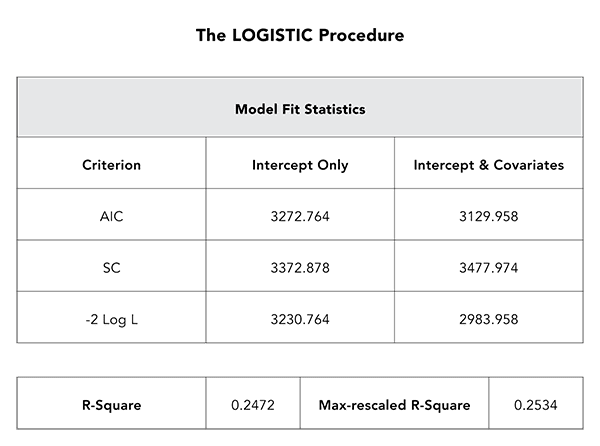
This dataset includes 1,005 observations with 22 variables; the response variable being the Hate Crime Bias. An initial regression was run on this dataset and the following Model Fit Statistics can be seen in Figure 1.
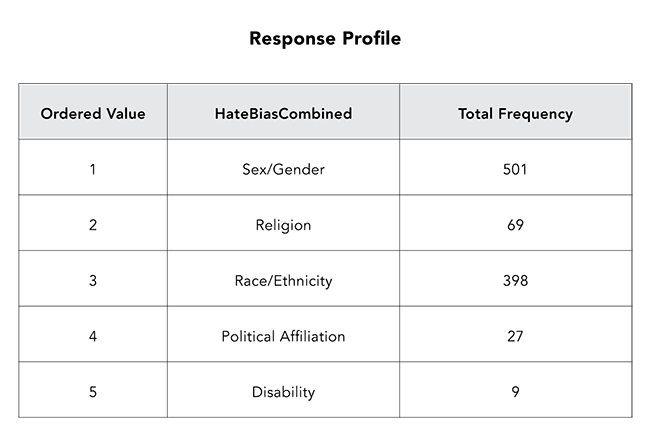
The next SAS regression was run by combining several of the categories of the 22 variables, and the new target variable was HateBiasCombined. The five new categories are sex/gender, religion, race/ethnicity, political affiliation and disability (Table 1).
The updated Model Fit Statistics can be seen in Figure 2.
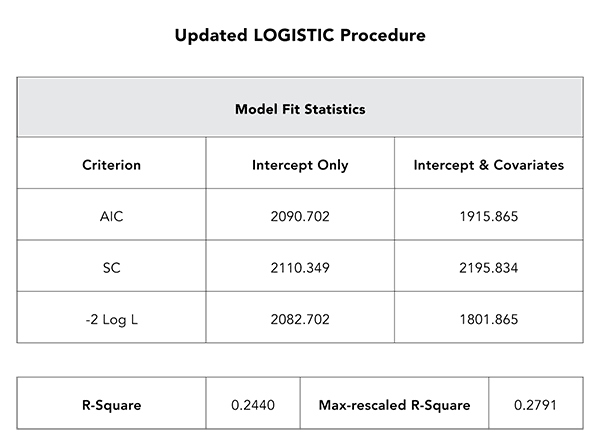
Comparing the two models, HateBiasCombined has a lower AIC (Akaike information criterion), and a lower value of AIC indicates a “better” model. This value is an estimator of out-of-sample prediction error and is considered an effective way to gauge the quality of a statistical model when comparing different models that use the same dataset.
The next step in the analysis addresses variable selection. One of the more important steps within model building is finding a careful balance with the number of variables and the complexity of the model. Table 2 shows the information from the SAS output that details the statistical importance of each variable. The orange rows identify the two variables that have a high p-value and should be dropped.
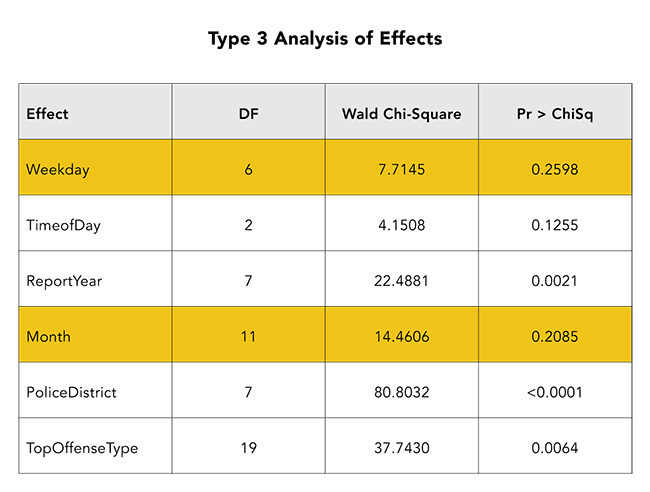
After dropping the two variables, Weekday and Month, the p-value for TimeofDay decreased slightly to 0.0108 (Table 3) and can now be considered more significant.
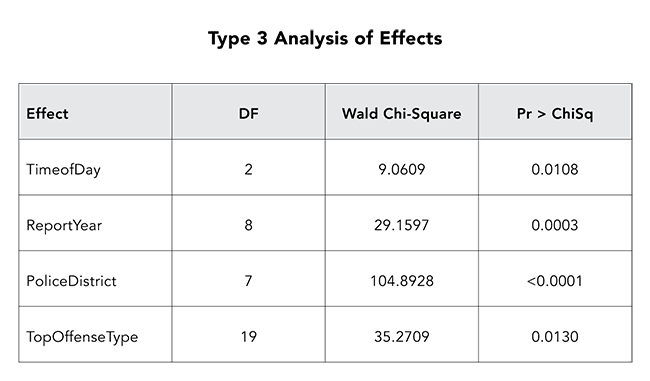
Using the response variable as HateBiasCombined, there are a total of four significant independent variables: TimeofDay, ReportYear, PoliceDistrict and TopOffenseType.
What the Data Says
After reviewing data from numerous metropolitan areas, I have noticed that most of the data is collected initially, only to be published on a city’s website several months later. Despite federal efforts to improve the quality and efficiency of data collection, each city handles its respective information differently. During 2018, there was a significant increase in hate crimes in Washington, D.C., however, less than 1% of those cases were ever charged. Unlike all other areas in the U.S. where crimes are locally prosecuted, crimes in D.C. are federally prosecuted by a U.S. attorney. U.S. Attorney Jessie K. Liu mentioned during an interview that there was only one staff member whose responsibility included reviewing more than 200 annual cases. The increased number of reported hate crimes were primarily due to an increase in people targeted based on sexual orientation and gender [4].
Future analysis and research of hate crimes may indicate that with rising anti-Asian racism and xenophobia, the Department of Justice and FBI will need to increase resources to help address the influx of reported cases. The rise of racist threats during the coronavirus pandemic was highlighted during a CNN interview between CNN host Lisa Ling and former presidential candidate Andrew Yang on April 2, 2020. Ling used words to describe attacks toward her on social media as “ugly, vicious, threatening and terrifying,” and according to U.S. Rep. Judy Chu (Calif.), more than 100 assaults on Asian Americans are being reported daily [5]. If this trend continues, California could expect 3,000 hate crime reports every month, which will require many more resources to address the rising problem.
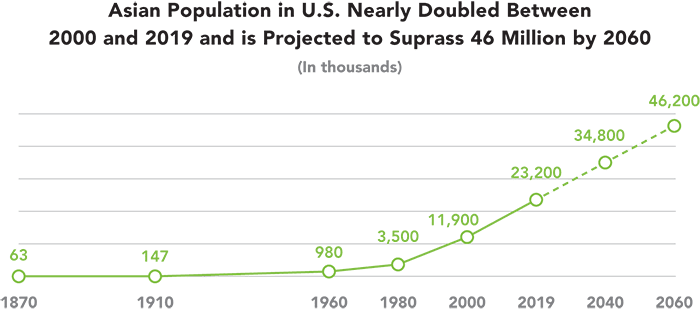
According to the U.S. Census Bureau, the following 10 states have the largest populations of Asian Americans: California, New York, Texas, New Jersey, Illinois, Washington, Florida, Virginia, Hawaii and Massachusetts. In addition, Asian Americans currently account for more than 5% of our nation’s population. We recommend that data scientists work with local leaders in these states, especially in metro areas, to help combat the increasing challenge of racial adversity as COVID-19 continues to impact our daily lives. Recent data from the Pew Research Center shows the increasing Asian population within the United States (see Figure 3) [6].
A national coalition that closely tracks anti-Asian-American discrimination, Stop AAPI Hate, recently reported data from all 50 states and the District of Columbia that within the timeframe of March 19, 2020 to Feb. 28, 2021, there were nearly 3,800 firsthand reports of racism and discrimination toward Asian Americans. An analysis of police department statistics by the Center for the Study of Hate and Extremism has revealed that the U.S. experienced a significant hike in anti-Asian hate crimes across major cities, revealing that while such crimes in 2020 decreased overall by 7%, those targeting Asian Americans rose by nearly 150% [7]. Likely a result from the COVID-19 virus first detected in China, the ethnic group reporting the largest increase of hate crimes in the past year with 42% are Chinese Americans [8]. In May 2021, President Biden signed the COVID-19 Hate Crimes Act into law, with support from both chambers of Congress. The act would order the Justice Department to put hate crimes at the top of its review list – especially those against Asian Americans and Pacific Islanders. It also includes resources for local law enforcement to document violence; directs the Department of Health and Human Services to work with local communities and raise awareness of hate crimes against the AAPI community; and provides an online reporting system that could help victims come forward [9].
Steps for Proper Crime Data Collection
As the U.S. continues to struggle with the diversity of individuals within its melting pot, all local, state and federal initiatives to address hate crimes should include seamless communication, standard data collection techniques, and a proactive approach to decrease the number of these heinous crimes. Data collection is just the beginning and is an important foundation to building a model that can help officials combat all crimes. Using advanced software capabilities that are under the umbrella of business analytics, numerous statistical and modeling techniques that can be built in packages such as R, SAS and Python are just a few tools that data analysts and data scientists can use to evaluate complex datasets. New capabilities such as machine learning and artificial intelligence can aid analysts by noticing trends within the data before evaluation even begins.
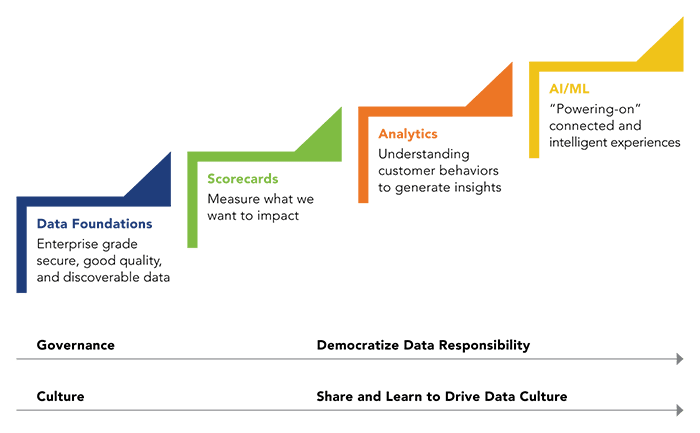
The four-step process shown in Figure 4 can help create, develop, maintain and support crime data collection.
Step 1. Data scientists can spend up to 80% of their time getting the raw data in a format to begin the modeling process [10]. Raw data typically requires extensive processing before it becomes useful information. After the raw data is compiled, data ingestion occurs at the beginning of the data stack, where information technology (IT) specialists combine the data from a wide range of sources to begin analysis. Local law enforcement officials who initially complete a police report must understand the importance of capturing as much information as possible concerning a potential hate crime. The factors should be immediately recorded in a database, and the individual record must be accurately entered to help government officials better understand the complex dynamics that are part of these bias crimes.
This is the data foundation where quality data should be entered in a secure portal using enterprise-grade server, storage and firewall equipment. Once the data is available, data analysts and scientists can begin modifying the .xls or .csv in Python, R or SAS to understand the data and identify trends and patterns.
Step 2. Scorecards leverage data on a wide range of policing-related issues to help departments better interact with the communities they serve. Data within the scorecard can be used to help evaluate officers and provide a method to maintain accountability. Scorecards capture critical information that can help measure what police departments and agencies hope to accomplish in keeping communities safe. Typically, relevant information is decided by input from activists and experts in the field. This valuable information is used to help police forces, administrators, researchers, policymakers and communities improve public safety.
With the recent momentum behind reducing police departments to help monitor communities, the use of a standards-based scorecard approach may help justify interest by using real-time data to demonstrate that large police departments may not be as effective as they have been in the past. Local municipalities tend to know their community better than federal government administrators, and using a data-driven approach, such as a scorecard, can justify adequate funding and resources to improve accountability and public safety on a local level. Regardless of location – metropolitan city, suburb or rural area – using telecommunications data to learn GPS coordinates of an incident may help local officials better combat hate crimes. Evidence in the D.C. hate crimes data indicates that location is a relevant variable (in which police district the crime was reported).
Step 3. In the existing uncertain environment in which COVID-19 has turned the world upside down, many aspects of our daily lives have changed. As students, faculty and administrators return to classrooms, there is a high probability that many will pass through a detector that immediately checks one’s temperature. When a shopper enters a store, there is a high likelihood that someone will be scanning their forehead before entering. This enhanced method of data collection puts a burden on organizations, businesses, churches, etc. that is normally left in the hands of IT experts. A wave of federal funds, such as the CARES Act, Paycheck Protection Program and American Rescue Plan, have been dispersed to help address the financial burden that wreaked havoc on schools, campuses, businesses, etc., as well to help enhance safety measures moving forward.
Superintendents, principals, board members and CFOs are now making quick decisions about deploying new technology without considering how these new investments will impact existing IT systems. A total cost of ownership should always be considered when investing in a project, and many of these reactive decisions do not take into consideration how this technology will be supported using existing resources. Business analytics, if used correctly, can help business-minded professionals better understand the data. Using data to understand behaviors and trends will only become useful insights if the data is accurate and there is a meaningful output for someone to understand. Executives appreciate data visualization because graphs and charts can help tell the story in a more impactful way than combing through spreadsheet data or SQL, R and Python code.
Step 4. The final major phase of data analytics includes new capabilities, such as artificial intelligence (AI) and machine learning. As more personal information is shared in the world, law enforcement can extend the basic profiling information from fingerprints, facial recognition, driver’s licenses and IDs, to learning more about individuals based on what they post on social media. Using an eight-month period starting in August 2013, U.K. researchers developed an AI algorithm to identify nearly 300,000 posts from Twitter that included hateful language. The objective of this study, released in 2019 from the HateLab project based out of Cardiff University, was to help police better predict and prevent surges in crimes directed against minorities. Computer scientists used data to aid law enforcement to help justify allocating resources to specific areas within London. By recognizing that social media may lead to physical violence, this is the first significant study that recognizes the importance of bias-motivated crimes based online.
Matthew Williams, director of HateLab, said: “This is the first U.K. study to demonstrate a consistent link between Twitter hate speech targeting race and religion and racially and religiously aggravated offences that happen offline. Previous research has already established that major events can act as triggers for hate acts. But our analysis confirms this association is present even in the absence of such events. The research shows that online hate victimization is part of a wider process of harm that can begin on social media and then migrate to the physical world” [11].
Machine Learning is Critical
Within the past two years, U.S. cities such as New Orleans, Los Angeles and Philadelphia have begun experimenting with machine learning to help test predictive policing. The goal is twofold; first, identify a specific location in which a future crime may occur, and second, what individual(s) and/or group(s) are likely to commit a crime [12]. By automating decision-making, sophisticated software will use algorithmic tools to help remove the inherent bias that may exist within law enforcement.
In our current environment where there is a national outcry to improve police accountability, machine learning can be critical as we search for solutions that enhance fairness, add factual data to improve analysis that aid valid conclusions, and provide a more efficient way to investigate complex crimes. In our 24/7 news cycle, the ability to scrutinize police decisions has never been easier. Police departments are now having to spend countless hours addressing media requests because real-time video has become a new standard in documenting incidents. The U.S. federal government should continue investments in advanced features of data analytics to help all law enforcement agencies better document how hate crimes are reported. AI and machine learning methods can help improve the field of security governance.
References
- “Hate Crimes,” The United States Department of Justice, May 10, 2021, https://www.justice.gov/hatecrimes.
- “Hate Crimes Case Examples,” The United States Department of Justice, May 4, 2021, https://www.justice.gov/hatecrimes/hate-crimes-case-examples.
- Bias-Related Crimes (Hate Crimes) Data. Accessed May 14, 2021, https://mpdc.dc.gov/hatecrimes.
- Miller, Michael E., 2019, “The Victims of D.C.’s Record Year of Hatred,” The Washington Post, Aug. 21, https://www.washingtonpost.com/graphics/2019/local/dc-hate-crimes/.
- Sullivan, Kate, 2020, “Yang: Asian Americans Being Attacked over Coronavirus Is ‘Heartbreaking,” CNN, April 3, https://www.cnn.com/2020/04/02/politics/andrew-yang-asian-americans-attacked-coronavirus/index.html.
- Budiman, Abby, and Neil G. Ruiz, 2021, “Key Facts about Asian Americans, a Diverse and Growing Population,” Pew Research Center, May 3, https://www.pewresearch.org/fact-tank/2021/04/29/key-facts-about-asian-americans/.
- Yam, Kimmy, 2021, “Anti-Asian Hate Crimes Increased by Nearly 150% in 2020, Mostly in N.Y. and L.A., New Report Says,” NBC News, March 9, https://www.nbcnews.com/news/asian-america/anti-asian-hate-crimes-increased-nearly-150-2020-mostly-n-n1260264.
- Jeung, Russell, Aggie Yellow Horse, Tara Popovic and Richard Lim, 2021, “Stop AAPI Hate National Report,” Stop AAPI Hate, Feb. 2, https://stopaapihate.org/wp-content/uploads/2021/04/Stop-AAPI-Hate-National-Report-210316.pdf.
- Cathey, Libby, 2021, "House passes anti-Asian hate crimes bill, legislation awaits Biden's signature," ABC News, May 18.
- Wong, Phoebe and Robert Bennett, 2020, “Everything a Data Scientist Should Know About Data Management,” Towards Data Science, May 31, https://towardsdatascience.com/everything-a-data-scientist-should-know-about-data-management-6877788c6a42.
- “Increase in Online Hate Speech Leads to More Crimes against Minorities,” 2019, Cardiff University, Oct. 15, https://www.cardiff.ac.uk/news/view/1702622-increase-in-online-hate-speech-leads-to-more-crimes-against-minorities.
- Vestby, Annette, and Jonas Vestby, 2019, “Machine Learning and the Police: Asking the Right Questions,” Policing: A Journal of Policy and Practice, June 14, https://doi.org/10.1093/police/paz035.
Resoundingly Human podcast interview, featuring Matthew Matlack
In a episode of the INFORMS podcast Resoundingly Human, Matthew Matlack takes a deeper dive into the topics discussed in this article and shares what drives his passion for his work. Visit pubsonline.informs.org/magazine/orms-today/podcasts to learn more and listen!
Matthew Matlack is a technology sales professional based in Tulsa, Oklahoma. He has attained two graduate degrees from University of Tulsa in which he has blended his passion for technology with research concerning race relations. His research should help increase the awareness of the importance of preventing hate crimes and providing education to communities that struggle with race and gender issues.