


August 4, 2021 in O.R. at Stanford
A 67-year eyewitness account of the illustrious history of operations research at Stanford University
Faculty of O.R. heroes produces major contributors to the field – a veritable who’s who of OR/MS
SHARE: PRINT ARTICLE: https://doi.org/10.1287/orms.2021.04.02

Over the last 67 years, I have had the great privilege of both observing and participating in the glorious history of operations research (O.R.) at Stanford University. Sharing this journey with numerous gifted colleagues and students has been a wonderful experience. I record below the highlights of this journey.
1954-1961: Integrating O.R. courses
When I arrived at Stanford as a freshman in September 1954, operations research was still a very young field. Only the most progressive universities were beginning to introduce O.R. into their curriculum – Stanford was one of them. A new course, Introduction to Operations Research, was being offered in the Department of Industrial Engineering (IE). This particularly interested me because I was planning to major in IE, and this was exactly the kind of course I wanted to take. It was to be taught by Gerald (Jerry) Lieberman, a new assistant professor with a joint appointment in industrial engineering and statistics. A little later, Harvey Wagner also joined the Stanford faculty as an assistant professor, and he occasionally taught this course. (Both Lieberman and Wagner went on to become prominent members of the international O.R. community and INFORMS.)
During this time period, there were other Stanford faculty members who were starting to teach O.R.-related courses, including Kenneth Arrow (mathematical economics), Samuel Karlin (stochastic processes and applied probability) and Herbert Scarf (inventory theory). These three individuals then jointly conducted foundational research on the mathematical theory of inventory and production. Their results are still used today.
1962-1967: Ph.D. offering and big names
With the growing prominence of operations research, Stanford was ready to make a big push in this area. An Interdepartmental Program in Operations Research began to offer a Ph.D. in operations research in September 1962. Jerry Lieberman became the chairman of the program. In addition to Jerry, the faculty consisted of a number of other prominent Stanford professors who had appointments in closely related departments and were teaching the courses needed for this program. Harvey Wagner was a particularly active member of the program before leaving Stanford in 1967.
Some junior faculty needed to be hired to help support this program. With my research and teaching interests in queueing theory, integer programming, risk analysis in capital budgeting, etc., I was the first to be hired upon the completion of my Ph.D. in 1961. Arthur (Pete) Veinott (inventory theory, dynamic programming and lattice programming) arrived a year later. (Both of our appointments were in the IE department.) Within a few more years, Donald Iglehart (applied probability and simulation) and Richard Cottle (mathematical programming) joined the staff.
All four of these junior faculty members were destined to become core members of the Stanford O.R. program throughout the next few decades as they gained increasing prominence in the field. All four became INFORMS Fellows and winners of other major awards from INFORMS. (Started in 2002, INFORMS Fellows are a highly selective group of INFORMS members who have been awarded this honor because of their outstanding lifetime achievement in operations research and the management sciences.)
An especially important move during this period was adding George Dantzig, the renowned “Father of Linear Programming,” to the faculty in 1966, who went on to have a huge impact on the O.R. program.
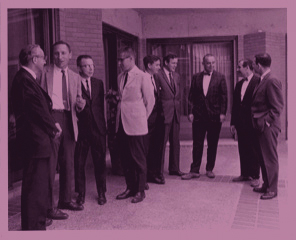
(l-r) George B. Dantzig, Alan S. Manne, Frederick S. Hillier, Donald L. Iglehart, Arthur F. Veinott Jr.,
Rudolf E. Kalman, Gerald J. Lieberman, Kenneth J. Arrow and Richard W. Cottle.
1967-1995: Successful O.R. program becomes department, more big names
Stanford’s Interdepartmental Program in Operations Research proved to be a great success, with many outstanding Ph.D. graduates who became major contributors to the field. Therefore, in 1967, this program was converted into a full-fledged Department of Operations Research in the School of Engineering that also would offer an M.S. degree in O.R. and a small number of undergraduate courses. Lieberman continued as the chairman until 1975. He was a natural academic leader and so then moved on to senior administrative positions, including serving as the acting provost or provost under three different Stanford presidents.
Another notable event in 1967 was the publication of the first edition of the “Introduction to Operations Research” textbook, coauthored by me and Lieberman, which became the preeminent textbook on this topic through a total of 11 editions (including one last year). (See a companion article in the June 2021 issue of OR/MS Today for this story [1].)
With Dantzig joining the faculty, everything was in place for the Stanford Department of Operations Research to enter a golden age. In addition to his research and teaching, Dantzig made a great impact by bringing in a large number of outstanding researchers to complement our program. Using his research funds, he founded the Systems Optimization Laboratory and hired outstanding computer scientists such as Michael Saunders, Walter Murray, Margaret Wright, Philip Gill and John Tomlin to do research in scientific computing and develop O.R. software packages. Dantzig established and led the Energy Modeling Forum; John Weyant was (and still is) a leader in that activity. Others arrived to work with Dantzig in other areas, including Gerd Infanger in the stochastic programming area. Dantzig also supervised many outstanding Ph.D. students, with many impactful research papers (and even a few books) ensuing from his group.
The outstanding contributors to the O.R. program in the initial decades after Dantzig’s arrival extended well beyond George and his collaborators mentioned above. The four junior faculty from the 1960s had become highly productive members of the field. Along with Lieberman, two outstanding mathematical economists, Alan Manne and Arrow (who won a Nobel Prize in 1972) were also founding members of the department. Rudolf Kalman was another founding member, but he left Stanford in 1971. Somewhat later, the department hired two younger faculty – Curtis Eaves and Peter Glynn – who became important longtime members of the department. (Eaves has retired, but Glynn is still a very productive Stanford faculty member who served several years as chairman of the Department of Management Science and Engineering.)
The Department of Operations Research proved to be a real magnet for outstanding students wanting to enter the field. For many years, at least half of the National Science Foundation Fellowship winners going into O.R. each year chose to enter the Stanford Ph.D. program. Those Ph.D. graduates generally went on to become prominent members of the field. Many won the prestigious Fellow Award from INFORMS. Many became deans or senior faculty at top O.R. programs or became prominent practitioners. Many also provided important service to INFORMS and its predecessors.
The department also attracted several dozen students each year for the one-year program leading to an M.S. in operations research. Some of these students were either employees of Bell Labs or members of the military who were sent to Stanford for further education. Additionally, Stanford offered several undergraduate O.R. courses, including a two-quarter sequence that introduced O.R. (using the Hillier-Lieberman textbook) that was largely taken by students majoring in IE. Enrollment ranged as high as 190. A similar two-quarter sequence with a little more mathematical content was also offered to students in the popular undergraduate major of mathematical and computational sciences.
I introduced an undergraduate course entitled “Models and Applications of Operations Research in Society” (although the faculty privately referred to it as our “O.R. for Poets” course). It had no mathematical prerequisites and was aimed at students in the humanities and social sciences to introduce them to the powerful impact that O.R. could have when addressing societal issues. This course was quite successful, drawing up to 45 students, but was eventually dropped.
Department of Engineering-Economic Systems
Thus far, my history of O.R. at Stanford has focused on the Department of Operations Research and its origins. However, there is much more to this story. To start, consider the Department of Engineering-Economic Systems (EES) that was formed in the School of Engineering at about the same time as the O.R. department. The EES department was another outstanding department that revolved around the techniques and application of O.R., but with a more applied orientation. Many of the faculty came out of an electrical engineering background, and the focus was on the analysis of engineering-economic systems. This department also had many distinguished graduates who made an impact on the field. Two pioneering members of the EES faculty (now retired) were particularly renowned contributors to the O.R. field and warrant special mention.
Even before joining the EES faculty, Ronald Howard was a key pioneer in developing the important O.R. technique called Markov decision processes. He then became known as the guru for how decision analysis should be applied and taught. Numerous students (including many from the O.R. department) who took his legendary decision analysis course swear by it. His 2016 textbook with Ali Abbas, “Foundations of Decision Analysis,” is a real gift to the field.
David Luenberger was another prominent pioneering member of the EES faculty. He is a brilliant expositor (Saul Gass Expository Writing Award winner) who has written outstanding multiple textbooks on different topics within the O.R. field. A 1969 book, “Optimization by Vector Space Methods,” is a classic that is still widely cited. Another example is his outstanding textbook, “Linear and Nonlinear Programming,” first published in 1973, but still popular today. (Now retired, Luenberger has added a current faculty member, Yinyu Ye, as a co-author for the last two editions. They now are preparing a new edition.)
Graduate School of Business
Stanford’s Graduate School of Business (GSB) has long been a major center of O.R. activity. Three of the best early Ph.D. graduates of the Department of Operations Research – Michael Harrison (one of my Ph.D. students), Lawrence Wein and David Kreps – joined the GSB faculty a few decades ago. Both Harrison and Wein are INFORMS Fellows who have won several major INFORMS awards, while Kreps has become a prominent mathematical economist. Other GSB faculty have also made special contributions related to O.R. Evan Porteus (another INFORMS Fellow) was a leading researcher in the inventory management and supply chain management areas. William Sharpe won a Nobel Prize in 1990 for using an O.R. type of approach to investment performance analysis. Robert Wilson (a specialist in game theory and its applications in business and economics) was a popular Ph.D. advisor to several students in the Department of Operations Research.
Notably, one of these O.R. department students (mentored by Wilson) was Alvin Roth, who has since gone on to win a Nobel Prize in Economics and is on the Stanford faculty in the Department of Economics. Wilson himself just won the Nobel Prize in Economics in 2020. His co-winner, Paul Milgrom, is also in the Stanford Department of Economics and is affiliated with both GSB and the Department of Management Science and Engineering.
Other Centers of Operations Research Excellence
Although several of its faculty members moved over to the Department of Operations Research in 1967, the Department of Industrial Engineering (later renamed the Department of Industrial Engineering and Engineering Management) gradually became a major center for research on applications of O.R. During the latter years of the 20th century, the department included three prominent faculty members – Margaret Brandeau, Hau Lee and Elisabeth Paté-Cornell – who became INFORMS Fellows. Brandeau became a prominent leader in what is now the hot area of applying mathematical and economic models to support health policy decisions. (She also has a courtesy appointment as a professor of medicine.) Similarly, Lee (who later moved to GSB in 2002) became a prominent leader in applying O.R. to supply chain management. Paté-Cornell is widely acknowledged to be a leading expert in applying O.R. to risk analysis.
The list of where O.R. blossomed at Stanford outside of the Department of Operations Research goes on and on. O.R. faculty frequently found common ground with faculty in the Department of Statistics, Department of Computer Science, Institute for Computational & Mathematical Engineering, Department of Economics, other departments in the School of Engineering (especially Electrical Engineering), and so forth. For example, the current chair of the EE department, Stephen Boyd, is an INFORMS Fellow whose primary research interests are convex optimization and its engineering applications.
In 1992, the Department of Operations Research celebrated the 25th anniversary of its founding. The celebration was held in conjunction with an ORSA-TIMS Annual Meeting in San Francisco, so there was a big turnout of Stanford alumni. What everybody found remarkable is that, with the exception of Harvey Wagner and Rudy Kalman, essentially the entire core O.R. faculty from the 1960s onward was still there and going strong. However, changes would be coming soon.
1996-2021: Department of Management Science & Engineering Becomes New Home for Operations Research
Big organizational changes involving operations research began to take place at Stanford. The Department of Operations Research and Department of Engineering-Economic Systems merged in 1996, which was then merged with the Department of Industrial Engineering and Engineering Management in 2000 to form the Department of Management Science and Engineering (MS&E). Bringing together the distinguished faculties from the three heritage departments provided great strength in various areas of O.R. and its applications. (Although many members of the faculty in 2000 have since retired, such luminaries as Brandeau, Paté-Cornell and Glynn are still there.)
The MS&E department has added some outstanding faculty who at least overlap with O.R. and analytics.
- Yinyu Ye (a Ph.D. graduate of EES under George Dantzig’s supervision) specializes in mathematical optimization, including interior-point methods. He won the 2009 John von Neumann Theory Prize from INFORMS and the 2014 SIAM Optimization Prize.
- Jose Blanchet earned the 2010 INFORMS Erlang Prize, which is awarded to early career researchers for particularly outstanding contributions to applied probability.
- Ashish Goel and Amin Saberi are involved with algorithmic research.
- Nick Bambos is an expert on network architecture.
- Ramesh Johari deals with statistical and machine-learning techniques used by online platforms.
- Ben Van Roy is a leading expert on machine learning and reinforcement learning algorithms.
- Kay Giesecke studies stochastic financial models.
- Itai Ashlagi specializes in matching markets such as kidney exchange optimization.
- Additional O.R. talent is provided by three outstanding assistant professors – Markus Pelger, Aaron Sidford and Irene Lo.
- In addition, two Nobel Laureates in the Department of Economics mentioned earlier – Roth and Milgrom – also have courtesy appointments in MS&E.
Another feature of the department is that its research and courses remain at the cutting edge of the O.R. field, including current trends in analytics and data science.
The current generation of O.R. scholars in MS&E is fully carrying on the tradition of leadership in the field that epitomized the original O.R. department. The important additional strength of MS&E is that it surrounds the O.R. area with a unique focus on the interface of engineering, business and policy to provide a context for the O.R. research that befits a department in Silicon Valley. Research emphases include organizational behavior, entrepreneurship and technology innovation, technology ventures and the intersection of technology strategy and organizational learning. Thus, the O.R. research is conducted in the context of dealing with the real technological business world.
The formation of the MS&E department in 2000 represented something of the changing of the guard for the original Department of Operations Research faculty. Lieberman had just passed away the preceding year and the great George Dantzig passed away in 2005 at the age of 90. To honor these giants of the field, I led fundraising drives in 2005 and 2006 (with good help from Pete Veinott and Dick Cottle) to establish an endowment fund that would provide multiple annual Dantzig-Lieberman Operations Research Fellowships in the MS&E department in perpetuity. The response was wonderful, including contributions from the hundreds of Ph.D. graduates of the Department of Operations Research. This endowment fund currently holds more than $4 million. Each year, Stanford sends me a packet of thank-you letters and resumes for the students who held one of these fellowships for at least part of that year. I am delighted that my department will continue to send top-notch young O.R. scholars into the field each year.
Lessons Learned
The Stanford O.R. history suggests some lessons for other operations research programs.
- Stay on top of new trends. For example, recognize that the term analytics (or data science or artificial intelligence) tends to convey much more to potential consumers of our field than the term operations research (or management science), so embrace these new terms.
- Also embrace new advances in the field. For example, learn the valuable new techniques provided by analytics, data science and artificial intelligence and add them to your toolkit.
- Be a missionary for this wonderful field. Perhaps add a course such as “The Role of Analytics in Society” for non-majors.
- Stanford’s Department of Management Science and Engineering provides an interesting model for a core STEM department that combines our field and its complements.
- It appears that the leadership of Stanford in O.R. and analytics will continue into future decades.
- Enjoy the experience of being surrounded by exceptionally talented colleagues.
Reference
- Hillier, F.S., 2021, “The Remarkable Ongoing Story of the Birth and Longevity of the Classic Hillier-Lieberman Textbook,” June, OR/MS Today, https://doi.org/10.1287/orms.2021.03.04.
Frederick S. Hillier is professor emeritus of operations research at Stanford University.