


August 3, 2021 in Quantum Computing Education
OR/MS Education and Quantum Computing
SHARE: PRINT ARTICLE: https://doi.org/10.1287/orms.2021.04.22

Quantum computers use the laws of quantum mechanics to manipulate information. The corresponding model of computation can be faster than any classical computer for certain tasks. (See some introductory material [1, 2] and a comprehensive reference [3].) For several decades, researchers – mostly in theoretical computer science and quantum physics – have been studying the quantum computing model and investigating what can be done with it. Recent hardware developments have spurred a tremendous surge of interest from the government, industry and academia; see [4] for a discussion of the current state of quantum computing hardware, possible applications and the challenges that lie ahead. This interest has prompted institutes of higher education to explore what a quantum computing curriculum should look like. This article discusses the role that operations research and management science (OR/MS) disciplines can play in the education of quantum computing scientists.
Interface Between OR/MS and Quantum Computing
Quantum computing (QC) is considered a branch of physics or computer science, especially the parts that concern algorithms. At the same time, some of the main application areas of QC for scientific computation, such as optimization and simulation, are traditionally within the domain of OR/MS. The main reason for this apparent disconnect is probably the lack of available quantum computers up to this point: OR/MS is a field rooted in practical problems and numerical evaluation, whereas quantum algorithms have – for the most part – remained purely theoretical.
With recent progress in QC hardware, companies (e.g., IBM, Rigetti Computing, D-Wave), academic institutions (e.g., Berkeley Labs through their AQT initiative) and government institutions (e.g., Sandia National Laboratories through their QSCOUT initiative) are making their QC hardware available to the public. Thus, it is time for the OR/MS community to start looking at QC as a model of computation that could have practical applications in a few years. Not only can QC algorithms be developed for OR/MS applications, but OR/MS techniques can also be used to improve existing QC methods (e.g., classical optimization is an important component of many QC algorithms for near-term quantum computing devices).
Further intersections arise in key areas of QC related to noise mitigation, embedding of quantum circuits, and development of new quantum computing algorithms, to name a few. This interaction may lead to the development of new quantum-inspired methodologies to address OR/MS problems using classical computation; for example, quantum-inspired algorithms have been proposed in areas such as linear algebra, support vector machines and heuristic optimization methodologies. For the intersection of QC and OR/MS to thrive, we must provide students with the skills to excel in these fields.
QC Skills for the Job Market
QC encompasses many subareas, each of which focuses on specific aspects. It would be impossible to list all of them; therefore, we limit ourselves to a few areas that have a large overlap with OR/MS. Note that we only discuss the intersection with OR/MS, refraining from giving an exhaustive description of the skills required in each area.
- Quantum algorithms: This area requires a strong training in linear algebra, discrete mathematics (including graph theory), probability and computational complexity. Quantum algorithms are generally taught separately from classical algorithms due to the important differences in the computational model. Because optimization, simulation and machine learning are highly sought-after application areas, training in these disciplines is extremely valuable. Understanding quantum physics is not strictly necessary to work on algorithms, although it may help, especially since many efficient quantum algorithms concern the simulation of quantum mechanical systems.
- Hardware design and control: This area requires training in data analytics (statistics, machine learning), probability and optimal control. Optimization and modeling skills are also desirable and can be very useful in tackling new challenges that arise in hardware design.
- Quantum software development: Writing quantum software requires knowledge of linear algebra, discrete mathematics, computational complexity and programming languages.
The importance of these subareas is based on the personal experience of the authors, as well as a survey conducted on companies that recruit in the area of QC [5]. Specifically, the study [5] focuses on 21 companies of different sizes and with different areas of focus that belong to the Quantum Economic Development Consortium (QED-C) (see Figure 1 in [5]). The study found that 57% of the reviewed companies hire students with a bachelor’s degree in engineering, while 38% hire students with Ph.D. degrees in engineering (a high number of students that pursue graduate studies in OR/MS do so after graduating from a B.Sc. in engineering, or pursue the graduate program in an engineering department, such as industrial engineering).
Although the area of OR/MS is not explicitly mentioned in the study, its results show that students going into a graduate program in OR/MS from a more purely mathematical or computational science background also have plenty of opportunities in the quantum industry. In particular, the study shows that 24% of the companies hire students with a Ph.D. in computer science, and 10% hire students with a Ph.D. in mathematics (see Figure 3 in [5]), two areas that overlap with certain concentrations of Ph.D. degrees in OR/MS.
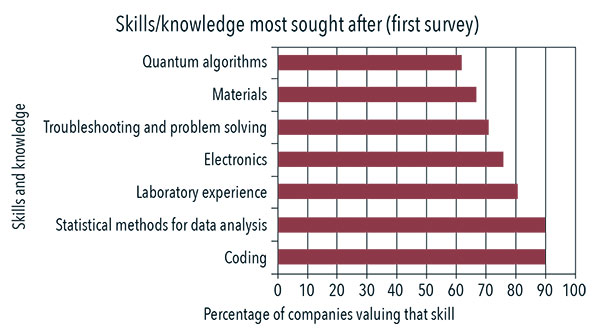
One of the most important conclusions of this study for students in OR/MS that are looking to get involved in the quantum industry is companies are not necessarily looking only for experts in QC and/or quantum information. The quantum industry is also looking to fulfill positions in which a deep knowledge of the theory behind quantum information science is not a necessary or sufficient requirement. Indeed, classical skills are highly valued as well (see Figure 1).
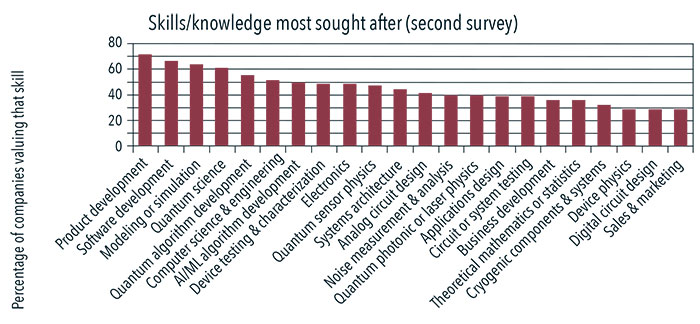
A second study performed by the QED-C, with responses from 60 companies in the quantum industry, provides a more granular view. A summary is reported in Figure 2, the original data is discussed in the videos available at the NSF Workshop on Quantum Engineering Education [6]. As before, the conclusion is that many sought-after skills are typically taught and developed in OR/MS curricula, e.g., modeling and simulation, machine learning, statistics and business development.
While this discussion is not exhaustive, we hope it provides an overview of the skills that should be trained to be successful on the job market, and this in turn should inform the development of school curricula. To get a sense of available positions, we provide two useful resources. The first is the database maintained by the Quantum Economic Development Consortium (QED-C) [7]. As of June 2021, the list included 369 entries from companies such as Amazon, Google, IBM, D-Wave, IonQ, Microsoft, QCWare and Rigetti, among others. The second is the newsletter produced by the ORNL Quantum Computing Institute, which not only contains job openings (hundreds of them in the June 2021 newsletter, plus directions to 245 company and university career sites with multiple open positions), but also a summary of news in the area, such as funding opportunities and calls from conferences [8].
OR/MS Courses in QC Education
Due to the vastness of the field of QC, as well as its inherent interdisciplinarity, a course of study in QC is unlikely to be offered by a single department. This is especially true at the undergraduate level, where the basis for the discipline has to be established. At the graduate level, where courses are more specialized, such an endeavor is possible. The prototypical QC degree includes foundational classes in linear algebra, QC and quantum information science, computer programming (at least classical), and is likely to include at least some classes in quantum technologies (i.e., the basic principles underlying quantum hardware). These classes are unlikely to be offered by an OR/MS department, although linear algebra is often a prerequisite in OR/MS curricula.
The contributions of OR/MS to quantum education begin to shine when elective classes are considered. What follows is a nonexhaustive list of courses that could be offered as electives in a QC curriculum, and that may in fact be required classes for certain concentrations.
- Modeling and simulation: Modeling skills are at the heart of OR/MS and find multiple applications in QC. These skills are required for quantum application researchers and developers; quantum algorithms for simulation [13] have been developed, therefore expanding them and applying them to real-world problems is an important task for this job role. They are also required for noise characterization in quantum hardware.
- Optimization: Optimization is one of the main areas being investigated for quantum applications; it is also pervasively used in many branches of business and science. In addition to quantum algorithms for optimization, optimization is a frequently used subroutine for some quantum algorithms for near-term quantum devices, and is used in quantum information science, making it a required skill for quantum application researchers and developers. Hardware design problems can also benefit from optimization.
- Machine learning and data analytics: Multiple experimental tasks (noise characterization, tuning of devices) employ these skills, which are also required for many quantum application researchers and developers. The area of quantum machine learning is very active and receives significant attention from the industry, developing at rapid pace.
- Probability: This should be a required course for all engineering-type degrees in quantum computing, due to its ubiquity.
- Project management: Several job roles in the quantum industry related to management and business development require traditional management science skills such as project management.
To get introduced to some of the existing capabilities of quantum computers in these areas, as well as the corresponding research challenges, some comprehensive reports and the references therein are an excellent starting point to find elements of QC that can be incorporated into the above classes [9, 10]. The NSF workshop on quantum engineering education website [6] also contains several resources regarding QC education (an extensive report on QC undergraduate education, being prepared by the QED-C, is likely to be available in the near future).
Programming Languages
There are plenty of online resources to understand the available quantum programming languages and their functionality. Major companies working in the field have developed their own languages and tools, and most of them come with learning resources. Programming languages tend to be heavily Python-based, so working knowledge of Python is often a requirement. Quantum code (usually in the form of circuits) can be tested using local simulators, which work for a restricted number of qubits on normal laptop computers – but more than enough qubits to test and learn. Access to quantum hardware is available via the cloud from various companies and national laboratories – free of charge in some cases. Excellent entry points for a discussion on quantum computing languages are the technology column [11] and the more detailed survey [12].
In conclusion, we believe that this is an excellent time to invest in quantum engineering education. Given the surging demand from the industry, it is vital that we equip the workforce of tomorrow with the analytical background to adapt to new technical challenges. The intersection of the classical and quantum model of computing presents many beautiful problems that OR/MS disciplines can address if we teach students the relevant skills.
Acknowledgments
The INFORMS Computing Society formed a working group on quantum computing in November 2020. This article is written by the members of the working group.
References and Notes
- Nannicini, G., 2020, “An introduction to quantum computing, without the physics,” SIAM Review, Vol. 62, No. 4, pp. 936-981.
- Rieffel, E. and Polak, W., 2000, “An introduction to quantum computing for non-physicists,” ACM Computing Surveys (CSUR), Vol. 32, No. 3, pp. 300-335.
- Nielsen, M.A. and Chuang, I., 2002, “Quantum computation and quantum information,” Cambridge University Press.
- Preskill, J., 2018, “Quantum computing in the NISQ era and beyond,” Quantum, Vol. 2, p. 79.
- Fox, M.F., Zwickl, B.M. and Lewandowski, H., 2020, “Preparing for the quantum revolution: What is the role of higher education?” Physical Review Physics Education Research, Vol. 16, No. 2, Article no. 020131.
- NSF Workshop on Quantum Engineering Education, https://www.osa.org/en-us/meetings/topical_meetings/quantum_engineering_education_workshop/.
- Quantum Economic Development Consortium (QED-C) jobs database, https://quantumconsortium.org/quantum-jobs/.
- ORNL quantum computing mailing list, https://elist.ornl.gov/mailman/listinfo/qci-external.
- Aspuru-Guzik, A., Van Dam, W., Farhi, E., Gaitan, F., Humble, T., et al., 2015, ASCR Workshop on Quantum Computing for Science. Technical report, Sandia National Lab, Albuquerque, N. M.
- Wolf, S.A., Joneckis, L.G., Waruhiu, S., Biddle, J.C., Sun, O.S. and Buckley, L.J., 2019, “Overview of the status of quantum science and technology and recommendations for the DoD.” Technical report, Institute for Defense Analyses, Alexandria, Va.
- Matthews, D., 2021, “How to get started in quantum computing,” Nature, Vol. 591, pp.166-167.
- Heim, B., Soeken, M., Marshall, S., Granade, C., Roetteler, M., et al., 2020, “Quantum programming languages,” Nature Reviews Physics, Vol. 2, No. 12, pp. 709-722.
- This refers to event simulation and estimation of probabilities; not to be confused with Hamiltonian simulation, a fundamental problem in QC for which efficient quantum algorithms exist.
Giacomo Nannicini is an associate professor of Industrial and Systems Engineering, and Electrical and Computer Engineering at the University of Southern California. His main research interest is optimization and its applications. Swati Gupta is a Fouts Family Early Career Professor and assistant professor at H. Milton Stewart School of Industrial and Systems Engineering, Georgia Institute of Technology. Sven Leyffer is a senior computational mathematician in the Mathematics and Computer Science Division, Argonne National Laboratory. Jim Ostrowski is an associate professor and director of graduate studies in the Department of Industrial & Systems Engineering, University of Tennessee. Luis F. Zuluaga is an associate professor in the Department of Industrial and Systems Engineering at Lehigh University.

([email protected])

([email protected])

([email protected])
([email protected])