
August 5, 2021 in Student Perspectives
INFORMS Academic Program Database: A Tool to Identify the Best Analytics Programs
SHARE: PRINT ARTICLE: https://doi.org/10.1287/orms.2021.04.23

The growing trends of digital data generation, low-cost computing resources and storage devices, and efficient, easy-to-use software have made analytics ubiquitous. As a result, analytics professionals are in high demand and analytics-focused courses and degree options are proliferating. The lengthy list of learning options can make the task of selecting the items most compatible with one’s personal interests and professional goals overwhelming; this problem of plenty paralyzes even current analytical professionals as they search for experiences to keep their skills updated.
Enter the INFORMS Academic Program Database [1], which markets itself as a “tool [that] allows you to search by dozens of different criteria so that you can narrow down your search quickly to find the program that is right for you.” It follows the pattern of other program search tools offered by organizations such as U.S. News & World Report, Peterson and the Princeton Review. What sets the INFORMS Academic Program Database apart from these is its free access, unhindered by advertisements and chat boxes, and easy navigation. An array of filters enables analytics professionals to quickly match their interests with the available courses and programs.
Navigating the Database
An illustrated example will help highlight the features and functionality of the database, which enables users to find the results best suited to their needs.
Meet Jessica. Jessica is a Singapore native entering her second year of work as an analyst in one of Singapore’s leading investment banks, her first job since obtaining her undergraduate degree. While a valuable learning experience in itself, she realizes that her career would further benefit if she obtained a graduate education focused on data analytics. Her primary interest is in courses on formulating the right questions to derive business insights that can be leveraged to form cutting-edge strategies for her employer. She seeks a full-time program in the American South because her brother is currently pursuing his doctoral degree in chemical engineering from the University of Florida. Four months ago, she took the GMAT and earned a good score.
Following are filters available in INFORMS Academic Program Database for search.
- Program Type: Enables you to customize the degree of your next learning Options range from bachelor’s to doctoral. Jessica chose all of the M.S.- and MBA-related filters.
- Classification: Identifies the specific field (Course Tags) for the degree; for example, financial engineering for finance-based analytical programs. Jessica chose the “Business Analytics” filter.
- College Type: The “Business” type is best for students seeking to obtain business insights through analytics. “Arts & Sciences” would be a better fit for students interested in the methodological development aspects of Bayesian statistics. Jessica chose business colleges.
- Program Delivery Method: Extends the usefulness of the database for a wider range of analytical professionals. “On Campus: Full Time” covers traditional learning options whereas “Online Only: Part Time” extends options for working professionals. Jessica selected “On Campus Only: Full.”
- Testing Requirement: Often, standardized test results are required to make admission-related decisions. Test scores are valid over a couple of years, and this filter provides you the option to shortlist courses matching with valid test scores. If your GRE score is valid, you can shortlist all courses accepting GRE test Jessica selected the “GMAT” filter.
- S. Region & U.S. State/Territory: Allows you to spatially narrow down your learning options in the United States, selecting from four regions and the 50 U.S. states plus American territories such as Puerto Rico. Jessica selected “South” in U.S. Region.
Applying these filters identified one result, the Master of Quantitative Management: Business Analytics Program from Duke University, as a potential option for Jessica (see figure to the right).

On expanding this option, Jessica found information on the program website, including objectives, full-time duration, testing and other application requirements. She also learned about required credit hours and the financial aspects of the degree. She was very happy with the result and pleased that the database displayed the key information within the database itself, rather than redirecting her to another page. Moreover, the entry was updated in the current academic year cycle!
Observations
Jessica made a few key observations during the navigation process. The filter options are collapsed by default. Once expanded, the options stayed visible unless she manually collapsed the menu. Additionally, search results were dynamic in nature, automatically reflecting the effects of the last selection. “Clear Filters” let her restart the search when needed.
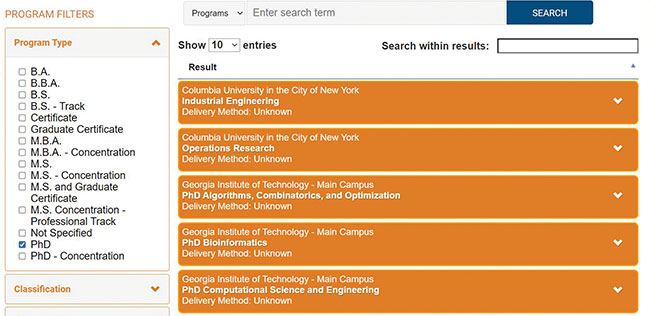
Megan, Jessica’s friend, found key information on doctoral programs in operations research (see figure below). She read through the different school names and their delivery methods. By clicking on the results, she found more information on each program. The additional information had few minor variations.
Use Cases
To further understand the possible uses of the INFORMS Academic Program Database, use cases are provided from the perspectives of specific analytics enthusiasts, undergraduate students and experienced working professionals.
Analytics enthusiasts:
- Program options for specific analytics needs. Ryan, a Chicago native, has a bachelor’s degree in business. For the last two years, he has worked as an associate consultant specialized in aspects of the supply chain. He would like to find analytical degrees incorporating his job skills, so he selects the “Supply Chain” option in the Classification Filter and finds engineering and management-driven options.
- Program options for generalized analytics needs. Tom, a budding analyst, is about to finish his undergraduate degree in information systems and wants to explore academic analytics programs providing an M.S. degree. He selects all four M.S. options in Program Type and selects the “Analytics” classification to gather information.
Undergraduate students:
- Deciding analytics-driven elective courses. Jill, an undergraduate student in business economics, used the database to look at analytical programs under “Management Science” to determine elective possibilities to add an analytical edge to her education.
Experienced working professionals:
- Deciding professional growth strategies. Cynthia, an experienced healthcare analyst, is experiencing a technological transition in her job on account of growing electronic health records (EHR) usage and migrations to distributed data processing approaches. She used the database to look at analytical programs by selecting “Information Systems” classification to devise learning strategies for her professional development.
Opportunities for Database Improvement
One of the drawbacks that a user first engaging with the tool will discover is the small selection of schools. Given that most of the universities in the U.S. have multiple variations of analytics degree programs offering perspectives from business, engineering and science schools, the database covers about 100 programs. Furthermore, it is missing programs from outside the United States. This sparse program and university representation is partly explained by the way INFORMS collects the data, reporting that, “the data you see here is maintained by the universities themselves,” which eliminates advertisements and sponsored content [2]. Being an international society, INFORMS should make definite attempts to enhance program and university representation.
Other features worth re-evaluating are the filter options, which, while certainly concise, are slightly complicated. In Program Type, for instance, there are 15 options: four bachelor’s programs, six master’s programs, two Ph.D. programs, two certificate programs and one unspecified. Simplification to “Bachelor,” “Master,” “MBA,” “Certificate” and “Ph.D.” would be less overwhelming. The number of options for classification is appropriate given the diversity in the analytics and OR/MS fields, but the developers of the tool might consider including, perhaps at the bottom of the page, an introductory glossary for the subject areas listed. This would especially benefit students and young professionals just beginning to deeply explore analytics.
Users should be aware that, due to the wealth of filter options and paucity of database entries, there are a handful of searches that yield no results. To name a few, selecting “Data Mining” classification, “PhD-Concentration” program type, “Online Only: Part Time” program delivery method, or “IELTS” testing requirement results in zero program suggestions. In the U.S. State/Territory filter, Arizona, among other states, has no program representatives, despite Arizona State University boasting a Master of Science in Business Analytics program that in 2021 ranked in the top 10 for business analytics programs by U.S. News & World Report.
Conclusion
Places for improvement notwithstanding, the INFORMS Academic Program Database as it exists now does offer a valuable resource for students and professionals exploring their interests in operations research and management science. The comprehensive annotations for the results give prospective students an idea of what to anticipate in the programs at the universities that they will see in the database and from there contextualize their expectations for similar programs at unlisted universities. The database offers an accessible, clutter-free solution to the “problem of plenty” by presenting in the filter options the types of programs and range of academic focuses offered at universities across the United States. It has the capacity to assist all kinds of analytical professionals, from amateurs to experts, thanks to its variety of filter options. The database is rich in information and has the potential to immensely benefit students, academics and professionals in the INFORMS community.
References
- https://www.informs.org/Resource-Center/INFORMS-Academic-Program-Database
- Wendy Swenson-Roth, 2021, “INFORMS Academic Program Database,” OR/MS Today, July 9, https://doi.org/10.1287/orms.2021.04.04.
Mihir Mehta is a doctoral student in the Industrial and Manufacturing Engineering Department at Penn State University. His main research topic is trustworthy artificial intelligence in the public health context. He is an editorial staff writer for OR/MS Tomorrow. He is currently serving as a technical mentor for the Data Science for Social Good UK Chapter Summer Program 2022. He is invited to present “Inclusive Pedagogy” at the 2022 INFORMS Annual Meeting. Abigail Lindner is a recent graduate of Regent University, where she earned a B.S. in mathematics. She is currently enrolled as a Ph.D. student in the mathematics program at Worcester Polytechnic Institute in Massachusetts. Her research interests lie in the nonprofit sector and theoretical ecology. Abigail has served as an editorial staff writer with OR/MS Tomorrow since the spring of 2020.