


July 30, 2021 in What's Your StORy?
What's Your StORy? Ann Campbell
SHARE: PRINT ARTICLE: https://doi.org/10.1287/orms.2021.04.24
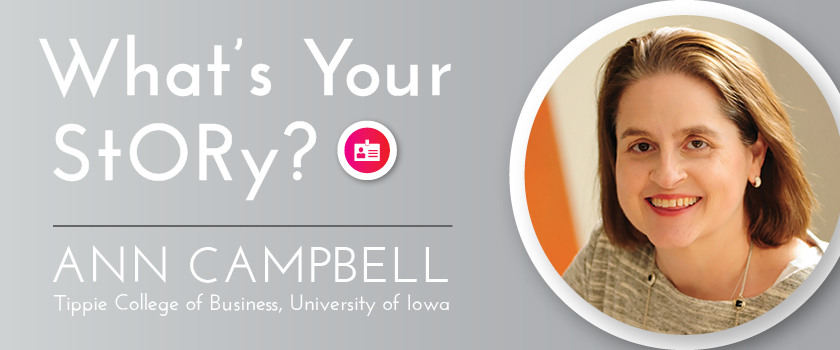

Name: Ann Campbell
Affiliation: Department of Business Analytics, University of Iowa
Title: Department Executive Officer and Clement T. and Sylvia H. Hanson Family Chair
INFORMS member for 25 years
 Tell us how you got started in your O.R. career.
I completed my mathematics and computational science undergraduate degree at Rice University. Like most people, I went to college with no idea what I was going to major in so I just tried a collection of different classes; I went from political science, thinking I was going to be an elected official, to science classes to a class on applied math that used algorithms to solve very hard problems.
Then a lightbulb turned on and it made me realize that solving problems using O.R. was kind of like solving a puzzle, so that became my undergraduate major. After that, I decided to work for a couple years and then go to grad school at Georgia Tech where I majored in industrial engineering, but with a specialization in optimization, and it sort of took off from there in terms of getting my Ph.D. and now my faculty career.
 What advice do you have for early career professionals?
I participate in a lot of different panels and such where I give advice to young assistant professors. One of the biggest pieces of advice I give is to really guard your time. I think a lot of people, particularly some of us women assistant professors, feel obligated to say yes to all kinds of things when really saying no is just fine.
But one thing that has been helpful for me, is that it's not a bad thing to go to your department head or other senior colleagues and get their advice on taking certain opportunities.
One thing I do recommend that a lot of junior faculty do that might sound a little different is to be on their department search committee because who they hire can have a very direct impact on who they have available to work with and share teaching materials with, and it can be such a big impact.
 Would you say the work you do saves lives, saves money, or solves problems? Which one(s) and how?
I would love to say save lives, but like most academics, I would have to say solves problems, because to be able to understand the core issue of a problem we have to pull off a few layers of the real world and the reality to really start understanding it. Even though I do a lot of work in disaster relief and last-mile delivery, I’m trying to build insight into what are the best solutions for those problems, such as how to be best prepared for a disaster in terms of what supplies to store and how much. I'm really turning these problems into math and trying to solve the math and then hoping the companies can apply the solution to do those things like save money and save lives.
 You are a member of several INFORMS societies and groups, including the Diversity Community, WORMS, Transportation Science & Logistics and INFORMS Speakers Program, to name a few. Why do you find this involvement so important?
My biggest involvement over my time at INFORMS has definitely been with Transportation Science & Logistics (TSL). I've been part of the TSL Society the entire time and I’ve been an officer within that group. I think it's so important – and this is another good piece of advice for people who are earlier in the career – is to find a community where you can have a smaller place within the bigness of INFORMS. For example, I think the INFORMS Annual Meeting can be intimidatingly large and I can see how someone can feel very lost, but when you go to the TSL meeting, or whatever your society is, you're guaranteed to go to a room with some familiar faces.
 Apart from the individual INFORMS groups and networking, what is your favorite member benefit?
That's kind of a tricky one, because obviously the networking is a huge piece. I would say the awards piece is a big part of what INFORMS does for a lot of members. For example, I remember an Annual Meeting a few years ago, where a colleague from my department won an award at the TSL meeting. My Ph.D. student won a travel award at the TSL meeting, which not only made me happy, but it made me feel like it really was putting the University of Iowa on the map as a group that's doing transportation science.
Speaking of awards, since I just became department head last year, one of my goals was to submit our department for the UPS George Smith Prize. I believe when INFORMS gives recognition to a department, that's better than any recognition I could create, so we submitted a packet and now we’ve been named the 2021 Smith Prize winner!
 You also volunteered as a FacilitatOR for the Virtual 2020 INFORMS Annual Meeting. Thank you! Can you talk about this experience?
I wanted to be very supportive of the virtual meeting because I know it was a challenge to put all that together, so that was one little thing I could do to help. I had two different times, where I went in the virtual meeting area within the conference and had different people meet with me – once on the topic of transportation and once on the topic of job hunting.
Since I’ve been on search committees many times, I thought I could give advice on either. I had about 5-7 people show up each time with questions.
For the transportation one, people came specifically to ask me questions and ended up sending their papers and looking for feedback, which was very rewarding. On the job search topic, it was more general job search questions.
 Give us some pros & cons to both virtual and in-person conferences.
I have to say I am looking forward to an in-person INFORMS meeting more than I ever have. Initially, the virtual meetings had their own novelty because you could go to conferences in your pajamas or whatever. But I think we're all ready to be back in person and see other people and network and have that more open dialogue.
The virtual piece has certainly been nice to be able to gather people from all different locations. For example, we had a seminar series in our department and we've been able to have people from China and Italy who wouldn't normally come over for a seminar, so that is a benefit.
But that dialogue and discussion, and that personal contact; I think we're all sort of craving that and are ready to move a little out of the virtual and into the in-person meeting again so I’m looking forward to good attendance in Anaheim.
 Can you talk a little bit about how the COVID-19 pandemic has affected your last year? Professionally or otherwise.
In terms of how it affected me professionally is – totally unrelated to COVID – I was scheduled to become the interim department head on March 1, 2020, and two weeks into my new job, the world changed, so it affected my perspective on this new position because I didn’t know what normally being department head was like. I'm looking forward to finding that out.
 What do you like to do on the weekend?
I live in Iowa, and I don't know if it's an Iowan thing, but I like to have a very big garden. I just had mine double so I’m excited to do double the gardening this year. I love to cook different dishes using things out of my garden. I love to walk my dogs in the neighborhood. My son convinced us we needed a new dog; we fell for the pandemic puppy. Just simple pleasures.
 If you could have dinner with one famous person from history, who would it be and why?
That's a really, really hard one because there are so many people that are interesting and I want to pick their brain. I've always been impressed by women who seem fearless and I always want to know, “Where do they pull that from?” and “How are they able to do it?” Because that's my goal. I always want to seem that way, so I want to ask women in history who had that trait.
An example I can think of is, growing up Houston in the 1990s, we had a governor named Ann Richards – she had the big white bouffant hair and was the first woman governor in the State of Texas. She always came off as fearless, funny and smart. She’s one I'd like to talk to about how she crossed through that glass ceiling and always come off so strong and fearless. A current example is Kamala Harris. It's not even a political thing – she’s the first woman vice president! I'm always looking for role models on how to do things better.
SHARE: