
July 23, 2021 in Member Insights
Choosing between Academia and Industry after Finishing Your Ph.D.
SHARE: PRINT ARTICLE: https://doi.org/10.1287/orms.2021.04.28n
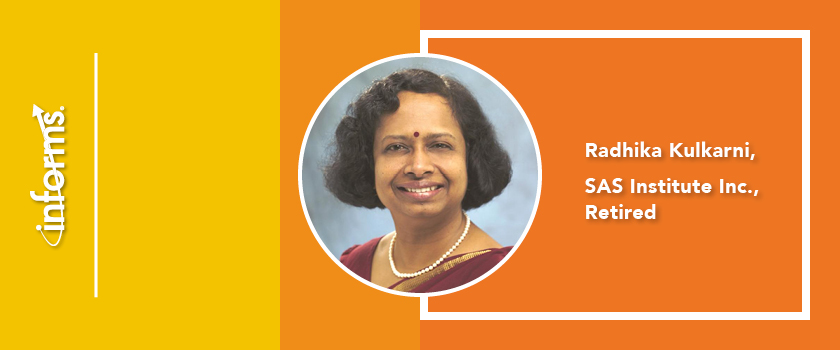
Academia? Industry? Which career path should I take? How can I succeed? What are the pros and cons of each?
These are questions at the top of every Ph.D. student’s mind as they near the final year of their program. Years ago, I had all these questions plaguing me along with many constraints restricting my choices. Even today, 40 years later, many students have the same questions and constraints varying from geographical restrictions, work permit limits, dual-career couples, unavailability of positions in one’s area of research, etc. Navigating the available options is as challenging now as it was then for me. How did I choose my path? What helped me successfully reach my career goals? Does the choice of academia or industry limit your ability to grow in your field? What are the opportunities for valuable interaction between the two communities? I would like to share my experiences and hopefully provide some insight that would benefit graduates as they face the future.
When I finished my Ph.D. in operations research from Cornell University, I was keen to join academia – I enjoyed research and loved to teach. Unfortunately, my husband, who had graduated from the same department a year earlier secured a tenure-track position at UNC-Chapel Hill– which placed the first two constraints on my feasible space: geography and availability of tenure-track positions in the same discipline! The department at UNC offered me a visiting position for two years, allowing time for me to look at alternate positions. At the end of one year, it seemed unlikely that I would be able to stay in academia and I started an active job search in the Research Triangle area of North Carolina. This led to an operations research analyst position at SAS Institute in the nascent O.R. department within the Research and Development Division – an optimal position in my constrained feasible space! At least that was my perspective as I started this job.
Fast forward to my retirement from SAS Institute from my role as VP of Advanced Analytics R&D at the end of 2018… I can say that it turned out to be an optimal decision for me, regardless of the initial constraints. Reflecting on my 35-year career at SAS Institute, I can attest that it was a wonderful ride where I was able to experience the best of both worlds: research and practice.
Here are a few activities that illustrate the many interactions between my R&D team and multiple universities:
- Building an optimization software suite from scratch was a tough challenge that I undertook early in my career, requiring me and my team to reach out to various universities to find the best talent.
- Engaging with many leading researchers in academia to explore the R&D direction for the core O.R. toolset as well as some complex optimization-based solutions for several domains such as retail, hospitality, finance, healthcare, etc.
- Close collaboration between SAS and many universities seeking to teach analytics software skills to students, which provided another avenue for me to engage with multiple universities, whether it be for giving presentations, participating on advisory boards or collaborating on joint initiatives in analytics and data science.
- In some cases, working closely with specific faculty members on their grant proposals related to areas of mutual interest.
As an R&D executive at a software company I recognized the value of fostering close collaborations with universities and supporting the partnership, which is crucial for many reasons:
- The practice community has a wealth of unsolved problems to inspire innovative theoretical as well as applied research for academia.
- The academic community’s cutting-edge research yields practical applications that are very valuable for the development of innovative new products in industry.
- Universities train the future labor force for both communities. A partnership can strengthen the curriculum and training to serve both the producers and consumers of analytics including:
- researchers in core algorithms that are critical both for university faculty and R&D groups in industry;
- consumers of operations research and analytics tools who may need a broad range of analytics skills in multiple areas; and
- senior managers and users of advanced tools and models requiring basic analytics literacy.
Coming back to the original dilemma of selecting a career plan, I would say the following: If you have an unconstrained problem, you may be fortunate to land a job in a university or industry as per your heart’s desire. Sometimes you may not have that luxury. However, regardless of where you land, you can certainly find opportunities for rich collaboration with researchers and practitioners from both worlds. The field of operations research and analytics will continue to grow as a result of these valuable collaborations. To the young graduates today, I say, “You have a wonderful future in front of you with many options to succeed in whichever field you choose!”

Radhika Kulkarni, Ph.D., is an advanced analytics professional, active in the areas of operations research, artificial intelligence and machine learning. She retired as Vice President of Advanced Analytics R&D at SAS Institute Inc., overseeing software development in many analytical areas including statistics, operations research, econometrics, forecasting and data mining. Kulkarni served as the 2022 president of INFORMS.