
October 12, 2021 in Modeling DEI Progress
An Analytics Approach to Diversity, Equity and Inclusion
SHARE: PRINT ARTICLE: https://doi.org/10.1287/orms.2021.05.25

Authors’ note. Examples and associated figures in this article are fictitious and for illustrative purposes only.
Diversity, equity and inclusion (DEI) efforts rank among the top priorities for organizations, both academic and industrial. Not only is it the right thing to do, but it also drives increased performance. According to a recent McKinsey study, companies in the first quartile of gender and ethnic diversity on executive teams were respectively 25% and 36% more likely to enjoy above-average profitability [1]. Yet many organizations, particularly in the technology fields, struggle to make progress in the DEI arena. One reason may be that measuring progress, much less driving it, is often ambiguous and subjective. By offering data-driven and objective tools, analytics may help surmount these obstacles to DEI.
This article reviews some DEI statistics to underscore the severity of the issue and define basic concepts. It also outlines a systems-dynamics approach for modeling DEI progress in an organization and showcases the application of the theory of constraints to illustrate how to rigorously prioritize DEI efforts to maximize impact. Finally, it concludes with a discussion of alternative DEI metrics to more holistically drive inclusion.
DEI: Magnitude of the Challenge and Basic Definitions
Tech companies perform poorly in terms of diversity. For example, in terms of gender diversity, only 39% of physical scientists in the United States in 2021 are female [2], dropping to 25% among computer scientists, and only 17% among data scientists [3]. According to a 2018 study, where numbers were cited by job level, this percentage drops to 10% among executives and 6% among senior individual contributors [4]. Even worse, in Silicon Valley only 2.2% and 4.7% of technical professionals in 2017 were African American or Hispanic, respectively [5].
Inclusion appears to be a key root cause of the diversity problem. Not feeling welcome, women and minorities are leaving the tech industry by the hundreds of thousands. For example, a U.S. Equal Employment Opportunity Commission study highlights that, of women in STEM fields, 32% feel “stalled” and are likely to quit within a year; indeed, half of the women entering tech fields quit their jobs [6]. The situation is no better for ethnic minorities. Moreover, 15.5% of women of color and 13.1% of men of color are working in fields unrelated to their STEM degrees – about twice the 7.4% rate for white males [6].
Although progress must be made, measuring progress to enable actionable insights remains challenging and subjective. Analytics techniques provide an objective and data-driven avenue to tackle these challenges. In particular, they support structural innovations by enabling diversity, inclusion and equity to be defined, modeled, understood and addressed as part of an integrated system.
Before we consider analytic definitions, first let’s gain some basic understanding via qualitative definitions of diversity, equity and inclusion.
- Diversity is a static measure. It captures how well an organization has succeeded in achieving representative staff variability in terms of gender, ethnicity, religion or other metrics.
- Inclusion is more of a dynamic measure. It represents the degree to which an organization enables all its diverse members to contribute, succeed and progress.
- Equity reflects how well an organization provides appropriate opportunities to achieve inclusion. We can define these terms mathematically in a variety of ways.
First, consider diversity – a measure of similarity between population distributions. It measures how much the relative size of groups within an organization resembles a representative baseline. For example, according to the U.S. Census Bureau, in 2019 women represented 27% of the STEM workforce [7]. A technical organization might measure (short-term) diversity in terms of their percentage of female employees at a given job level relative to this 27%. If 24% of the organization’s staff are female, the organization might express its gender diversity as 100% - (27%-24%)/27% = 89%.
Next, consider inclusion – a measure of similarity between rates of success. The more people from different groups are fully enabled to succeed, the less their average success rates will vary. Success might be measured in terms of promotions, engagement survey scores or other metrics. For example, if 25% of an organization’s male employees advanced from Level 1 to Level 2 in a given year versus only 20% of its female employees, the organization might measure its gender inclusion at Level 1 as the following: 100% - (25%-20%)/25% = 80%.
Finally, consider equity – a measure of how inclusion is improving over time. As a key enabler of inclusion, one might measure equity in terms of how quickly inclusion is approaching 100%. Continuing the earlier example, if gender inclusion was 80% this year versus 60% last year, an organization might measure equity as (100% - 80%) / (100% - 60%) = 50% per year. In other words, the gap was cut in half.
A System Dynamics Model of Diversity and Inclusion
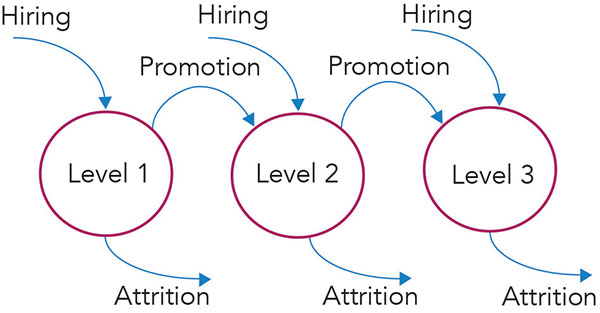
Using the definitions from above, we can design a system dynamics simulation allowing an organization to simulate and forecast its progress and perform “what-if” analyses on key levers. For example, in the hypothetical schematic in Figure 1, an organization has three levels that employees move in, through and out of based on hiring, promotion and attrition rates. The specific values of these rates might be based on historical trends and/or expected results from initiatives, set via goal-seeking to understand what would be required to achieve future diversity targets, or generated from probability distributions in a Monte Carlo analysis.
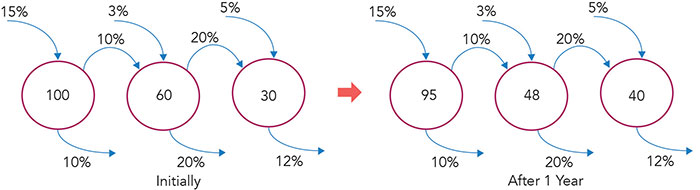
Figure 2 continues the example via one step in a system dynamics simulation through the organization from Figure 1 for one group of employees. Here, the numbers on the arcs represent rates of flow and the numbers in the circles representing the “stocks,” in this case the number of employees of the group at the given level. The 40 employees at Level 3 after one year consist of the original 30, plus 5% x 30 new hires plus 20% x 60 employees promoted from Level 2, less 12% x 30 employees lost to attrition. We could similarly simulate multiple groups over multiple years. Inclusion and diversity initiatives may be reflected via changing rates over time. Based on the results, we can calculate how diversity, equity and inclusion evolve over time.
The Theory of Constraints: Focusing and Maximizing the Impact of Improvement Efforts
While informative, system dynamics simulations by themselves don’t provide guidance on what to do; we need a framework to leverage it to efficiently guide improvement efforts. The theory of constraints, popularized by Eli Goldratt [8], provides one such framework. At its simplest, this framework first identifies the goal to maximize and the constraint that most limits that goal. It then focuses efforts to remove that constraint as the limiting factor.
First, let’s examine how we might identify the constraint. Suppose our target goal is to improve diversity by maximizing the number of employees of our target group at Level 3 after two years – two simulation steps – by modifying the rates of hiring, promotion and attrition from Figure 2. For purposes of this example, suppose that: 1) we can’t change attrition or hiring rates by more than 10% of their current values; 2) we can only promote an additional 10% of employees from one level to another in any year; and 3) we make the same change in both years. Applying these rules and repeatedly running our system dynamic simulation, we generate the results summarized in Table 1 and conclude that the promotion rate from Level 2 to Level 3 is the limiting constraint.
|
Changed Rate |
Level 3 Population |
|
Baseline |
47 |
|
Promotion Level 1 to Level 2 |
49 |
|
Promotion Level 2 to Level 3 |
51 |
|
Hiring and attrition rates |
<48 |
Table 1: Impacts of improving various rates to identify the limiting constraint.
But is this really the constraint, or is it merely a symptom of a more fundamental constraint? One possibility is overt discrimination in selecting who gets promoted. But suppose investigation reveals that the size of the pool of promotable candidates is limiting the number of promotions. If multiple criteria differentiate between Levels 2 and 3, we can perform another constraint-finding exercise to identify which of these is the fundamental constraint. For example, suppose four criteria must be met to be promotion-eligible and the percentage of Level 2 employees satisfying each criterion is as presented in Table 2. In this example, project leadership experience stands out as the fundamental constraint.
|
Criterion |
% Satisfying |
|
Project leadership experience |
25% |
|
Advanced degree |
90% |
|
>5 years of experience |
95% |
|
At least one performance award |
75% |
Table 2: Degrees to which members of the target group satisfy promotion requirements.
Now we can move on to removing the constraint on project leadership experience. In this phase, techniques such as design thinking to generate and iteratively prototype and test ideas are invaluable. First, we consider how to exploit the constraint and use it to its fullest capacity. For example, if some projects are operating without formal leaders, these offer the potential to generate more leadership opportunities.
If exploiting the constraint doesn’t remove it as the main limiting factor, we need to examine how to adjust the overall process to focus on alleviating the constraint. Let’s consider an approach with an analytic interpretation. One possible reason a disadvantaged group doesn’t receive enough project leadership opportunities may be that they start out with a slight disadvantage and so lose out initially to others. Those others, by winning the first opportunity and having proven themselves, are even more likely to win subsequent opportunities. Over time, the slight initial advantage grows exponentially – a power law or “rich get richer” relationship.
To avoid this power law phenomenon, one may apply the concept of equity. Recall that equity is about offering appropriate opportunities to achieve inclusion. Instead of always assigning opportunities only to the most qualified person, one might also factor in who might benefit the most from an opportunity. For example, a person who successfully led two projects might be most likely to successfully lead a third project. But they would likely experience little career growth and might benefit more from a different type of opportunity. Meanwhile, another slightly less qualified person with no prior project leadership experience would likely experience significantly more career growth from leading a project.
One beneficial side effect of such an approach is to develop the organization as an integrated portfolio of skills. Rather than minimize short-term risk by always offering opportunities to a “safe” go-to person, the equitable approach spreads the opportunities, developing a cohort of experienced and balanced employees. This minimizes long-term risk by mitigating the impacts of attrition and providing a broader pool of candidates to take on more senior positions.
The final, and usually most expensive, approach to removing a constraint is to invest in increasing its capacity. In our example, this might take the form of providing education and training equivalent to a project leadership experience.
Once a constraint is eliminated, if inclusion hasn’t yet been achieved, this process may be iteratively repeated. Each time through, a constraint is addressed to remove it as the factor most limiting the goal. In our case, the goal was to increase the promotion rate from Level 2 to Level 3. Of course, this wasn’t the end goal of improving diversity by increasing the number of employees of the target group at Level 3, so we might have to repeat the process to address the other higher-level constraints in turn.
Analytics and DEI
Inclusion is a complicated multidimensional concept involving a sense of belonging and fairness, as well as progress. By addressing the promotion rate from Level 2 to 3 in our example to improve diversity at Level 3, we also addressed an inclusion metric – a rate of progress. But inclusion goes beyond promotion rates. In an academic context, other aspects of success might include first-author publications, committee memberships and grant funding. These metrics would have to be converted into rates to allow comparison between groups (e.g., number of first-author publications per person per year. Other inclusion metrics reflecting personal satisfaction, such as employee engagement percentages, may be naturally expressed as rates.
To each individual, different metrics will matter – another critical form of diversity. The rich variety of ideas offered by a diverse collection of individuals confers value upon an organization. Similarly, successfully applying analytics to DEI requires a diversity of approaches. We only present one possible set of analytic metrics for DEI and applied the theory of constraints to one example diversity goal. But a truly robust DEI analysis would also consider several different inclusion metrics to provide every employee with a sense of belonging and accomplishment. This, we believe, is critical to engaging employees and inspiring progress on this important challenge.
References
- Sundiatu Dixon-Fyle, Kevin Dolan, Vivian Hunt and Sara Prince, 2020, “Diversity Wins: How Inclusion Matters,” McKinsey & Company.
- Cary Funk and Kim Parker, 2019, “Women and Men in STEM Often at Odds Over Workplace Equity,” Pew Research Center.
- “2021 Data Science & Analytics Salaries: Hiring Research, Developing Trends, Market Insights,” 2021, Burtch Works.
- “The Burtch Works Study: Salaries of Data Scientists,” 2018, Burtch Works.
- Maya Beasley, 2017, “There is a Supply of Diverse Workers in Tech, So Why is Silicon Valley So Lacking in Diversity?,” Center for American Progress.
- “Diversity in High Tech,” 2016, U.S. Equal Employment Opportunity Commission.
- Anthony Martinez and Cheridan Chrisnacht, 2021, “Women are Nearly Half of U.S. Workforce but Only 27% of STEM Workers,” U.S. Census Bureau.
- Eliyahu Goldratt and Jeff Cox, 2004, “The Goal,” Great Barrington, M.A.: North River Press.
Daniel Reaume has been leading analytics efforts for 27 years as a technical fellow, adjunct professor, consultant and a senior executive for Fortune 100 companies. Dan obtained his Ph.D. in industrial and operations engineering from the University of Michigan and has subsequently obtained several additional degrees in technology management and law, reflecting his interests in applying analytics to critical societal issues. Dan is an active member of the INFORMS Roundtable and is a licensed attorney and professional engineer. Beata Kilos, Ph.D., is a research scientist in the Chemical Science group of the Dow Company’s Core Research & Development organization. She is the author of over 30 scientific publications and 16 patents/patent applications; treasurer of the North American Catalysis Society; and serves on several editorial advisory boards. Beata is active in diversity and inclusion efforts, serving as founding chair of the Dow Growing R&D Opportunities for Women (GROW) group (2015-2017) and leading the development of Dow Core R&D’s mentoring initiatives.