October 15, 2021 in Roundtable Profile
Operations Research at UPS
SHARE: PRINT ARTICLE: https://doi.org/10.1287/orms.2021.05.26
“UPS has a rich history of innovation and is a pioneer in the use of many technologies to improve logistics operations and serve customers. Operations research (O.R.) has been a key component of our innovation strategy. Through O.R. UPS has driven operational, cost and service improvements for many years as demonstrated by the ORION and Network Planning Tools programs. We plan on continuing to take advantage of O.R. practices and advances for many years to come.” – Juan Perez, UPS Chief Information and Engineering Officer
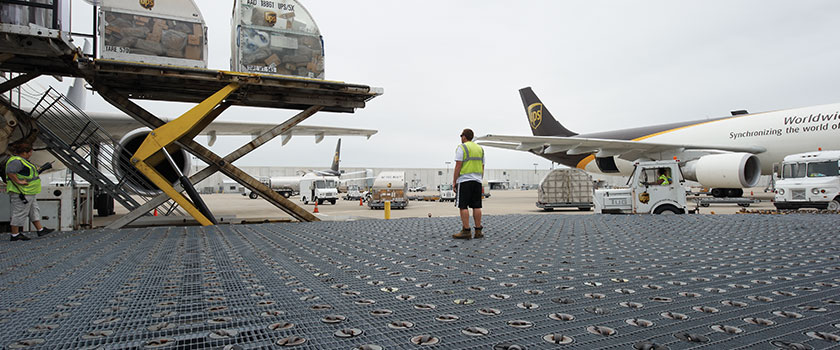
 Founded by Jim Casey in 1907 with a borrowed $100 as a messenger service company in Seattle, Wash., today UPS is a global leader in logistics. It offers a broad portfolio of services that are far different from its messenger service days, with a service portfolio that ranges from logistics consulting to warehousing and distribution to customs brokerage and shipping insurance. Employing 543,000 people globally, UPS currently operates in more than 220 countries and territories. Boasting an annual revenue of $84.6 billion in 2020, UPS delivered about 6.3 billion packages and documents. Its global network operates more than 127,000 vehicles serving some 1,800 operations facilities and 576 aircraft that cover 1,944 flight segments operating out of 795 airports.
Because of its position in the world of logistics, UPS has contributed to the growth of e-commerce while at the same time growing because of it. Today, its activities are much wider ranging than its humble beginnings. Individuals may never know that UPS helped facilitate their e-commerce orders, transported their fresh-cut Valentine’s Day roses, or contributed to the development of environmentally sustainable vehicles. It is a full-service logistics provider that is enabling global commerce. Two percent of global GDP and 6% of U.S. GDP flows through the UPS network.
During the COVID-19 pandemic, UPS has been supporting the global economy by helping keep supply chains moving. Equally noteworthy is that UPS was one of the companies chosen to distribute the COVID-19 vaccine in the U.S. and abroad. To date, UPS has delivered more than 600 million vaccines with an on-time performance rate of 99.9%.
After 114 years of growth, Jim Casey may not recognize UPS today.
Legacy of George Smith: Operational Improvement
George Smith, the company’s second CEO, made extensive use of industrial engineering and operations research (O.R.) to set UPS on its course to grow.
Smith joined UPS in 1925 at the behest of Jim Casey to manage the company’s bookkeeping. An accountant by training, Smith was an engineer in heart and mind. He used his position as office manager to learn about all aspects of the business. At some point during his long and illustrious career at UPS, prior to becoming its CEO in 1962, he had managed every aspect of the company.
Improving efficiency and effectiveness was an obsession for Smith. He foresaw the need for a methodical approach to make UPS nimble and efficient, and concluded that industrial engineering (IE) was the means for achieving greater efficiency. For about 10 years, Smith taught UPS’ employees about industrial engineering. When the line managers were reluctant to use measurement and analysis, they were trained so that they could better understand the principles and make use of IE when they went back to their operations. Due to Smith’s efforts, UPS became the first transportation company to make extensive use of work measurement and process analysis.
After World War II, Smith learned about O.R. and formed a research and development (R&D) group with employees who had a good educational background, had been with the company for a long time, knew its operations well, and were imaginative.
Every task was measured and analyzed, and a method was prescribed for performing it. Because of his efforts, process improvement through analysis and work measurement became a staple at UPS. By the time Smith retired in 1972, UPS had come to be regarded as a company of methods and measurements. It earned the nickname “Tightest Ship in the Shipping Business.”
The culture of analytics and innovation still permeates all levels of UPS today.
UPS’ ORION Project
No discussion of operations research at UPS would be complete without mentioning the On-Road Integrated Optimization and Navigation (ORION) project.
In early 2000, UPS realized that investing in cutting-edge technologies was vital to gaining and maintaining a competitive edge. Using operations research to improve efficiency was selected as one of the cornerstones of its technology strategy. ORION was the first project with this new focus.
ORION was conceived to help UPS manage its growing pickup and delivery (P&D) operations. P&D accounts for a major part of UPS revenue, costs and profit. Though the project had substantial challenges, and came close to being shut down, it ultimately proved to be one of the most successful O.R. projects. Nearly 10 years in the making and employing more than 800 employees at the peak of its three-year deployment period, analytics and process innovation academic and author Tom Davenport described ORION as “arguably one of the largest O.R. projects in the world.”
Current State of O.R. and Analytics at UPS
Operations research and analytics are viewed as core components of UPS’ competitive strategy – the number of groups and projects related to O.R. and analytics continues to increase.
The hallmark of UPS package operations is its ability to adopt to customers’ changing needs. Package volume can significantly change depending on the day of the week, week of the month, month of the year, or the season. During the period between Thanksgiving and Christmas, package volume increases to twice the normal volume. In 2018, UPS delivered 32 million packages on the peak day. It is a significant challenge to build and maintain a physical network that can efficiently and profitably operate at both ends of the capacity spectrum.
The O.R. groups at UPS are organized along functional lines, including:
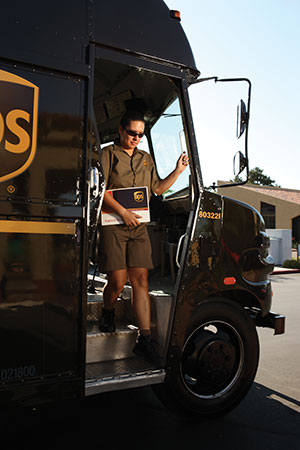
- Pickup and Delivery (P&D) Operations: P&D operations is the largest of all operations within UPS. P&D is responsible for delivering packages to customers, as well as picking up packages from UPS distribution centers. The O.R. group supporting P&D operations is located in Timonium, Md.
- Transportation Operations: Transportation operations deals with moving packages from origin cities to destination cities. This group is comprised of UPS Airlines and UPS Ground Transportation. UPS Airlines is responsible for moving premium service and international packages that have to be delivered in a short period. The main hub is in Louisville, Ky. Ground Transportation is responsible for moving packages between cities either by trucks or trains. UPS has also built an extensive ground network consisting of many consolidation hubs, and is a large customer for many railroads. The principal hub in Chicago can simultaneously load and unload more than 1,000 trucks. The transportation O.R. group has locations in Louisville, Ky., and Atlanta.
- Advanced Technology Group (ATG): ATG is responsible for creating and evaluating the feasibility of futuristic models for transporting and delivering goods. It evaluates everything from drones, robotics and autonomous vehicles to alternate delivery methods. ATG is located in Atlanta and extensively collaborates with universities.
- Advanced Analytics Group (AAG): AAG is a rapidly growing group that is tasked with promoting and supporting analytics throughout the company, and is responsible for setting UPS’ strategic roadmap and governance policies. One of its goals is to promote best practices and facilitate the use of data and analytics for making better decisions at all levels of the company. Its activities span data science and machine learning, enterprise BI, analytics reporting, data modeling, executive dashboards and applied analytics.
- In addition to these four groups, there are also smaller groups involved with analytics that are spread throughout a multitude of functions and geographical regions.
Most of the groups – with the exception of AAG – report to the global engineering president. AAG reports to a senior vice president in the UPS Information Services. Ultimately, all groups report to the UPS Chief Information and Engineering Officer, who is responsible for information services and engineering.
From Concept to Computerization
The sheer size of UPS provides opportunities as well as challenges. Small improvements in efficiency can result in big savings. In the same way, a small loss in efficiency can have big costs. For example, one mile saved per driver every day in the U.S. delivery operations (covering 70,000 package cars or delivery vehicles) can result in $60 million in annual savings. Hence, every change in any process, no matter how small, goes through exhaustive testing and evaluation.
Just as in George Smith’s days, operations research is truly a team effort at UPS. Teams are formed by joining people from various departments with diverse skills. Team members consist of O.R. specialists, software engineers and operational experts. These teams are responsible for developing fully-functional algorithms, prototyping the optimization systems and field testing them. Groups work in conjunction with the operations and engineering teams to field test and deploy. If the applications are not mission critical, hardened prototypes are deployed. If the applications are mission critical, as in the case of ORION, the process improvement group works with the IT systems group to develop and incorporate algorithms in the respective systems. The O.R. group provides the optimization algorithms to IT as black boxes.
Public Recognition and Contribution to the Profession
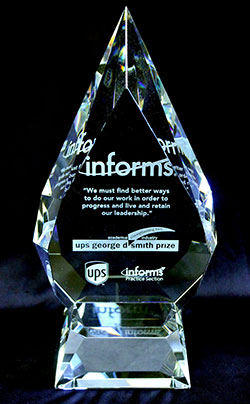 UPS has won numerous awards for its sustained integration of operations research and analytics in its operations. Most notably, UPS is the first company (and only, thus far) to win the INFORMS Prize twice – first in 2003 and again in 2020. This achievement is a testament to the genius of George Smith.
The Volume, Location, and Aircraft Network Optimization (VOLCANO) project, developed by the transportation group in collaboration with MIT, was the co-winner of the 2003 Edelman Award, and the only time in the history of the prize that it was awarded to two projects.
The UPS ORION project was the winner of the 2016 Edelman Award. In addition to numerous other awards, ORION was also the winner of the 2012 Gartner Business Analytics Prize and has been the subject of many case studies and textbooks.
In 2015, Jack Levis, a longtime INFORMS member who managed UPS’ development of ORION, was honored by INFORMS when the organization recognized him as an INFORMS Fellow. He was also awarded the INFORMS President’s Award and George E. Kimball Medal for his contributions to advancing the O.R. practice.
In addition to bringing recognition to UPS, ORION also increased the public awareness of the operations research and analytics discipline.
UPS operations research projects have been extensively featured by news media including The Wall Street Journal, PBS’ NOVA series and Tom Friedman’s book “The World is Flat.” UPS has hosted and participated in many defense, government and private panels that explored the benefits of O.R. and analytics.
The success and importance of ORION inspired UPS’ management to sponsor the UPS George D. Smith Prize in collaboration with INFORMS, under the stewardship of the INFORMS Practice Section, to promote the effectiveness and innovation in preparing students for the practice of operations research and analytics. The prize was established in 2011 with a generous underwriting by UPS.
Ranganath Nuggehalli is the principal scientist at UPS. He has been with the company for nearly 30 years. He is a longtime member of INFORMS and was part of the UPS team that won the 2016 Franz Edelman Award for UPS’ On-Road Integrated Optimization and Navigation (ORION) Project.