


October 15, 2021 in Sports Analytics: NHL
Optimizer for the 2021 NHL Expansion Draft
Details and results from the member-built analytics tool
SHARE: PRINT ARTICLE: https://doi.org/10.1287/orms.2021.05.29

The National Hockey League (NHL) is a professional ice hockey league in North America, and widely considered the top professional league in the world. This year, the NHL expanded and added a 32nd team, the Seattle Kraken. As part of the expansion process, the league held an “expansion draft” on July 21, 2021, where Seattle built its inaugural roster of players by drafting from all of the other teams, except the Vegas Golden Knights (themselves an expansion team from 2017 and exempt from this draft).
Expansion drafts operate with a specific set of rules [1]. Teams are allowed to protect a certain number of players in each position, which would prevent Seattle from selecting them. Teams must also expose a certain number of players for selection. Seattle, on the other hand, is allowed to select one player from each team, and the total annual contract value of those players must satisfy salary cap constraints. Making good protection and selection decisions is extremely important. In the last expansion draft in 2017, Vegas constructed a strong roster through good selections and ended up going all the way to the Stanley Cup Finals in their inaugural season, a feat that had never been previously accomplished by an expansion team.
The rules that govern the expansion draft can naturally be formulated in an integer programming model [2]. In particular, the rules form hard constraints, but each team’s objective function is up to them to decide. One can think of the objective function for Seattle as maximizing the “value” associated with the roster that they build and for the other teams as maximizing the value that they keep. This value can be measured with several different metrics. For example, each player can be assigned a score based on their “point shares” (how much they contributed to their team’s wins over the last season) or their “cap hit” (their future salary). The first metric measures the on-ice performance of the player, and the second impacts the team’s future financial flexibility if they keep or draft that player. The integer programming model for the existing teams minimizes the value of their exposed players, while Seattle’s model maximizes the value of their assembled team.
Analytics Tool for Hockey Enthusiasts
Our team of engineers and graduate students from the University of Toronto have built the NHL Expansion Draft Optimizer (www.nhlexpansiondraft.com), a website that that lets hockey enthusiasts play “armchair general manager” for Seattle or for any of the current teams. Users start by selecting a team to manage. They then construct a custom scoring function by first choosing a player performance metric and a team financial flexibility metric from a pool of three different options for each (making a total of nine combinations), and then choosing how much weight to put on the performance versus the flexibility metric (on a 100-point scale). The website runs an integer programming model with this objective function, showing the optimal protections that the user-selected team should make and optimal selections that Seattle should make. Users can modify this objective function or even set different custom objectives for every team at once to see how the results change. They can also investigate the impact of manually selecting certain players to be protected or exposed.
To build an engaging website for sports analytics fans, our team needed to ensure that we could parse user instructions, build and solve an optimization model, and return the results within seconds. We first collected data on player performance metrics and salaries from several online resources and stored this information in a MemDB database. The optimization model was built using Python PuLP configured with the CBC Solver. The backend of the site was implemented in FastAPI, and the frontend used Vue.js and Bootstrap. In total, it takes less than three seconds from the time that users press the optimize button to display the results.
The Kraken Rises
In the days leading up to July 21, after the current teams had released their protection lists, our optimizer showed that Seattle had tremendous drafting opportunities (see Figures 1 and 2). If Seattle wanted to maximize the team’s on-ice performance, then under the draft rules, they could theoretically build a roster with the highest total point shares (103 points) in the NHL on a middle-of-the-league cost. Alternatively, if Seattle wanted an inexpensive roster, they could achieve the lowest aggregate cap hit ($48.9 million) in the league while still having the third-highest point shares (78.8 points).
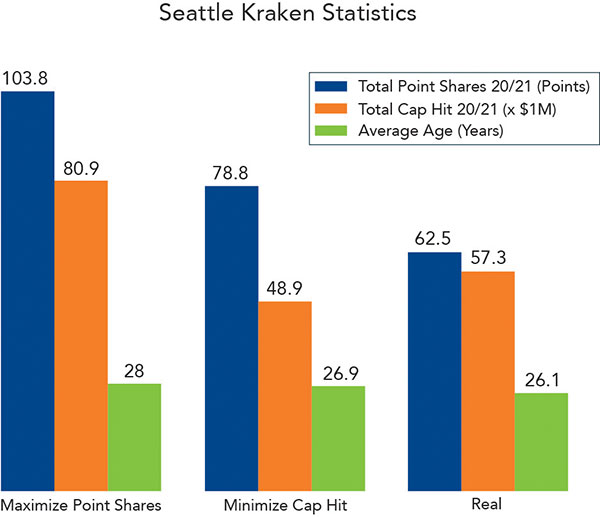
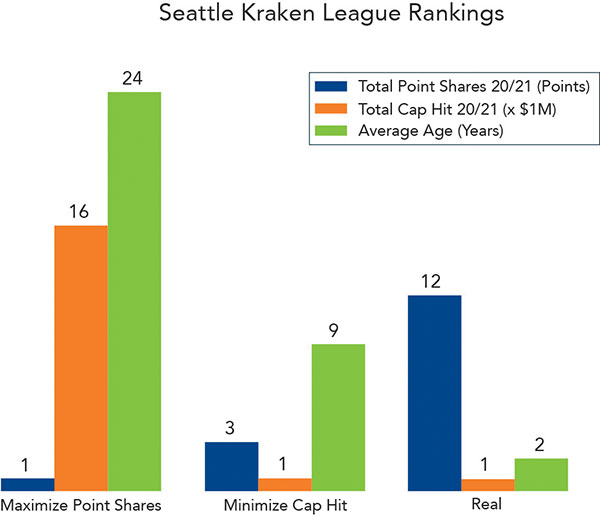
On draft day, Seattle went for financial flexibility. They obtained a total cap hit of $57.3 million, which is still the lowest in the league. However, the aggregate point shares of their roster is only 62.5, suggesting that even at this cost, they could have drafted better players. But did Seattle really miss an opportunity to draft an elite roster? One counter-argument is that point shares do not perfectly measure team performance and perhaps Seattle optimized different metrics to evaluate players. For instance, they drafted the youngest roster in the league with an average age of 26.1 years. Commentators also observed that Seattle drafted larger players, particularly for defense. This implies they wanted a more physical team, which was not a metric in our optimizer.
To further understand Seattle’s position, it is also worth revisiting the 2017 Expansion Draft for the Vegas Golden Knights. Analyzing Vegas’ selections shows that they also drafted a “suboptimal” combination of point shares and financial flexibility. However, Vegas famously made 10 “side deal trades” with other teams, where they would agree not to draft certain players in exchange for receiving tradable assets (such as options to draft rookie players in the future). Throughout the season, Vegas then traded these assets to improve their roster to a Stanley Cup contending level.
Stories in the NHL media suggest that Seattle tried to replicate Vegas’ strategy, but they did not complete any side deals. Perhaps this time around, other teams were more wary of giving too many tradable assets to the new team. Nonetheless, Seattle still has a lot of salary cap space and there is plenty of time for them to acquire better players, suggesting that the Kraken are still in position to be highly competitive in the coming years.
Optimizing Future Drafts
Draft rules can be easily modeled but it is impossible to know beforehand the exact metrics that a new expansion team will optimize. Instead, we can implement a broad set of metrics to simulate potential outcomes. The second source of uncertainty in draft models are side deals, which cannot be easily optimized because they require human negotiation. Here, we can use sports knowledge to manually calibrate models by fixing specific protections and selections.
Having formed two new teams in the last four years, the NHL is likely finished with expansion for the near future. However, we can look forward to basketball where the NBA is rumored to be exploring expansion opportunities. Another potential avenue of interest is to evaluate current draft rules. By analyzing optimal outcomes if, for example, existing teams were allowed to protect one additional player, we can quantify the impact of the current settings and suggest better mechanisms in future drafts.
Our team believes the Expansion Draft Optimizer is an opportunity to showcase the power of O.R. in a fun and accessible setting that would appeal to both sports fans and O.R. enthusiasts. In the interest of promoting optimization in draft analytics, we have released our code for the optimization model and the analytics website at: https://github.com/potterben/expansion-draft/. To use our model, visit https://www.nhlexpansiondraft.com. If you have any questions or comments, email our team at [email protected] or find us on Twitter @NHLExpansionOpt.
References
- NHL.com, 2021, “Kraken 2021 NHL Expansion Draft rules same as Golden Knights followed,” July 20, https://www.nhl.com/news/seattle-kraken-2021-nhl-expansion-draft-rules-same-as-vegas-golden-knights-followed/c-302586918.
- Booth, Kyle E. C., Chan, Timothy C. Y. and Shalaby, Yusuf, 2019, “A mathematical optimization framework for expansion draft decision making and analysis,” Journal of Quantitative Analysis in Sports, Vol. 15, No. 1, pp. 27-40.
Michael Shin is a software engineer at Intel. He studied at the University of Toronto and wrote his undergraduate thesis under the supervision of Prof. Timothy Chan. Yusuf Shalaby is a technology specialist at BAI Communications, leveraging cloud technologies to deliver data solutions to transit agencies. In 2020, he completed his MASc in operations research at the University of Toronto. Albert Loa is a senior O.R. product developer for the AD OPT team at IBS Software Canada, building products for airline crew planning optimization. In 2022, he completed his Master of Applied Science in operations research at the University of Toronto. Ben Potter is an applied research scientist in the Advance Technology Group at ServiceNow. In 2018, he completed a master’s in operations research at the University of Toronto. Timothy C. Y. Chan is the associate vice president and vice provost, strategic initiatives; Canada Research Chair in novel optimization and analytics in health; and professor in the Department of Mechanical & Industrial Engineering at the University of Toronto. His primary research interests are in operations research, optimization and applied machine learning, with applications in healthcare, medicine, sustainability and sports. He is a member of INFORMS. Rafid Mahmood is an AI resident in the NVIDIA Toronto Artificial Intelligence Lab. In 2020, he completed his Ph.D. in operations research at the University of Toronto. He is a member of INFORMS.
