
December 3, 2021 in Member Initiatives
A Community Approach to Strengthening Diversity in Analytics, Data Science and AI (ADA): Introducing Ada’s Tribe
SHARE: PRINT ARTICLE: https://doi.org/10.1287/orms.2021.06.07
Data science has rapidly developed from analytics to artificial intelligence (AI), intertwining with the engine of operations research (O.R.) to empower the creation of algorithms, models and data insights. Leveraging technologies, the combination of data science and O.R. has delivered powerful impact from optimized logistics to improved medical therapies.
New solutions can, however, unintentionally create new problems and cause social harm if developed without sufficient care, skill and consideration. Inequality and discrimination are exacerbated by algorithmic and data biases. Well-known cases include automated job applicant screening that reject female candidates, differing credit card approval limits according to gender and race, and facial recognition used by law enforcement that incorrectly recognizes people of color as criminals.
The Need for Diversity
Anticipating potential implications and unintended impacts of optimization and algorithms requires diverse perspectives at all development stages. Despite organizational efforts to increase diversity, equity and inclusion (DEI), gender diversity remains severely underrepresented in data science fields, with women comprising only 17% of data scientists [1].
As the use of data and AI increasingly impacts people’s lives, it is crucial to increase multidimensional diversity in these fields, to enable better represented shaping of technology and solutions. Without diversity, most of our society risks a form of invisibility, having their futures shaped by technology and systems created without representation of their thoughts, voices and needs. These concepts are explored by Caroline Pérez [2] and Joy Buolamwini [3].
The Challenging Environment for Women in Data Science
Data science shares the masculine culture of computer science, yet women are even less represented in data science than in computing and technology, especially as complexity increases to AI. Many women with strong expertise in data science, AI and O.R. are ethnically diverse, coming from Eastern Europe, Asia, Southeast Asia and the Middle East. They face the intersectional challenges of gender and ethnicity, experiencing isolation and intercultural challenges to pursue their data science careers in Western countries. Women with caring responsibilities for children or elderly parents are even more likely to be underrepresented and face potential discrimination.
As the data science field rapidly grows, plentiful opportunities exist for women to cross-skill and upskill, applying their existing domain knowledge. However, the barriers are also significant, without clear career paths and well-connected networks to support them.
From our personal experience as women working internationally in data science and male-dominated industries such as technology and finance for more than 20 years, we know it can be a lonely and difficult experience, requiring high resilience.
We all know the importance of role models to encourage young girls to enter a challenging field; the same need applies for women to have role models to grow their careers. We recognize the responsibility we hold to support other women.
The Story of Ada’s Tribe
Inspired by female role models from the O.R. community, Catherine is passionate about supporting other women in analytics, data science and AI (ADA), which we affectionately call ADA fields to pay homage to Ada Lovelace [4] and her vision for computing.
Following her return to Australia from the U.S., Catherine consistently volunteered in the local data science community, building networks and running events. Although this achieved some local impact, it was limited and still held within a male-dominated community.
Bienna Chow and Revathi Kanduri – two women entering the AI and data science fields – echoed the desire for an inclusive community to support women along all stages of their ADA career. It needed to be more than a networking-style meetup, instead fostering authentic connection among those identifying as women to support, guide and empower each other. Ada’s Tribe was born to bring together ADA women with common values to share, learn and grow.
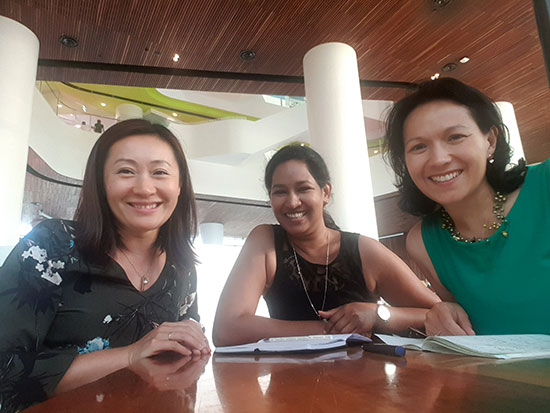
Ada’s Tribe seeks to support women through its community approach, guide through mentoring and expert sessions, as well as empower members with opportunities for networking, professional development and practical experience. Recognizing that numerous groups exist to support women in ADA fields – including INFORMS Women in OR/MS Forum – Ada’s Tribe works collaboratively with other groups and organizations toward the common goal to support women.
The key to building a community was to encourage real connection, listen to what members wanted and shape activities to meet their needs – from organizing group mentoring sessions to online interview preparation; from machine learning industry examples to thought leadership in AI; from online webinars to an in-person breakfast event; from basic data visualization training to advanced machine learning research projects.
Part of the Ada’s Tribe culture is to hold safe space for informal chats before and after online events, which gives members the opportunity to get to know each other. Since we launched in July 2020, we shared many things, including struggles and achievements, both in our ADA journey and in life. Although we anticipated Ada’s Tribe to support women mainly in their career development, having a strong community approach provided a holistic connection. As we all struggled through the COVID-19 pandemic and social isolation, the Ada’s Tribe events became something for members to look forward to and connect with each other. Many members expressed gratitude for the support that Ada’s Tribe offered during those difficult times.
Creating Impact and Transitioning Careers
Beginning with three international women who met in Australia with a common vision, Ada’s Tribe now has nearly 200 members with multidimensional diversity, located mainly in Australia with growing numbers overseas. As an inclusive community, member career stages span from early career to leaders, graduates to distinguished, as well as return-to-work mothers and retired academics. Our members are also ethnically diverse with professional backgrounds ranging from technology to finance, business and management to academic and public services.
Ada’s Tribe has successfully encouraged more women to step outside comfort zones and explore ADA career opportunities, providing guidance and support along the way. Practical experience, technical skills and domain knowledge are key elements to transitioning careers into ADA. As part of our culture to share and learn, ADA leaders volunteer their time and expertise to guide members developing new skills to work on projects for social good. Past projects include applying machine learning to COVID-19 mitigation analysis and air pollution forecasting, as well as using data visualization to analyze women in data science. Through these project initiatives, Ada’s Tribe members improved their technical competency while contributing to social good. Members have also broadened their professional skills and improved self-confidence through volunteering within the community.
We hear exciting news every month from our members on their ADA journey moving into new roles toward their career goals with support from our community. Examples include members transitioning from the disciplines of physics, healthcare and finance to ADA.
Welcome to Ada’s Tribe
We are a diverse and inclusive community from different cultural and professional backgrounds with the purpose to support, guide and empower women in ADA. As data science and O.R. continue to develop together, we welcome more women contributing to the diverse perspectives and talent needed for impactful solutions.
Join Ada’s Tribe’s mighty network group at https://adastribe.mn.co, a platform where members can easily communicate and receive frequent updates. You can also follow us on LinkedIn to see event updates, featured stories, etc.
References
- Daniel Reaume and Beata Kilos, 2021, “An Analytics Approach to Diversity, Equity and Inclusion,” OR/MS Today, October, https://doi.org/10.1287/orms.2021.05.25.
- Caroline Criado Pérez, 2019, “Invisible Women: Data Bias in a World Designed for Men,” New York: Abrams Press.
- Joy Buolamwini, 2016, “The Algorithmic Justice League - Unmasking Bias,” Medium, Dec. 14, https://medium.com/mit-media-lab/the-algorithmic-justice-league-3cc4131c5148.
- “Ada Lovelace,” https://en.wikipedia.org/wiki/Ada_Lovelace.
Catherine Lopes, Ph.D., is co-founder of Ada’s Tribe with 20 years of experience internationally across a range of sectors. She is a strategic, outcome- and value-focused data scientist, and a passionate educator in data and analytics. She is an advocate for supporting women in analytics and data science and bridging gaps between academia and industry. She serves on the advisory boards of The Australian National University and AI, Data & Analytics Networks. Dr. Lopes holds a Ph.D. in computer science and her Ph.D. thesis, “Characteristic-based Forecasting for Time Series Data,” was awarded the best Ph.D. thesis at Monash University in 2005. Bienna Chow, CFA, GAICD, is co-founder of Ada’s Tribe. She is the strategy director at Direction Innovation focusing on the intersection of technology and society through a Responsible Technology approach. Bienna has led Corporate Strategy for Asia Pacific and managed pension fund and corporate venture capital investments at Bosch.