
February 3, 2022 in Forest Products Sectors
COVID-19 and Forest Products
Analysis of the pandemic’s effect on the forest products sector, including lumber pricing and demand, reduction of labor
SHARE: PRINT ARTICLE: https://doi.org/10.1287/orms.2022.01.16

The SARS-CoV-2 pandemic has roiled the lives of virtually everyone on Earth over the past two years. Along with multiple waves of illness and death have come disruptions to how we buy and consume. With our lives more centered around our homes, where many of us now work, consumption patterns changed in ways that altered forest products purchases [1, 2]. Homeowners invested more in their houses but delayed selling and moving; demand for new construction was therefore elevated after a brief slowdown [3, 4], creating conditions for higher prices in wood products that mirrored the roller coaster of illness that beset the nation. This article discusses this last aspect of the pandemic, with a focus on the forest products sector in the United States.
Volatile Prices and Demand
Perhaps the phenomenon most illustrative of the pandemic’s effects on the forest products sector has been the wide swings in softwood lumber and structural panel (plywood, oriented strand board) prices in 2020 and 2021. In March 2020 when the pandemic hit the U.S., the average wholesale price (i.e., price paid at the mill gate) of softwood framing lumber was about $400 per thousand board-feet, and the composite wood-based panel price was about $400 per thousand square feet [5]. After a sharp drop in the nation’s aggregate economic output by 8.9% in the second quarter of 2020 (an annualized drop exceeding 30% of the nation’s real gross domestic product, seasonally adjusted) [6], wood product prices began to rise [5]. Builders resumed a high rate of residential construction at a seasonally adjusted annual rate that averaged 1.5 million homes per year from July to December 2020 [7]. Additionally, homeowners undertook a higher rate of repairs and renovations than they had prior to the pandemic [6], utilizing the extra savings (which more than doubled from 7.9% to 18.9% of income between April 2020 and March 2021) that they found themselves holding due to reduced spending on things such as vacations and dining out [8]. The apex of the run-up in wood products prices was in mid-2021 when the North American softwood lumber price index topped $1,500 per thousand board-feet and the panel price index exceeded $1,500 per thousand square feet [5].
Labor Supply Contraction and Stagnant Wood Product Output
Compared to 2019, worker illnesses were up 16% in the wood products sector and 42% in the paper products sector in 2020 [9]. It is unknown at this time the extent to which forest sector workers’ availability for paid labor was affected by increased household responsibilities of home healthcare and childcare, but it is clear that COVID-19 played a role. This reduction in labor availability is termed a “backwards shift in labor supply” in economics. Although the forest sector workforce has been shrinking over many decades because of labor-saving technology change [10] – reducing employment by an average of 1%-2% per year since 1990 – the shrinkage of the workforce in 2020 was a sizable annual drop compared to 2019 [11]. In the wood products sector, the employment level was an average of 3% lower in the 12 months from April 2020 to March 2021 compared to those same months in the year prior.
The revived demand for wood due to resumed residential investment interacted with the labor supply contraction mentioned earlier to create conditions for a volatile wood products market. As orders flowed in from builders and big-box wood retailers in the wholesale market, available inventories were quickly exhausted because mills were labor-constrained. The labor supply contraction corresponded with higher weekly wages, which were up by an average of 5.8% from April 2020 to March 2021 compared to the same period in 2019-2020 [11]. However, higher pay was insufficient to attract enough workers to substantially increase production in 2020 and early 2021. For example, softwood lumber output in the Pacific, Intermountain and Southern U.S. increased an average of 3.8% in the four quarters from April 2020 to March 2021 compared to the year earlier [12].
The combination of labor supply contraction and higher product demand produced a set of repeated bidding wars for wood products that has endured throughout the pandemic, driving prices higher still. Through March 2021, wholesale (mill gate) softwood lumber prices averaged 95% higher than in the comparable quarters a year earlier [5]. The U.S. Bureau of Labor Statistics [13] reports that prices for wood products overall averaged 14.7% higher from April 2020 to March 2021 compared to a year earlier; sawmill output prices were 30% higher and plywood mill output prices were 29% higher.
Economic research suggests that producers are able to adjust labor, capital and raw material input allocations in response to altered market conditions over the course of many months to years [14]. Therefore, the short-run behavior in markets, demonstrating limited output adjustments, seen in this light, is not surprising.
With the lumber price increases that took place, an industry without labor retrenchment would have been expected to produce substantially more softwood lumber than observed. Estimates vary, but given the approximate doubling of softwood lumber prices nationwide, output would have increased an estimated 23%, and possibly more [14], had labor supply not contracted.
Still, the higher product prices and nearly stagnant output translated into overall higher revenues flowing to manufacturers. In the wood products sector, a share of that revenue covered higher labor costs (wages plus employer contributions), which were up by an average of 2.7% from April 2020 to March 2021 compared to the year prior [11]. But that cost increase was less than one-fifth the size of the overall wood product price index increase registered over the same time frame.
Mills Did Not Demand Much More Wood
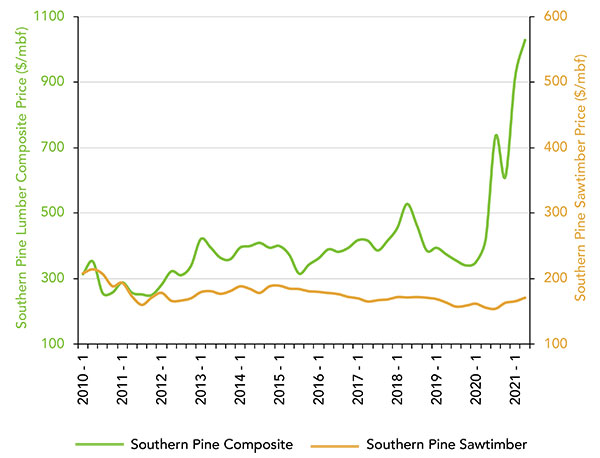
The result of the labor contraction and limited wood product output response was a weak or nonexistent increase in the demand by mills for sawtimber to make lumber. The lack of strong sawtimber demand makes sense, as the decrease in the rate of wood product output naturally leads to a decrease in the need for raw material input. In contrast to the higher manufactured product prices in the southern United States, where most of the U.S. softwood lumber is produced, prices for southern pine sawtimber (and delivered sawlogs) were unchanged over the four quarters spanning April 2020 to March 2021 [15]. The disconnect between lumber and sawtimber prices is shown in Figure 1.
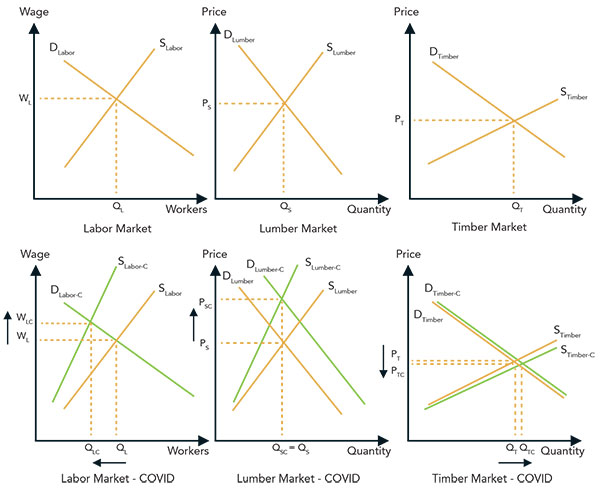
The market changes observed in the COVID-19 era can be illustrated with a collection of supply-and-demand graphs. In Figure 2, we show the markets for labor, lumber and timber in the absence of the pandemic (top three graphs) and in the presence of COVID-19 (bottom three graphs). The top-left graph presents an equilibrium of labor supply (SLabor) and demand (DLabor) at the number of workers at QL and the average wage at WL. In the lumber market (top middle), equilibrium lumber supply (SLumber) and demand (DLumber) is found with a quantity produced of QS and market price of PS. In the timber market (top right), the timber supply (STimber) and demand (DTimber) intersect to define quantity produced (QT) and the price of that timber (PT). In the COVID-19 era (bottom row), labor supply (bottom left) shifts back to SLabor-C, defining a lower number of workers (QLC) and a higher wage (WLC). In the lumber market (bottom middle), because of fewer workers available at any wage level, supply shifts back to SLumber-C, but vigorous demand for lumber means that lumber demand shifts out to DLumber-C. A new equilibrium price is found at PSC, which is a large jump from PS. But the quantity of lumber produced is nearly unchanged, settling in at a quantity QSC, which is barely different from the pre-pandemic quantity of lumber QS. Finally, in the timber market (bottom right), the spike in lumber prices translated into a weak outward shift in timber demand (DTimber-C). In this figure, we posit a slight outward shift in timber supply (STimber-C), in line with a growing volume of standing timber inventory [16]. Therefore, the price of timber PTC is essentially the same as the pre-pandemic price PT, but the quantity produced increases slightly from QT to QTC.
Lumber prices have undergone large gyrations since March 2020 (Figure 1). The movements reflect the balance between contracting and expanding labor supply, which ebbed and flowed with the various waves of COVID-19 in the U.S. It is not yet known precisely how labor supply and lumber supply variations interacted with product demand conditions. The data are accumulating, and research is underway to fully identify the temporal and cross-input (labor, wood) dynamics since March 2020 in the U.S. and globally.
Transport Concerns
Although we have been focusing on the wholesale market for wood products, a salient consideration is that shipping labor supply also contracted during the pandemic. Employment changes in the trucking industry illustrate the supply chain interruptions. From April 2020 through March 2021, employment in the specialized trucking sector, which includes log transport, decreased by 6.3%. Of importance for wholesale buyers of wood products, including builders and big-box retailers, a parallel shift took place in the overall trucking sector, whose employment levels dropped by 4% over the same time frame [11]. The implication is that, even if mills demanded more logs or builders demanded more lumber and panels, producers and buyers found it difficult to move product, contributing to a backlog of unfilled orders. When producers have a backlog of orders, prices are naturally bid up to make supply available equal to demand, even if the total quantity bought and sold only slightly changes.
What about International Trade?
A discussion of the U.S. market for forest products cannot ignore the role of international trade. For softwood lumber, softwood plywood and oriented strand board, the United States imports more than it exports. Pre-pandemic, the nation imported about one-third of the softwood lumber it consumed from Canada [17]. During the pandemic, Canada, like the U.S., has experienced output constraints in wood products, with additional complications related to its recovery from the mountain pine beetle epidemic [18]. Canada did increase its softwood lumber exports to the U.S. by 3.5% for the months of April 2020 to March 2021 [13], and other overseas suppliers similarly responded to high U.S. prices [12]. But it is apparent that U.S. imports from these foreign sources were insufficient to substantially dampen U.S. market prices. Given recent U.S. Department of Commerce findings regarding Canadian softwood lumber imports [20] and the limited success of other foreign producers at meeting domestic wood products demand, the future role of trade affecting COVID-19 related price volatility is highly uncertain.
What to Expect
We do not have the space in this article to fully flesh out the entire web of changes experienced in the forest products sector, but the statistics and graphical figures presented give a sense of what has happened since the advent of COVID-19 in the United States. The dynamics observed over the past two years also provide a roadmap for what to expect in the coming years.
First, with overall higher prices, domestic U.S. producers of wood products have a profit incentive to expand their output through the deployment of new production capacity. However, the labor market contraction has indicated that more workers may not be available to work in new or expanded mills at the wage rate that mills are willing to pay. Hence, the pandemic has offered a strong incentive to accelerate the ongoing process of capital intensification in combination with any increase in production capacity. Next, principles of international trade tell us that if a foreign producer cannot robustly respond to U.S. market signals, foreign investors have an increased incentive to invest in new production capacity within the borders of the United States. Product competition leads to another inferred outcome that could emerge from the pandemic: to the extent that wood competes with non-wood products in construction and other applications, higher lumber and wood-based structural panel prices encourage builders to substitute away from wood. Compared to the near doubling of the price of softwood lumber, non-wood substitutes in some applications did not increase much in the first 12 months of the pandemic, e.g., concrete increased 2.3% [20] and metal framing materials increased 0.9% over the same time frame (though the remainder of 2021 demonstrated a spike upward) [21].
In summary, the pandemic has scrambled product markets domestically and globally and provided fresh incentives disfavoring wood product sector employment, favoring new domestic production capacity potentially fueled by higher foreign direct investment, and disfavoring construction wood products over some non-wood substitutes. The long-run implications of this combination of factors are so far unknown, but it is plausible that the forest products sector of 2030 will look far different from the one that existed in February 2020.
Acknowledgments
This work was partially funded through Grant 20-JV-11330180-100 of the U.S. Department of Agriculture, Forest Service, Southern Research Station. A previous version of this article was reviewed by Dr. Stephanie Snyder of the U.S. Department of Agriculture, Forest Service, Northern Research Station and Dr. Jesse D. Henderson of the U.S. Department of Agriculture, Forest Service, Southern Research Station.
Disclaimer
The findings and conclusions in this publication are those of the authors and should not be construed to represent any official USDA or U.S. Government determination or policy.
References
- Mendez-Carbajo, D., 2021, “Consumer Spending and the COVID-19 Pandemic,” Jan. 4, https://research.stlouisfed.org/publications/page1-econ/2021/01/04/consumer-spending-and-the-covid-19-pandemic.
- USDA Economic Research Service, 2021, “COVID-19 Economic Implications for Agriculture, Food, and Rural America,” https://www.ers.usda.gov/covid-19/.
- Anenberg, E. and Ringo, D., 2021, “Housing Market Tightness During COVID-19: Increased Demand or Reduced Supply?,” Board of Governors of the Federal Reserve System, July 8, https://www.federalreserve.gov/econres/notes/feds-notes/housing-market-tightness-during-covid-19-increased-demand-or-reduced-supply-20210708.htm.
- National Association of Realtors, 2021, “Existing Home Sales,” https://cdn.nar.realtor/sites/default/files/documents/ehs-11-2021-overview-2021-12-22.pdf.
- Fastmarkets RISI, 2021, “Random Lengths Weekly Report (various),” Eugene, Oregon.
- U.S. Bureau of Economic Analysis, 2021, “Current-dollar and ‘Real’ Gross Domestic Product,” Dec. 22, https://www.bea.gov/data/gdp/gross-domestic-product.
- U.S. Census Bureau, 2021, “New Residential Construction,” https://tinyurl.com/2u75j32n.
- Federal Reserve Bank of St. Louis, “Personal Saving Rate, Percent, Monthly, Seasonally Adjusted Annual Rate,” https://fred.stlouisfed.org/series/PSAVERT.
- U.S. Bureau of Labor Statistics, 2021, “Industry Injury and Illness Data,” https://www.bls.gov/iif/oshsum.htm#20Supplemental_News_Release_Tables.
- Prestemon, J.P., Wear, D.N. and Foster, M.O., 2015, “The Global Position of the U.S. Wood Products Industry,” USDA Forest Service General Technical Report SRS-GTR-204.
- U.S. Bureau of Labor Statistics, 2021, “Quarterly Census of Employment and Wages, QCEW Data Files,” https://www.bls.gov/cew/downloadable-data-files.htm.
- Fastmarkets RISI, 2021, “Random Lengths Yardstick,” https://www.risiinfo.com/product/random-lengths-yardstick/.
- U.S. Bureau of Labor Statistics, 2021, “Producer Price Indices: PPI Industry Data, Original Value Data,” https://www.bls.gov/ppi/tables/home.htm.
- Song, N., Chang, S.J. and Aguilar, F.X., 2011, “U.S. Softwood Lumber Demand and Supply Estimation using Cointegration in Dynamic Equations,” Journal of Forest Economics, Vol. 17, No. 1, pp. 19-33.
- TimberMart-South, http://www.timbermart-south.com/.
- Oswalt, S.N., Smith, W.B., Miles, P.D. and Pugh, S.A., 2019, “Forest Resources of the United States, 2017: A Technical Document Supporting the Forest Service 2020 RPA Assessment,” Gen. Tech. Rep. WO-97. Washington, D.C.: U.S. Department of Agriculture, Forest Service, Washington Office, https://doi.org/10.2737/WO-GTR-97.
- U.S. International Trade Commission, 2021, “Dataweb: The Premier Source of Free U.S. Trade and Tariff Data. USITC Interactive Tariff and Trade Data,” Washington, D.C., https://dataweb.usitc.gov.
- Wood Resources International LLC, 2021, “The U.S. is Increasingly Dependent on Overseas Lumber Supply as Canadian Softwood Lumber Production Continues to Decline,” Jan. 18, https://www.prnewswire.com/news-releases/the-us-is-increasingly-dependent-on-overseas-lumber-supply-as-canadian-softwood-lumber-production-continues-to-decline-301210117.html.
- National Archives and Records Administration, 2021, “Certain Softwood Lumber Products from Canada: Final Results of the Countervailing Duty Administrative Review, 2019,” Dec. 2, https://www.federalregister.gov/documents/2021/12/02/2021-26152/certain-softwood-lumber-products-from-canada-final-results-of-the-countervailing-duty-administrative.
- U.S. Bureau of Labor Statistics, 2021, “PPI Commodity Data for Nonmetallic Mineral Products-Concrete Products, not Seasonally Adjusted,” https://data.bls.gov/timeseries/WPU133?data_tool=XGtable.
- U.S. Bureau of Labor Statistics, 2021, “PPI Commodity Data for Metals and Metal Products-Open Metal Flooring, Grating and Studs, not Seasonally Adjusted,” https://data.bls.gov/timeseries/WPU10740814?data_tool=XGtable.
- Prestemon, J. and Pye, J., 2021, “TimberMart-South Area Conversion Weights for Timber and Log Prices,” https://www.srs.fs.usda.gov/econ/data/tmbrmart/index.htm.
Jeffrey P. Prestemon is a senior research forester at the United States Department of Agriculture, Forest Service, Southern Research Station, RTP, NC. Jinggang Guo is an assistant professor of agricultural economics and agribusiness at Louisiana State University.