


April 12, 2022 in Viewpoint
Sustainable Development Goals, Women’s Economic Empowerment and INFORMS
SHARE: PRINT ARTICLE: https://doi.org/10.1287/orms.2022.02.02

The hardships of women have been shown throughout history, especially when it comes to unequal rights and unequal access to education and job opportunities [1]. I have indeed witnessed this plight through a Chinese refugee woman’s life in Hong Kong.
After the end of World War II, education, jobs and food were not easily accessible in China, even if they were available. For a 16-year-old Chinese girl with less than primary school education, getting married was her survival strategy. Unfortunately for this woman, the arranged marriage resulted in physical and verbal abuse. Taking her two sons and leaving her husband was the only escape route.
This single mother’s story was not uncommon after the war, but it is still a common story for many women in many developing and low-income countries. Is it possible for a developing country to support women and develop its economy? Why have these become mutually exclusive?
Perhaps China is a great example of a country that can achieve both simultaneously. The International Labor Organization reported in 2020 that the female labor participation rate (of age 15 and older) was 59.8% in China [2]. At the same time, the World Bank reported that more than 800 million people in China have escaped from extreme poverty in the past four decades [3].
Former United Nations (U.N.) Secretary-General Kofı Annan once said, “Empowering women is the most effective development tool” [4]. His passion and leadership gave the impetus to the development of the U.N.’s 17 sustainable development goals (SDGs) in 2015 [5].
Sustainable Development Goals
SDGs are intended to serve as a blueprint for U.N. member states to achieve a better and more sustainable future by 2030. The top 10 SDGs are: No Poverty; Zero Hunger; Good Health and Well-being; Quality Education; Gender Equality; Clean Water and Sanitation; Affordable and Clean Energy; Decent Work and Economic Growth; Industry, Innovation and Infrastructure; and Reducing Inequality [6].
These goals are unequivocally important, yet research formally addressing SDG issues remains rare. Searching INFORMS PubsOnLine with the keywords “sustainable development goals” [7] results in only 18 articles that mention SDGs in the text, and all of them were published since 2019 [8]. At the same time, when I searched through Google Scholar for articles published in Manufacturing & Service Operations Management (M&SOM) and Production and Operations Management that contain keywords “poverty,” “poor,” “women” or “economic development” in the title, I found only two articles since their inception – namely, those by Plambeck and Ramdas (2020) and Sodhi and Tang (2014) [9, 10].
Even though U.N. SDGs were established in 2015, it is encouraging that INFORMS members have been publishing their research related to SDGs since 2019. SDG issues are certainly broad, but gender equality is correlated with other goals such as poverty, hunger, education, economic growth, clean water and sanitation [11]. Therefore, I am convinced that improving gender equality through women’s economic empowerment can create “spillover” effects that can improve other correlated goals, as observed in the development of China.
Women’s Economic Empowerment
Even if we were to focus just on women’s economic empowerment, this goal can only be achieved if one can develop effective policies with limited resources and implement these policies with efficient operations. I have discussed how some affordable technologies (mobile phones and solar panels) and various innovative operations can enable women and children to access education, health information and job opportunities in many developing countries [11]. Operating efficiently with limited resources is the hallmark of INFORMS, and we should seize this opportunity to contribute to the sustainable development of the world.
Conducting research in uncharted waters is risky, but there are simple mechanisms to identify innovative research topics [12]. However, I would urge INFORMS journal editors to encourage exploratory research and even rigorous case studies that can identify clear research paths for other researchers to conduct more in-depth analysis. In addition, as a community, INFORMS should develop a vigorous OR/MS ecosystem by engaging researchers, policymakers, the World Bank, USAID, U.N. World Food Programme and other NGOs [13].
INFORMS should embark on this journey to encourage its members to conduct research on women’s economic empowerment along with other SDGs. The journey will be arduous, but INFORMS has the capability and talents to undertake a quest that can change the world.
The tenacity of the Chinese refugee woman in Hong Kong to raise her two sons as a single mother created some positive changes. Before her passing in 2000, I asked her why she did not leave her abusive husband before having any children. She said, “I left my husband for my children’s survival. Without my boys, I would never have [had] the courage to leave my husband in the late 1960s.”
Against all odds, this single mother raised her two sons, who later received their doctorate degrees and now work as professors. You may have guessed – this woman was my mother, and I am extremely proud of her courage that allowed me the career opportunities I have today [14].
We do certain things not because they are easy to do, but because they are the right things to do.
Acknowledgments
This article is dedicated to my mother, who raised me and my brother against all odds. I am grateful to Kara Tucker (editor of OR/MS Today) for inviting me to write this article.
References and Notes
- Haynes, J., 2017, “International Women’s Day: Five Reasons Life is Hard for Women in 2017 (And What You Can Do to Improve It),” ABC News Australia, March 7, https://www.abc.net.au/news/2017-03-08/five-ways-things-are-better-and-worse-for-women-in-2017/8318880.
- https://tradingeconomics.com/china/labor-participation-rate-female-percent-of-female-population-ages-15-plus--wb-data.html
- Ziyun, 2021, “Extreme Poverty is History in China, Officials Say,” The Economist, Jan. 2, https://www.economist.com/china/2021/01/02/extreme-poverty-is-history-in-china-officials-say.
- https://news.un.org/en/story/2005/02/130132-empowering-women-most-effective-development-tool-annan-says
- SOCISDG, 2018 “SDG Leadership – A Tribute to Kofi Annan,” Sept. 14, http://socisdg.com/en/blog/sdg-leadership-a-tribute-to-kofi-annan/.
- The remaining seven goals are Sustainable Cities and Communities; Responsible Consumption and Production; Climate Action; Life Below Water; Life on Land; Peace, Justice and Strong Institutions; and Partnerships for the Goals. See: https://www.un.org/sustainabledevelopment/sustainable-development-goals/.
- https://pubsonline.informs.org/action/doSearch?AllField=%22sustainable+development+goals%22&AfterYear=2018&BeforeYear=2022&queryID=13/434489879
- I found nine articles in M&SOM, two in Management Science, two in Strategy Science, two in INFORMS Journal on Applied Analytics, one in Service Science, one in Operations Research and one in Transportation Science.
- Plambeck, E. and K. Ramdas, 2020, “Alleviating Poverty by Empowering Women Through Business Model Innovation: Manufacturing & Service Operations Management Insights and Opportunities,” Marketing & Service Operations Management, Vol. 22, No. 1, pp. 123-134.
- Sodhi, M. and C.S. Tang, 2014, “Supply-Chain Research Opportunities with the Poor as Suppliers or Distributors in Developing Countries,” Production and Operations Management, Vol. 23, No. 9, pp. 1483-1494.
- Tang, C.S., 2022, “Innovative Technology and Operations for Alleviating Poverty through Women’s Economic Empowerment,” Production and Operations Management, Vol. 31, No. 1, pp. 32-45.
- Tang, C.S., 2017, “OM Forum – Three Simple Approaches for Young Scholars to Identify Relevant and Novel Research Topics in Operations Management,” Manufacturing & Service Operations Management, Vol. 19, No. 3, pp. 338-346.
- Sodhi, M. and C.S. Tang, 2008, “The OR/MS Ecosystem: Strengths, Weaknesses, Opportunities, and Threats,” Operations Research, Vol. 56, No. 2, pp. 267-277.
- Three endowed Madam See Lai Ngor memorial prizes have been established in her honor at the National University of Singapore for the UCLA-NUS EMBA program and NUS (Chinese) EMBA program since 2003.
Christopher Tang is a University Distinguished Professor and the holder of the Edward W. Carter Chair in Business Administration at the UCLA Anderson School of Management at University of California, Los Angeles. He received his B.Sc. (First class honours) in mathematics from King's College London in 1981, M.A. in statistics in 1983, M.Phil in administrative science in 1983, and Ph.D. in operations research in 1985 from Yale University. He is the INFORMS VP of Publications and former editor-in-chief of Manufacturing & Service Operations Management.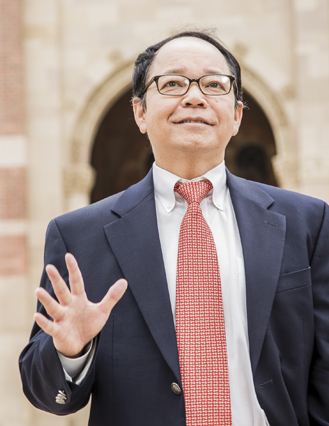
([email protected])