


April 11, 2022 in International O.R.
Operations Research Solutions and a New Disruptive Business Model to Transform Cash Management in Guatemala
How knowledge creation using O.R. methodologies allowed a small startup to become the market leader in the cash transportation industry in Guatemala in less than half a decade.
SHARE: PRINT ARTICLE: https://doi.org/10.1287/orms.2022.02.04
The story you are about to read is real and was developed in a unique framework of market restrictions and procedural and practical limitations. Guatemala is a Latin American country that has the largest economy in Central America. Its economy is about the size of Luxemburg, but its population is 18 million, which equals the size of Chile and the Netherlands and is larger than Belgium, Greece, Czech Republic, Sweden, Portugal, Hungary, Israel, Austria, Denmark or Switzerland. Guatemala’s strategic location, just two hours away from Miami, Mexico City and Panama by plane, makes it an attractive site for investing and financial intermediation and results in banking being one of its healthiest sectors. Remittances from the United States, for example, are now larger than the annual government budget. A consolidation process during the late 1990s achieved a dramatic reduction from 38 to 17 banks via mergers or acquisition, and this triggered many efficiency projects [1]. These require cash replenishment at regular intervals, which relies on the services of companies that deliver cash to and from automated teller machines (ATMs) at periods agreed upon by the banks involved.
In contrast to the ATM alliance, cash transportation services remained (until very recently) under an oligopoly of two major international companies that negotiated price agreements with each other, within regulations, to avoid entering price wars. These two companies dominated cash transportation services for many years, and excessive price increases were common. The operational models used at these companies dictated the now-common cash transportation business model: the price formula included the visit unit cost per number of visits, and the amount of cash moved per insurance cost, plus an expected margin. Banks usually negotiated service packages that would try to limit budgetary overflows by fixing a certain number of visits at a price with a discount. Bank managers sought to avoid budgetary crises since cash transportation was among the three largest operational cost accounts for most banks.
O.R. as a Path to Develop Key Knowledge to Understand Powerful Leverages
The solution forward included a combination of mathematical modeling to solve the restrictions and required needs for optimization to compete with two of the largest global cash transportation companies in the world. The approach was first to develop a mathematical solution applying a supply chain concept by detecting active ATMs, their speed of consumption, and historical behavior depending on their location, the day of the week and the month. This achieved a great capacity to respond to actual consumption and minimized the necessary cash to be available at each ATM as well as the number of visits and kilometers to be traveled each month.
The implementation of this model and the knowledge developed helped Improvement & Progress, or Improgress [2], develop a new operating model for a new competing local company, delegating all responsibilities of replenishment and cash management to the transportation company, henceforth reducing the time necessary to make decisions, cost through routing optimization, and the number of armored vehicles necessary to fulfill all required ATMs. Finally, this operating model was the base of a new business model, basically charging the banks per transaction instead of by visit or cash transported amounts, which aligns perfectly with the interest of the main customer, the banks, and maximizes the level of service to the final customer operating the cash debits on the ATMs.
Tackling the Technical Problem
By the end of 2014, a local entrepreneur in the phone card market and guard security services began to compete in the cash transportation market in Guatemala. His company, TAVSA (Transporte y Administración de Valores, S.A.), flared up in the marketplace, although the possibilities for a new and small company to compete with two of the largest cash transportation companies in the world were truly slim. He was certain that the development of a new business model could successfully compete in the sector. To develop a winning business strategy, he raised three questions:
- Should the company enter the market with the same price formula, or should it develop a new one?
- What was the minimum operational size to arrive at a breakeven point in the shortest possible period?
- How to find the differentiated customer value proposition to compete and gain market share as fast as possible?
The Consultancy Solution
TAVSA decided to help tackle these questions and looked for innovative consultants who had the operational experience to develop this new business model and dramatically impact the market in a traditional business environment. Improgress was selected because it gained considerable experience in just seven years designing and implementing optimized replenishment models for ATMs. Improgress used an innovative stochastic model to determine a daily forecast of the cash demand for every ATM using Bayesian theory and probabilistic distributions to determine which ATMs needed replenishment and the optimal moment to do so, the number of cassettes [3] to use and the number of cash notes to dispatch.
The primary aim of the model was to reduce the number of visits to ATMs by the cash transportation companies (see Figure 1). The outstanding success of applying this stochastic model resulted in the firm obtaining other projects with several banks and increasing its experience and understanding of key operating levers of the business model. Leonte Pallais, current CEO of 5B, describes the importance of these mathematical models for his company: “We based the operational core of our company on the efficiency produced by the mathematical tools implemented by Improvement & Progress.” For TAVSA, the challenge was to create a new, improved business model that could meaningfully compete with a well-established business operation dominated by two international companies in a traditional business environment averse to risk and failure. TAVSA appointed Improgress in 2015 to develop the desired innovative new model.
Improgress’ first aim was to maximize the customer value proposition. This was achieved by searching for an important job-to-be-done that was poorly satisfied for the customer and subsequently devising and developing an offering that could do the job better than alternatives at the lowest appropriate price. There seemed to be a poor alignment of interest between banks and transportation companies. In relation to ATMs, banks wanted to have the maximum number of transactions at the minimum cost, and cash transportation companies were looking to maximize the revenue by increasing the visit price or the number of visits. The latter dilemma became the opportunity for TAVSA to break into the market. After discussions and brainstorming sessions, Improgress’ staff asked: What would happen if a new cash transportation company offered to align its revenues to the number of transactions performed at each ATM instead of the number of visits? If transactions increased, the cost to banks would directly increase, but if transactions decreased, the cost would also directly decrease, maintaining the unit cost for banks. This became a very attractive approach. At the same time, TAVSA was able to offer lower prices because the new operational model allowed TAVSA to become more efficient cost-wise owing to larger volumes, synergies and control of the forecasting process and cash movement decisions.
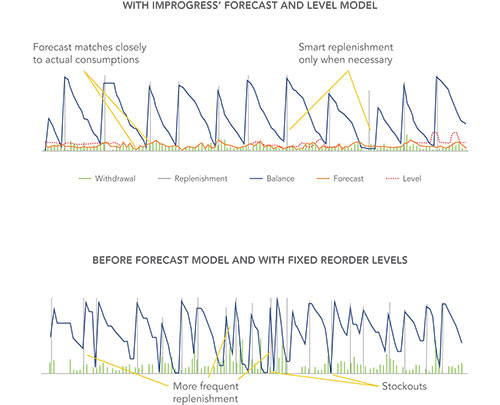
The traditional operational directives from 5B to perform cash replenishment of ATMs used the forecasting model developed by Improgress to determine visit needs and send daily instructions. The latter would take some time to arrive at the cash transportation companies, which would then integrate with the rest of the requests, adapting plans and routes. These operational restrictions limited the possibilities for optimization. Improgress concluded that if 5B would delegate the forecasting and visit planning to TAVSA, their mathematical model could determine which ATMs to visit, when and with how much cash. Then, the firm could reduce the time of response, increase the uptime of the ATMs related to cash, and minimize the number of visits, traveled kilometers and vehicles used to replenish the ATMs. The operational and financial outcomes could be dramatically better than those of the competition.
The Model
Using the forecasting model daily, a certain number of ATMs were selected for replenishment. The aim was to use the minimum number of cassettes per ATM, which would also minimize the use of the cash fund [4] prepared for ATM replenishment. The model calculated the minimum number of cassettes necessary to fulfill the forecasted demand. It includes a minimization of an objective function, capacity and cash fund restrictions linking the cost related to travel from the operations center to each ATM to be replenished, the available funds necessary to replenish the ATMs and the additional capacity provided by necessary cassettes to equal the demand.
The model includes a second part that integrates a traveling salesman problem, which solves the shortest route to replenish all ATMs in a clustered region. The model uses different algorithms to calculate different options and then selects the best option, including nearest neighbor, nearest insertion and arbitrary insertion, among others. Using the Miller-Tucker-Zemlin formulation [5], it can minimize the route and distance between ATMs, along with the recommended route.
Outcome
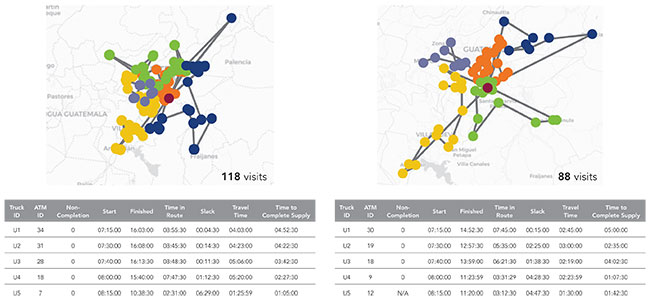
In a few weeks’ time, using the above linear programming (LP) solution and the best algorithm selection developed in R language, Improgress minimized on paper the number of visits and kilometers traveled, increased the uptime, and minimized the amount of cash used to replenish the ATMs in Guatemala.
The second step (using Johnson’s framework [6]) was to develop a profit formula, i.e., an economic blueprint that defines how the company will create value for itself and its shareholders. This specifies the assets and fixed cost structure as well as the margins and velocity required to cover them. In developing the formula, Improgress had the great help and experience of TAVSA to accurately determine key processes, resources, costs, margins and recovery speed. This process also took some weeks to discuss and prepare scenarios, which could help determine the optimal transaction price and make the company competitive. TAVSA’s then-CEO negotiated the new business model and economic conditions with 5B, who then agreed to delegate forecasting and cash management to TAVSA and signed a new contract. The thorough implementation of the new business model allowed TAVSA to achieve top results in all areas.
Client Comments
Miguel Ángel Sánchez, TAVSA CEO, explains, “This new business model helped us achieve the best indicators of all three companies in all areas. Minimum transportation cost per ATM, cash amount needed to replenish the ATMs and maximum uptime related to cash replenishment led to us becoming the most confident cash transportation service provider in Guatemala. This translated into a current 80% market share, which is an incredible leap for a small national company in only five years. TAVSA has become the largest cash transportation company in Guatemala, currently managing all of the ATMs under the administration of 5B.”
Without a doubt, grasping value through innovation based upon operational efficiency is, with limited exceptions, a way to compete and dominate the market. The Guatemalan case is, without a doubt, a differentiated example of what can be achieved even in small markets or where market share has been occupied mostly by the largest competitors.
References and Notes
- For instance, an alliance of five banks produced the most popular brand operation of ATM services, called 5B, which now manages around 40% of all 6,500 ATMs in the country.
- Improvement & Progress is a small consultancy firm founded in 2004 by two former teachers at the Operations Research Master’s Program of Galileo University. The author of this article is one co-founder. The company currently has 20 employees, mostly professionals with a master’s degree in operations research or business intelligence, nourished under the wing of Jorge Samayoa, director of the Operations Research Institute of Galileo University, and by commercial engineers from Francisco Marroquin University.
- The currency notes inside the ATM are stacked in boxes called cassettes. Each cassette is loaded with one denomination.
- Cash fund is the reserved amount of cash stored by banks ready to replenish the ATMs plus the amounts of cash included in the armored vehicles to replenish and the available cash at the ATMs.
- Der-San, Chen, Batson, Robert G. and Dang, Yu, 2010, “Applied Integer Programming. Modeling and Solution,” Hoboken, NJ: John Wiley and Sons.
- Johnson, Mark W., 2010, “Seizing the White Space. Business Model Innovation for Growth and Renewal,” Boston: Harvard Business Publishing.
