
April 12, 2022 in International O.R.
Providing Off-Grid Light to Poor Communities
A structural model and field experiments in Rwanda
SHARE: PRINT ARTICLE: https://doi.org/10.1287/orms.2022.02.05

One-tenth of humankind still does not have access to electricity. More than 80% of this population inhabits countries in Africa, a continent that is half unelectrified [1]. Not surprisingly, countries with low electrification rates are those in which the majority of people live on less than $2 per day (USD). Currently, the households in these areas predominantly rely on either flame-based (e.g., kerosene, candles) or battery-based (e.g., flashlights) solutions for their lighting needs, mainly because these solutions are easily accessible in local retail stores. However, the cost of these items is expensive for consumers in the long run, and they pose a threat to health and the environment because of the harmful smoke they generate or the improper disposal of replaced batteries.
Extending grid-based models of electricity supply in many cases may be neither technically feasible nor economical because of the remote and sparse nature of several unelectrified regions. Hence, there is a huge market for off-grid lighting solutions in such regions. Not all off-grid solutions, however, are easily accessible to consumers. For example, solar home systems require high upfront investments, which places this solution well beyond the reach of liquidity-constrained consumers. An alternative off-grid lighting model that is becoming prominent in these regions is rechargeable lamp technology. Under this model, instead of selling lamps to consumers at full price, firms either rent or sell them at a subsidized price. For the continued use of such lamps, consumers must recharge them at a village-level recharge center for a small fee. Sunlabob in Laos, Shidhulai Swanirvar Sangstha in Bangladesh, and Nuru Energy in Rwanda are examples of companies that operate based on this model.
The authors collaborated with Nuru Energy to examine the consumer behavior and operational inefficiencies that result from rechargeable lamp-based off-grid lighting models.
Nuru Energy, Rwanda
Rwanda is a small landlocked country in East Africa. More than 60% of its 12 million population lacks electricity. Of the remaining 40%, 30% are connected to the grid and 10% access energy through off-grid solutions. The country contains many hills, which makes it difficult to fully extend the grid. By 2024, Rwanda targets to put 50% of its population on-grid and provide the other 50% with energy through off-grid solutions [2].
Nuru Energy in Rwanda manufactures and sells rechargeable LED lamps (see Figure 1). Each lamp costs Nuru 6,000 RWF (~$6 USD) to manufacture, but each lamp is sold at 1,000 RWF (~$1 USD) [3]. The remaining amount is recuperated in the form of recharges. Each recharge costs 100 RWF (~10 cents) and provides consumers with 18 hours of light. Nuru employs a village-level entrepreneur (VLE) at the recharge center who recharges lamps by pedaling a stationary bicycle that can fully recharge five lamps with 20 minutes of pedaling [4]. The VLE is paid 50 RWF per recharge.
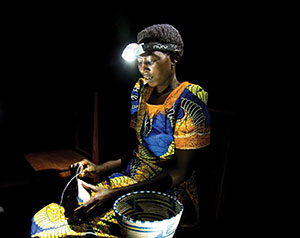
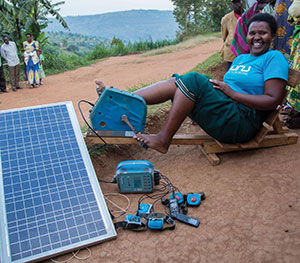
Figure 1: (a) Nuru’s rechargeable LED lamp; (b) The stationary bike used to recharge the lamps. Source: Nuru.
Using kerosene or flashlights costs more than using Nuru’s lamps. For instance, 100 mL of kerosene costs 100 RWF and produces close to six hours of light, whereas a Nuru lamp lasts for 18 hours for the same price. Thus, kerosene costs three times more, and in some remote villages, it can even cost 6-8 times more.
The Business Challenge
Our research collaboration with Nuru stemmed from the following business challenge. As previously mentioned, using Nuru lamps is cheaper than using alternative solutions. The field surveys and experiments we conducted showed that interest in adopting the lamps was reasonably high and the consumers were satisfied with the quality. However, the usage rate has been lower than expected. When we started the project, recharge rates were on average 1.2-1.6 times per month per household, which was not enough to sustain the business. Thus, the first objective was to understand what was contributing to the low adoption. It could be that the recharge price was too high for the consumers. Moreover, the act of recharging the lamps could have been inconvenient because, unlike grid- and solar-based solutions, consumers need to travel to a dedicated recharge center in this business model to recharge their lamps. Some of our field partners believed that inconvenience does not matter much to these poor communities when compared with money, which motivated us to explicitly test this hypothesis.
Simply measuring the impacts of recharge price and inconvenience, however, was not the endgame. If these factors indeed significantly contributed to the low usage of lamps, then the following is a natural question to ask: what changes can be made to the current business model to improve the recharge rates, and how would those changes perform? In other words, the second objective was to predict the efficacy of alternative business models. Next, we briefly discuss our approach to the measurement and prediction problems at hand.
Field Experiments
The authors conducted field experiments to measure – as precisely as possible – the impacts of recharge price and inconvenience on recharge rates. The experiments were conducted in the 29 villages of the Ruhango District of Rwanda. There were 2,500 lamps and 80-90 households per village; therefore, each household received one lamp. We randomly assigned consumers to different price levels ranging from 0 RWF to 120 RWF. The locations of the recharge centers were also (almost) randomly chosen, so the distances that the consumers had to travel were randomly allotted.
It was quite challenging to conduct these experiments in the remotely located villages of Rwanda, but what was even more difficult was to get the data from the experiments in a robust manner. Therefore, we enabled all the recharging devices with GSM technology (Global System for Mobile Communication). Whenever a device was attached to a lamp, it recorded the ID of the lamp and timestamp of the recharge, transferring the information to the GSM network, where we could automatically download it to our cloud database. We recorded the recharge rates of experimental households for three months, from December 2016 to March 2017.
Figure 2 illustrates two of our key findings from the experiments. We see that the recharges drop sharply as the price and distance from the recharge center increase. In Figure 2a, even when the price is zero, the average number of recharges per household is six, over a span of three months – on average, two recharges per month, which is not enough to sustain the business model. This finding also suggested that there are frictions beyond price that are hindering the adoption. In Figure 2b, we see that inconvenience is another major friction in the business model. On average, one-half kilometer increase in distance from the recharge center resulted in a drop of one recharge per household, which is quite significant.
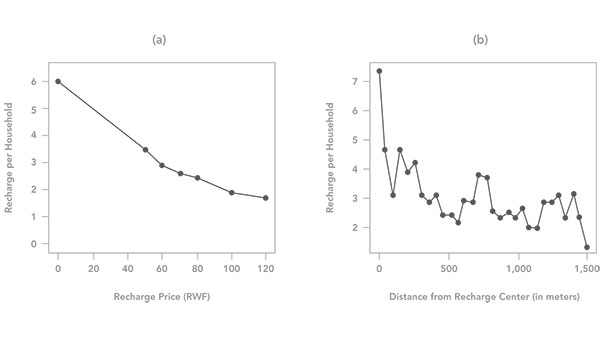
Overall, our analysis demonstrates that the recharge price, consumers’ liquidity constraints and inconvenience seem to be significant drivers of inefficiencies in the business model. So, how can we improve it?
How to Create a New Business Model
There are several changes that we can make to improve the current business model. For example, we could simply drop the price, or give more hours of light per recharge. We could address inconvenience by placing more recharge centers in a village or encouraging consumers to pool their lamps for recharge while taking turns. Furthermore, instead of making consumers walk to the recharge center, we could have the VLE periodically travel to them, going either door-to-door or to a specific set of locations. Alternatively, we could alleviate consumers’ liquidity constraints by offering payment flexibility – allowing consumers to partially recharge their lamps, prepay for the recharge, recharge on credit, or repay in micro-amounts.
However, it is unclear which of these alternative business models deserve most attention and hence should be tested. One way to evaluate candidate strategies is by directly implementing them in the field to see how they perform. However, this approach may not always be feasible, especially in a context such as this, wherein the budget constraints are tight and the strategies must be implemented in remote villages, requiring nontrivial investments in both time and money. Therefore, we need to be able to assess the effectiveness of a business model before it is implemented in the field – a challenging prediction problem.
The framework that we adopted to tackle this prediction problem is presented in Figure 3. First, we build a model of consumer behavior under the status quo business environment. One can imagine that for the predictions to be reliable, we need the model to closely imbibe the features of consumers’ decision-making processes and environment. We account for several important contextual details on consumers’ disposable incomes, their sensitivity to experiencing inconvenience and blackouts, light consumption patterns, and their dynamic decisions regarding whether to recharge their lamps. We estimate this model using the data from our field experiments. We designed our field studies in such a way that all the model parameters can be estimated using the randomized variations in the data. We make use of several methodologies, from stochastic dynamic programs and renewal theories to statistics, structural econometrics and machine learning. (The details of our model and the estimation process can be found in [5].)
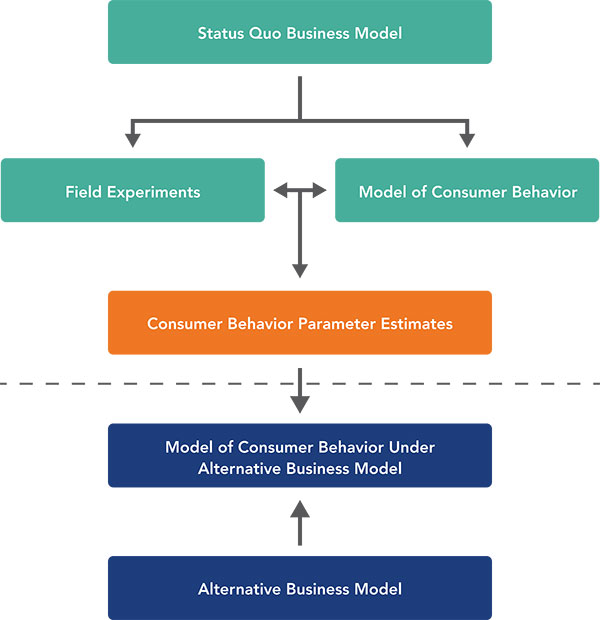
Once we have the model and its parameter estimates, we can use the framework to ask several what-if questions. As previously mentioned, our model captures the primitives of consumer behavior, so it is quite flexible and can be contorted in different ways to represent the consumer behavior under alternative business environments. If we want to learn how the recharge rates and revenues will look in an alternative business environment, we use the behavioral model under that business environment and the behavioral parameters previously estimated to simulate the new environment and compute the necessary metrics. Thus, one can think of this framework as a business model query engine: we can ask this engine how a change in the business model will perform, and it will give us an estimate. We ran this engine for a plethora of alternative strategies. Table 1 shows a sample of results.
Performance of Business Model Changes
First, let us focus on the two benchmarks in Table 1, wherein we completely eliminate either inconvenience or liquidity constraints from the business model. These benchmarks display a tremendous improvement in recharge revenue relative to status quo, which reaffirms that these two factors are major contributors to the inefficiency of the current business model. However, achieving these benchmarks will require implementation efforts toward a completely on-demand door-to-door recharge service and designing fully flexible payment schemes, which may not be practical; therefore, we can think of these as long-term strategies.
Instead, we can implement several short-term strategies. As can be seen in Table 1, some of these short-term strategies are quite powerful. For example, by having the VLEs travel door-to-door once a week or travel to just five locations in a village twice a week, we capture half the benefits from completely removing inconvenience. Similarly, by allowing consumers to recharge on credit, we capture more than half the benefits from totally alleviating liquidity constraints.
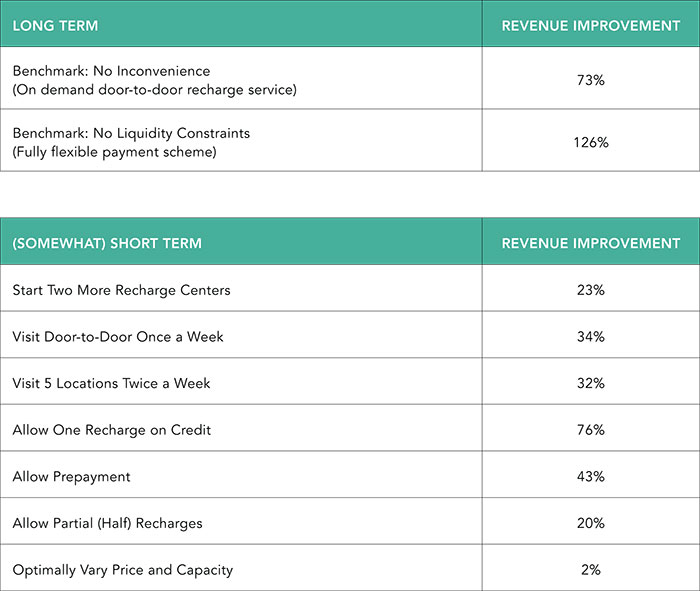
A natural response to low adoption when dealing with poor consumers is usually to drop the price. However, we see that revenue improvements are miniscule from lowering the prices, and we are better off relaxing the inconvenience and liquidity constraints by making simple changes to the business operations. Also, notice that allowing partial recharges is not quite effective when compared with other strategies; it is better to prioritize other strategies over this one. Therefore, using estimates like these, we can design short- and medium-term plans by optimally prioritizing and combining different strategies to first break even and then to make profits.
Key Takeaways
Table 1 shows that simple changes to the business operations, as opposed to just dropping the price, can achieve significant improvements in the performance of the business model. The framework in Figure 3 allowed us to predict the performance of candidate strategies before implementation. Similar approaches can be adopted in other contexts to create effective business models for the bottom of the pyramid consumers. What we need for that purpose is not necessarily big data. We can survive with small data too, as in our case, but we need smart models. Finally, we question the notion that inconvenience does not matter to the poor consumers. Our study conclusively shows that time is money even under poverty.
References and Notes
- IEA, 2020, “World Energy Outlook,” https://www.iea.org/reports/world-energy-outlook-2020.
- USAID, 2018, “Power Africa Rwanda Fact Sheet.”
- RWF = Rwandan franc
- Carrick, A.M. and F. Santos, 2013, “Nuru Energy (A): Financing a Social Enterprise,” Case study, INSEAD, France.
- Uppari, B.S., S. Netessine, I. Popescu and R.P. Clarke, 2022, “Design of Off-Grid Lighting Business Models to Serve the Poor: Field Experiments and Structural Analysis,” Working paper, Singapore Management University.
Bhavani Shanker Uppari is assistant professor of operations management at Singapore Management University. He is interested in analyzing business models at the bottom of the pyramid and in behavioral decision theories. Ioana Popescu is a professor of decision sciences at INSEAD where she investigates how people make choices and how organizations can respond. Serguei Netessine is senior vice dean and Dhirubhai Ambani Professor of Innovation and Entrepreneurship at The Wharton School of the University of Pennsylvania. He is broadly interested in business model innovation. Rowan Clarke is a Ph.D. candidate at Harvard Business School, where he conducts research with tech firms and startups that focus on poverty, financial inclusion and renewable energy.