
April 12, 2022 in International O.R.
Optimizing Port Operations to Cope with Shipping Congestion in South American Countries
SHARE: PRINT ARTICLE: https://doi.org/10.1287/orms.2022.02.09

Ports connect international supply chains and are essential to the global economic and trade system. It is estimated that ports are responsible for facilitating around 90% of the world trade [1]. Container terminals must reach high operational efficiency and service levels to yield productivity results while simultaneously facing many difficulties. The ongoing issues in global supply chain disruptions have raised many concerns about port productivity, among which port congestion is currently the biggest issue. These congestions, in turn, further stress supply chains all over the world, posing a ripple effect on many industries. In addition, a faster-than-expected recovery in demand for goods is causing supply chain disruptions such as container shortages and severe delays at some of the world’s busiest ports. Some ports around the world have stopped accepting import/export orders to ease congestion [2], at times when the most sophisticated tools for operational efficiency reach their top performance. Some shipping lines halted booking services to Latin American ports owing to backlogs in the U.S. West Coast ports [3] and a huge imbalance in container availability from Asia [4].
The Role of Digital Technologies
With the increasing introduction of digital and emerging technologies to ports [5], and more connectivity with stakeholders, managing operations at ports now benefits from faster flow of data between sensors, devices, equipment and software applications to enable the smart infrastructure driving ports to becoming state-of-the-art facilities of the future. Digital technologies and increasing data exchange among all stakeholders yield higher gains in efficiency and predictability in ports.
A first approach is to elevate the capabilities of port information systems to include smarter decision-making processes. Information systems with built-in large-scale analytics and optimization engines are now capable of putting together tightly coupled tactical and operational optimization models. With a focus on operational efficiency, the authors addressed the problem of jointly solving integrated, interconnected tactical/operational planning models for a Latin American port. The solution was built using the HAi optimization smart information system (as shown in Figure 1), an evolution of a previous decision support systems from DecisionWare Ltd.
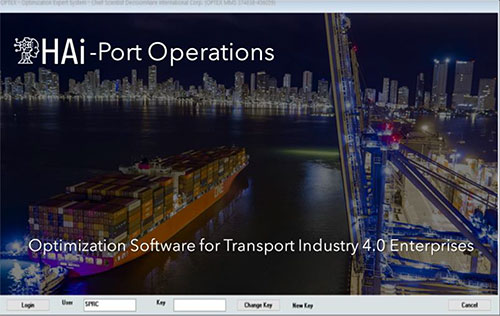
HAi – Port Operations is a task-oriented, autonomous, real-time distributed optimization framework built within OPTEX, an optimization expert system and a robust protocol of integrated algorithms that secure discernibility and informed decisions in real time for optimal efficiency throughout an entire system and/or process. HAi mathematical architecture provides a universal and language-agnostic application programming interface (API) comprising algorithms that run at scale within any environment, a state-of-the-art mathematical AI that infers and learns simultaneously.
Joint Tactical and Operational Optimization Models
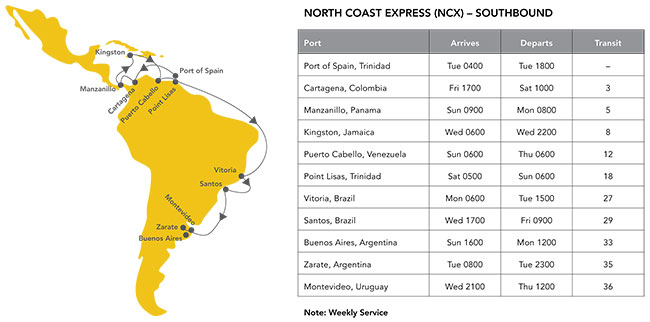
First, let us define a “service” as the many routes or itineraries offered by a shipping line company, which could be served by one or more vessels. Services are the basis for tactical planning models. For each service, we need relevant data for building tactical planning models, namely, (1) the name or label for the service; (2) the type of planned arrival, which could be regular or irregular (regular arrival services have priority over irregulars); (3) deviation; (4) date of first arrival; (5) movements and (6) the minimum required productivity. Figure 2 shows an example of a service line for ports in South America.
With the main goal of improving container port operational efficiency, we first study the subproblems that arise in port planning. The most relevant pain points to analyze for the improvement of operational efficiency include the following:
- The time a vessel is at the berth needs to be minimized.
- Land scarcity does not allow container terminals to meet the rapid-growth freight traffic.
- The overall congestion increases operation variability and reduces throughput.
- Operations on the different subsystems need to be effectively coordinated.
- The logistics of container terminals has reached a high degree of complexity.
The overall solution requires gathering and consolidating execution information from the different subsystems, leveraging optimization capabilities to tackle the complexity of the different interconnected subsystems and ultimately helping planners drive operational excellence and analyze terminal performances.
First, we aim to address the midterm implications of planning the assignment of terminal to services for shipping lines. There is a set of services with established itineraries and arrival patterns. Each service has a fleet of vessels with established characteristics. There is a group of terminals with docks and cranes of known specifications. The aim is therefore to assign ships to docks at each terminal to minimize the waiting time for services in the year. A service must be assigned to a specified terminal, but the vessels of a service can be assigned to different docks within the same terminal. The maximum and average wait time per service must be identified, as well as which time slots in the week have the most conflicts.
We then implement the berth and quays allocation problem given that we now have an assignment of services to terminals with a set (number) of movements per year per service, as well as a matrix of connectivity between services that indicates how many containers move between services. The aim is to assign the services to the terminals to minimize the number of transfers between terminals while maintaining an average wait time of a maximum of a certain percentage over the service time, previously set by the port. There are agreements between the shipping lines so that a certain number of containers that are in transit are left by one shipping line in the port to be later picked up by another shipping line. If transfer of containers occurs between terminals, the costs are entirely assumed by the port.
All models are tightly intertwined and run (and learned) in parallel. The interconnectivity among all models is shown in Figure 3. The information is first retrieved from the port’s enterprise resource planning (ERP) system and then fed into the different decision support models within HAi Port Operations.
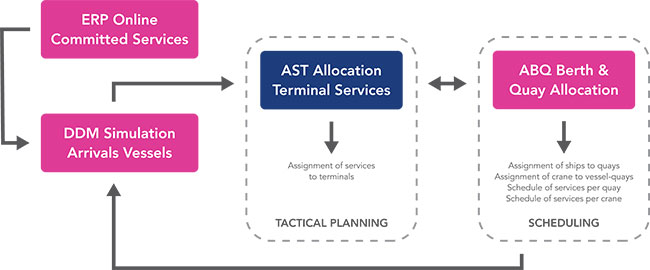
The Allocation of Services and Terminals (AST) support model assigns the terminals for all committed services for the shipping lines and builds a simulated allocation of what could occur in the coming months for all terminals. The model is a tactical planning model and is used with a frequency of the order of months according to the forecasted demand for services for the months within the next semester/year. It is a continuous-time model that solves a mixed-integer programming model.
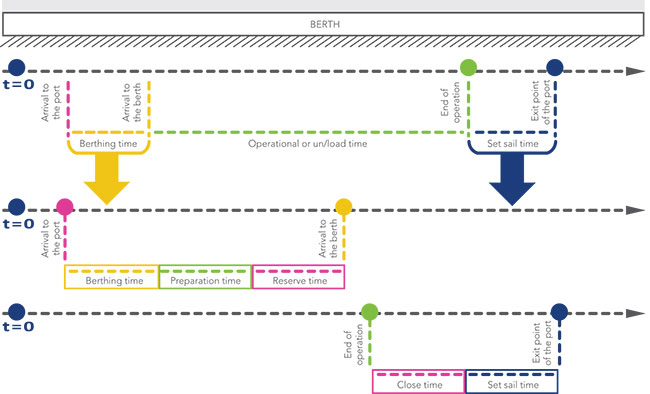
The Allocation of Berths and Quay Cranes (ABQ) support model runs a berth allocation scheduling decision support model, aiming to assign vessels belonging to shipping services to a dock that belongs to a terminal, and a set of cranes that will attend the service, all by tightly considering the operational constraints for the vessels and each terminal, its docks and its cranes. A detailed schedule is composed, by hours, of the assignment of vessels to docks, which implies defining the assigned dock, time of entry, waiting, operation and exit for each vessel. A detailed schedule of container transfers between terminals, considering the schedule for prior operations, is also created. This model runs daily or every time an event occurs (which warrants the rescheduling of the ongoing schedule). It is based on continuous-time modeling and solves a mixed-integer linear programming model.
Managing Port Congestion Issues
The port congestion problem is not exclusive to North America. In fact, Latin American cargo is disrupted mainly because of what is happening with the ports in China and the United States [3]. Port performance should be traced and monitored so that alarms could be triggered. Efficiency for Latin American ports has been well documented until 2018 [6], but nothing has been reported after the pandemic events that changed trade behavior patterns in 2020 and 2021. COVID-19 changed the nature of congestions by far, but nonetheless, they existed well before the pandemic began.
Port congestions are mainly due to potential port operational issues. At the import/export terminals, for instance, limited availability of yard cranes leads to congestion and delays on the loading process. High volumes of empty container discharge may also lead to congestion. At the transshipment terminals, yard space and availability of quay cranes cause bottlenecks. Limited space availability leads to reshuffling, congestion and delays on the loading process. In both cases, a better coordination between the quay and yard side is critical to smooth the load on the bottleneck. The bottleneck is shared across several vessels; therefore, a multivessel view is necessary to better solve the problem. Also, load/discharge operations across different vessels and quay cranes can generate a “traffic jam.” This could be because containers come from the same area in the yard that need to be moved to the quay side for loading on the vessel at the same time, typically known as yard clash. Minimizing yard clash is a key concern for operational optimization of port facilities.
To some extent, predictive models could be used to study the terminal selection on liner routes. Approaches that go beyond the scope of port choice to interact with in-land paths can be found in [7]. Predictive models, in turn, could feed the DDM simulation decision support system to further enhance the prescriptive capabilities of the HAi information system.
Prescriptive analytics models along with the mathematical models within the HAi Port Optimization information system resulted in optimizing the port operations in this study for three main purposes: (1) planning terminal-services assignments, (2) planning events in the port and (3) analyzing new commercial opportunities. We first validated and tested the set of models with a benchmark problem, using existing commercial solvers. Table 1 shows the validation results.
Table 1: Validation results for the interconnected models using commercial solver engines.
|
|
|
CPLEX |
GUROBI |
XPRESS |
CBC |
|
Assignment model |
Time |
35 |
29 |
28 |
762 |
|
Iterations |
8,739 |
36,825 |
– |
159,143 |
|
|
Nodes |
6 |
700 |
62 |
1,012 |
|
|
Objective function |
210,888 |
210,888 |
210,888 |
210,888 |
|
|
Best bound known |
210,888 |
210,888 |
210,888 |
210,888 |
|
|
Gap |
0 |
0 |
0 |
0 |
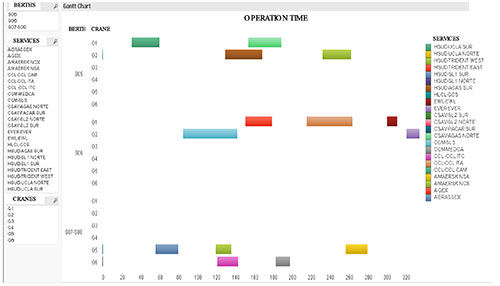
We then run the system to account for real port operations planning and were able to find feasible bounded solutions with two of these commercial solvers as well as optimized solutions for the three types of outcomes that we aimed for. Figure 5 shows a typical output layout for the planning of terminal and services assignments. We can now dynamically find optimized plans on a routine basis, as well as for the planning of big events or the evaluation of commercial opportunities.
Moving forward, we can integrate our solutions with any interconnected, real-time smart port framework and deliver optimized solutions that not only consider operations productivity but also take care of the sustainability 3P approach (people, planet, profit). Our AI-based solutions could, for instance, efficiently predict critical factors, such as port emissions inventories, and use them to constrain the optimization problem with more automated information from the vessels, trucks and port equipment and plan the transition to a net-zero approach for port operations planning.
References
- Rick Gould, 2020, “Shaping Shipping,” International Organization for Standardization, Nov. 17, https://www.iso.org/news/ref2588.html.
- Fiber2Fashion News Desk, 2021, “Congestion at China’s Yantian Port to have Ripple Effect Across World,” June 21, https://www.fibre2fashion.com/news/textile-news/congestion-at-china-s-yantian-port-to-have-ripple-effect-across-world-274666-newsdetails.htm.
- Maria Eloisa Capurro, 2021, “Latin American Cargo Hits Snags Amid U.S. Port Backlog,” Bloomberg News, May 3, https://www.bloomberg.com/news/newsletters/2021-05-03/supply-chains-latest-latin-american-cargo-hits-u-s-port-snarls.
- Juan Carlos, 2021, “Effects of Shipping Congestion on Latin America,” Tridge, July 22, https://www.tridge.com/stories/effects-of-shipping-congestion-on-latin-american.
- Adriana Moros-Daza, René Amaya-Mier and Carlos Paternina-Arboleda, 2020, “Port Community Systems: A Structured Literature Review,” Transportation Research: Part A, Vol. 133, pp. 27-46.
- Kahuina Miller and Tetsuro Hyodo, 2022, “Assessment of Port Efficiency within Latin America,” Journal of Shipping and Trade, Vol. 7, No. 4, https://doi.org/10.1186/s41072-021-00102-5.
- Nicolas Gomez-Jacome, Guisselle Garcia-Llinas, Carlos D. Paternina-Arboleda and Miguel Jaller-Martelo, 2019, “Caribbean Ports, Inland Logistics, and the Panama Canal Expansion: A Mode and Port Choice Analysis,” Computational Logistics, Springer, https://doi.org/10.1007/978-3-030-31140-7_10.
Jesus M. Velasquez is a mathematical programming entrepreneur and researcher and chief scientific officer at Hypothalamus AI. He received his Ph.D. in systems engineering from Universidad Nacional de Colombia, Medellin. Danilo Abril is a senior consultant at Hypothalamus AI. He received a master’s in industrial engineering from Universidad de los Andes, Colombia. Carlos D. Paternina-Arboleda is an assistant professor in the Fowler College of Business at San Diego State University and a supply chain information systems entrepreneur. He received his Ph.D. in industrial engineering from the University of South Florida in 2000.