


June 6, 2022 in Analytics in Chile
The Story of Chile and Analytics
What bringing home the 2022 Franz Edelman Award meant after two years of unpredictable and turbulent times amid COVID-19 in Chile
SHARE: PRINT ARTICLE: https://doi.org/10.1287/orms.2022.03.04

For anyone in attendance at the Edelman Gala during the 2022 INFORMS Business Analytics Conference in Houston in April, the announcement of the 2022 Edelman Award winner was an emotional one. The Chile team members yelled with joy (startling 2022 INFORMS President Radhika Kulkarni in the most memorable way), cheered with adulation or were mute with an unbelievable weight falling off their shoulders. Having been in the room, I can attest to feeling each of these emotions along with them – I even teared up a bit. The team’s excitement and humble gratitude was intensely palpable – you could tell winning the Edelman Award meant so much more than anyone could realize. Something else you might not realize is that this was actually the second time Chile won the Edelman Award; the first time was in 1998 when Bosques Arauco, led by Andres Weintraub, Rafael Epstein, Ramiro Morales and Jorge Seron, won for their project, “Use of O.R. Systems in the Chilean Forest Industries” [1]. And so begins the story of Chile, analytics and the Edelman Award.
The First Win
Since 1988, to compete in the world market, the main Chilean forest firms started implementing operations research (O.R.) models developed jointly with academics from Universidad de Chile. These models supported decisions on daily truck scheduling, short-term harvesting, location of harvesting machinery and access roads, and medium- and long-term forest planning. The Edelman-winning team used simulation, linear programming (LP) with column generation, mixed-integer LP formulations and heuristic method approaches to solve these complex problems. As of the 1998 win, the systems led to a change in organizational decision-making and estimated gains of at least USD $20 million per year.
These systems had a huge impact in Chile and were exported to other countries such as Brazil and South Africa. According to Andres Weintraub, winning the 1998 Edelman Award was a very important event at a time when communications were mainly by mail and Chile had just started being involved with the international research world. The award-winning work has evolved since then, incorporating new technologies and still being used as vital tools in current planning in leading firms including Arauco and CMPC. The visibility of winning the Edelman Award opened doors that led to working with different industries, including mining, salmon farming, shipping, sports scheduling and large-scale public auctions. The work with the shipping industry was a finalist in the 2011 Edelman Competition, and sports scheduling in 2016.
“Most importantly,” Weintraub says, “students and young researchers could see how O.R. and analytics can have a significant impact on firms and society, and that from Chile we could do frontier work. We were enthusiastic and proud to see that the new generation of researchers in our group won the 2022 Edelman Award, with superb work supporting essential decisions to fight COVID-19 in Chile.”
At the time of his team’s win, Weintraub was a professor in the Department of Industrial Engineering at the Universidad de Chile. Leonardo Basso, who led the 26-person 2022 Edelman-winning team, is currently a professor at Universidad de Chile in the Civil Engineering Department and director of the Instituto Sistemas Complejos de Ingeniería (ISCI), a position he took over from Weintraub. Rafael Epstein was the M.Sc. thesis advisor to Marcelo Olivares, Denis Sauré and Marcel Goic of the 2022 winning team. Gabriel Weintraub was also part of the new team, son of Andres (on another note, the first time a father and son won a pair of Edelman Awards).
There is clearly a legacy connecting the Edelman Award and Chile, and it simply shows their passion for and belief in applying analytics to make the world – and in this case, their home – a better, safer place. There is also a proven connection now between the two Edelman Award wins and the use of industry-academia collaboration to make an impact.
March 2020
When the COVID-19 crisis became pandemic status in March 2020, Basso and his team at ISCI realized right away that they could and therefore needed to help, and they needed to use analytics to do it. As the analytics team began to work, they realized it was imperative to convince the public sector that they had useful analytics tools that could help. They tried to gather people from the government, frontline healthcare workers and medical professionals to ask, “How can we help?” After several weeks of reaching out, Basso finally sent a last-ditch 3 a.m. WhatsApp message to an undersecretary, who responded that he and his team could have 15 minutes the following day to state their case. Basso and team put together a three-slide presentation, spoke for 15 minutes, and was given another 15 minutes the following day. After that, the Chilean Ministries of Health and Sciences decided to give it a go with ISCI and the Universidad de Chile, and thus, a groundbreaking collaboration was born. The interdisciplinary team also partnered with telecom company Entel to solve the myriad problems arising from COVID-19, including infection spread and death, hospital bed allocation and more.
More specifically, the Chile team worked on improving the pandemic response in their home country by providing guidance on contagion prevention, vaccination, central management of ICU beds, mobility, testing and active screening, and serology surveillance. Operations research and analytics played a crucial role, but what proved to be even more crucial was the public-private partnership. Part of what made this Edelman team stand out was proving the possibility of an interdisciplinary and institutional collaboration focusing on national needs in a timely and positive manner.
When asked about why the Chile team stood out among the six Edelman finalists, Manoj Chari, assistant professor of business analytics at Elon University and 2022 Edelman Competition judge, said:
The Edelman Award is very much about innovation, successful implementation and impact. What was significantly different about Chile was that it was a monumental implementation effort. Each subproject within the larger project had a different analytical problem that needed to be solved with rapid innovation, had a unique set of implementation details and required cooperation of different combinations of stakeholders from the central and local governments, the private sector, civil society and finally the general population. The public health benefits of the project would not have been realized without the team’s success in convincing such a diverse population of the goals of these projects, and keeping them engaged and on task throughout the implementation, especially given the urgency and environment of fear and uncertainty caused by the pandemic. This required open communication of the goals and ongoing dissemination of concrete, accessible information that tracked the progress on these goals. Doing all this on a nationwide scale, even for a medium-sized country, was a remarkable effort.
Even more surprising, he said, is “the fact that evidence-based approaches formulated by a team of scientists and engineers were able to influence and guide the policies of a government of a center-right political persuasion, and that they were able to work collaboratively for the larger good of the nation and society.”
In a similar sentiment, Andrés Couve, former Chilean Minister of Science, Technology, Innovations and Knowledge, said that winning the Edelman Award “shows the importance of investing in science, innovation and technology, and that a small and far away country can produce world-class, world-changing science.”
Paula Daza, former undersecretary of public health, also said, “The whole country had one objective: contain the pandemic. Everyone was working toward one goal, and that was the main point.” She went on to note, “These [analytics] innovations have been used in key decision aspects that helped with the three pillars of the Chilean strategy against the virus: contagion prevention (mobility and testing), centralized management of critical ICU beds and vaccination.”
The Chilean Strategy
To get even a small glimpse of what it was like conducting this lifesaving work against COVID-19 during the pandemic, Basso offered an image of team members working with babies in their laps, running prediction models for ICU planning at 2 a.m. and taking the results to the Minister of Science at 3 a.m. so that they would be ready for review by the President and the Ministry of Health by 7 a.m. “It was crazy,” Basso said, “it was really a lot of work and it was very hard on our families.”
According to Basso, it was a huge commitment from the entire team. There were 20-some students working up to 16-hour days, some who put their studies aside to help. He couldn’t even count how many hours his team worked each day. The people at the ministries were working on the project in addition to their regular day-to-day job tasks. “And we did this without knowing each other,” confirmed Basso.
Here’s what they worked on.
ICU Allocation. Throughout the COVID-19 pandemic, hospitals became one centralized system – at the most critical times – and a detailed forecast of beds needed in each region of the country was a necessity for ICU capacity planning, which quickly became the first order of concern for the analytics team. To prepare forecasts, Goic explained, the team studied inbound and outbound flows of patients: symptomatic cases, the number in need of beds and the number discharged. The first compartment model proved to be useful yet insufficient: The system for generating data was under constant stress and in need of continuous learning due to the novelty of COVID-19, and medical teams were also still learning to deal with critical cases. To accommodate these changes, the team ran autoregressive and machine learning models in addition to the compartment model and assembled them to implement the forecasting system that resulted in bed capacity in even the most congested regions of Chile. Forecasts were run every two days for the entire duration of the hospital crisis, resulting in approximately 850 fewer deaths.
Mobility. When school closures were mandated and localized lockdowns began in late March 2020, COVID-19 cases were quickly growing in lower-income areas, and the lockdowns were too late to contain outbreaks. Marcelo Oliveres, researcher at ISCI, said the team needed to quickly evaluate the effectiveness of lockdowns and use mobility data to anticipate outbreaks. ISCI started with mobility data from Google, which turned out not to be an adequate strategy because the data was not granular enough and there were no details of transmission between areas; data on outbreaks in one area was not enough. At this point, Entel allied with ISCI to study and understand mobility during a pandemic. The results allowed the team to transform data from mobile phones into a territorial dashboard and provided the foundation to build additional initiatives with the Ministries of Health and Science.
The team mapped movements to construct an origin matrix and implemented data aggregation to provide transparency to individuals on a publicly available platform, which became a useful tool. Paola Pontoni, Health Emergencies Director of Ministry of Health, explained that this information was valuable to plan for lockdowns and assess their effectiveness. The platform also contributed to other public policies developed in Chile during the pandemic, all data was made publicly available, and reports gathered impressive amounts of attention from the press, including more than 25 interviews on national television.
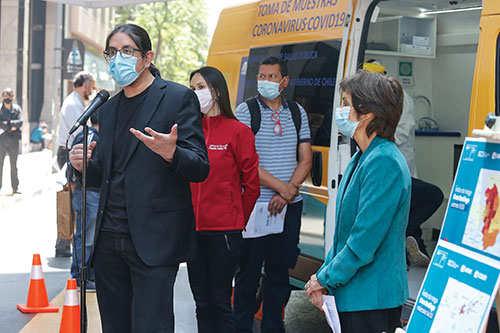
Testing. Analytics was used to increase testing capacity in Chile – in particular, through group/pool testing. Denis Sauré from ISCI explained how the team took this from theory to practice and piloted COVID-19 testing at a long-term care facilities, ultimately diagnosing people at a lower cost. Group testing accounted for 20% of the total testing in Chile, a 50% increase in testing capacity and $90 million in savings. At the time, Chile was playing defense against COVID-19 cases, and it was time to switch to offense by searching for cases – especially asymptomatic cases. The team began placing PCR testing stations in public spaces. The system was built around an active screen index called the BAC index – which stands for Active Case Search in Spanish – weighting estimated positivity calculated from case density of the area from which the positive patient came as well as mobility data. The index studied how the disease moved in territories; it was not enough to simply know where positive cases were or came from – the movement had to be studied. This data was provided to teams on the ground in the form of heat maps to help them better choose the locations to conduct testing in the public space. The information was also integrated into the Ministry of Health surveillance platform. The BAC index became a key component in active case screening, and the heat maps helped pinpoint and prioritize areas in need of testing, identify case clusters and possible outbreaks, and finally project future cases.
Serology Surveillance. In all areas, the COVID-19 vaccine rollout was essential to contain the pandemic, but vaccine supply in Chile was uncertain. The country did not have much access to mRNA vaccines and thus, decided to combine the use of vaccines with different technologies to speed up the process. This led to substantial use of the Sinovac (CoronaVac) vaccine, which was used to inoculate 75% of the Chilean population. Because this vaccination strategy was novel, the team could not use international vaccine data to study its effectiveness. Miguel O’Ryan and Juan Pablo Torres (Faculty of Medicine, Universidad de Chile) and a team of engineers from ISCI had to monitor Sinovac. Testing stations were selected using integer programming and mobility data to provide population representation. Results were pivotal to show that the strategy worked: A potent immune response was achieved, but it also showed early evidence to determine a third dose was needed for Sinovac. The national strategy led to 29,000 fewer infections and 1,000 fewer deaths – another incredible outcome of the unlikely collaboration.
What’s next in Chile?
As noted, the success of the project was mainly due to the national public-private partnership of a team that created reliable systems in record time to break a raging pandemic. These systems can now be used for other diseases or future pandemics and be relevant to a diverse set of research applications. In fact, the project led to at least five publications in outlets such as INFORMS’ Management Science and The Lancet Infectious Diseases.
The team used cutting-edge science in the fields of O.R. and analytics. Gabriel Weintraub, professor of operations, information and technology, is now using this top-notch research with real-world application in a course at Stanford University.
According to Daza, all of these efforts can be used in subsequent stages of the COVID-19 pandemic and the evidence-based decision-making can be used in future public policy or health emergencies.
Chile can be an example to the world of how science can be leveraged to inform and help mold public policy. The relationship between government and academia brought O.R. to the forefront. Even the president of Chile, Gabriel Boric, noted the importance of this team’s collaboration, remarking, “This government will be at the service of science!”
Current Minister of Health, Begoña Yarza, said, “We are very proud that this work in Chile has received this prestigious award. Our administration is just starting, and we are enthusiastic to continue collaborating and using analytics to support decision-making in other public health challenges.” Finally, Antonio Moreno, managing director of Entel Ocean, emphasized “how fruitful the joint work of academia, government and a private sector willing to innovate was, and may be in the future.”
Although he knew that the work he and his team were doing was important in the moment, the impact became clear much later to Basso. “It was only when we applied for the Edelman Award that we were pushed to calculate the impact of our work. We didn’t see it before. Not only because of money [saved] … it’s 3,000 lives, it’s impressive. It really hit us at that time, when we saw these numbers.”
All in all, the team, its project and use of analytics made a sizeable impact on many aspects, saving $207 million and nearly 3,000 lives. It’s a good time to be Chilean (except for La Roja fans). Don’t worry, there’s an Edelman trophy to hoist.
Reference
- Rafael Epstein, Ramiro Morales, Jorge Seron and Andres Weintraub, 1999, “Use of O.R. Systems in the Chilean Forest Industries,” Interfaces, Vol. 29, No. 1, pp. 7-29, https://doi.org/10.1287/inte.29.1.7.
2022 Edelman Award Finalists
As a first-time Edelman finalist, Leonardo Basso couldn’t help but be extremely impressed with the other five competitors. “The projects were massive,” he said, “When you think about it, it is the [culmination of] the work of a lot of very intelligent people over five or seven years. It’s very impressive.”
The additional finalists included:
- Alibaba for “Integrated Forecast, Inventory, Price Optimization and Recommendation Has Reduced Millions in Inventory and Shrinkage Cost and Sustained Revenue Increase for Alibaba Retail Businesses”
- General Motors for “Vehicle Content Optimization at General Motors”
- Janssen Pharmaceutical Companies of Johnson & Johnson (Janssen) for “Data-driven COVID-19 Vaccine Development for Janssen”
- Merck Animal Health for “Operations Research Improves Biomanufacturing Efficiency at MSD Animal Health”
- U.S. Census Bureau for “Optimization and Routing for the 2020 Decennial Census”
