August 3, 2022 in Innovative Education
The Longitudinal Education Programs of AI4OPT
SHARE: PRINT ARTICLE: https://doi.org/10.1287/orms.2022.04.12

The National Science Foundation (NSF) Artificial Intelligence (AI) Research Institutes program is designed to enable long-term research and foster U.S. leadership in AI through the creation of Research Institutes, each of which becomes a nexus for collaborative efforts. These institutes undertake foundational research in AI that has the potential for broad and lasting impact. The research program of the Institutes is also use-inspired, addressing some of the fundamental societal and technological challenges facing the nation. Equally important, the NSF AI Institutes are intended to train the next generation of talent and create a strong and diverse workforce that will meet future challenges and provide leadership in AI.
The NSF AI Institute for Advances in Optimization (AI4OPT) is one of the first 18 AI Research Institutes. Its mission statement is “to revolutionize decision making at massive scales by fusing AI and mathematical optimization into intelligent systems that will achieve breakthroughs that the two fields cannot achieve independently.” AI4OPT’s foundational research lies at the intersection of AI and operations research (O.R.) and is inspired by grand challenges in energy systems, supply chains, circuit design and control, and resilience and sustainability. It is a multidisciplinary institute that brings together researchers in AI, machine learning, optimization and computational statistics, with domain experts in the end-use cases that drive the foundational research.
AI4OPT features an innovative educational program with the goal to “democratize access to AI education, research and jobs, bridging the gap in opportunities that exists in many communities.” AI4OPT is building pathways in “AI in Engineering” for African American and Hispanic communities, starting with high school education and continuing with community colleges and universities. These pathways for AI in engineering leverage existing partnerships with historically Black high schools, new collaborations with historically Black colleges and universities (HBCUs) and minority-serving institutions (MSIs) around the U.S., and engagements with nonprofit organizations that aim to broaden participation in AI and O.R.
The AI4OPT educational initiative is organized around six fundamental principles:
- Get students interested early
- Keep the students interested
- Teach the teachers
- Help the teachers create their own programs
- Organize mentorship programs
- Broaden participation
Together, the principles are shaping a sustainable, bottom-up and longitudinal educational model that empowers a generation of underrepresented students and teachers to join the AI revolution.
The High School Initiative
High school education is probably the most critical and challenging component of the proposed educational pathways. The difficulties faced by high school educators, especially for underrepresented groups, are perfectly crystallized by Sky Adams, the first female director of the award-winning Computer Science Academy at Santa Barbara High School, when she wrote:
“There are two challenges facing educators who want to see students from historically underrepresented groups find CS [computer science] careers: getting them interested in the field and then getting them to stay interested.” [1]
The AI4OPT high school initiative addresses these two challenges and leverages the significant expertise built when developing the in-person and online Seth Bonder Summer Camp (SBC) in Computational and Data Science for Engineering [2]. Since 2018, the camp has been recruiting students who do not have exposure to computer or data science in their middle and high schools. This resulted in a truly diverse set of participants, heavily weighted toward minority students and young women. The high school initiatives represent a step change in the impact of the SBC, moving from training hundreds of students to the (longitudinal) education of thousands, possibly tens of thousands, of high school students through multiple long-term partnerships and flipped classes. The high school initiative consists of three longitudinal SBC camps:
- Level 1: Introduction to Computing in Snap! (the Snap! camp).
- Level 2: Introduction to Data Science in Python (the Python camp).
- Level 3: Introduction to Deep Learning in Keras (the Keras camp).
The Snap! camp is an introduction to essential control and data structures (including recursion) using Karel the robot and its grid environment. The Python camp introduces computational and data science concepts through applications in computational social science (sentiment analysis), machine learning (medical diagnosis), optimization (solving Sudoku) and computational biology (sequence alignment). The Keras camp is an introduction to deep learning focusing on modeling and problem solving: it covers tensors for images and text and culminates in sentiment analysis and object recognition. Each of these camps will be delivered in person each year at Georgia Tech, once the final videos are recorded for Levels 2 and 3. The camps are Marvel themed to motivate students and keep them interested. The material, which includes videos and projects, is also available through the Canvas environment at Georgia Tech for any institution interested in delivering similar camps or after-school programs. In addition, AI4OPT is working with high schools to bring the material into the classroom. In spring 2022, Van Hentenryck and Ms. White, a faculty member at Drew Charter high school, piloted the Level 3 camp in three sections of the engineering practice class.
Mentors: AI4OPT is also pioneering a mentorship program for its longitudinal camps. Students who complete a camp will be eligible to mentor the camp for subsequent years. Each mentor will receive a stipend and benefit both financially and academically because they will acquire a deeper understanding of the material. The mentorship program is a critical element to retain students and keep them interested.
Teacher Professional Development: AI4OPT is constructing teacher professional development programs (“teaching the teachers”) for each summer camp. The goal is to train high school teachers and nonprofit organizations to run the camps themselves (either as summer camps or after-school programs) or integrate them in their curricula. This activity is critical for the scalability and replicability of the initiative. The first camp in the Teacher Professional Development program was offered in June 2022.
Partners: In 2022, AI4OPT offered a dedicated SBC for Banneker High School (approximately 1,449 students with 94.1% Black and 4.1% Hispanic population), Drew Charter High School (approximately 997 students with 60.6% Black students) and Westlake High School (approximately 2,148 students with 95.3% Black and 2.5% Hispanic students). Kids Teach Tech, a nonprofit organization in California, is also offering camps based on the SBC material.
The University, College and Community College Initiative
AI4OPT also runs the Faculty Training Program (FTP), an ambitious undergraduate education initiative led by Professor Charles Pierre. Pierre and Van Hentenryck began developing the ideas behind the FTP when they met in the first cohort of the INFORMS DEI Ambassadors in 2020 [3].
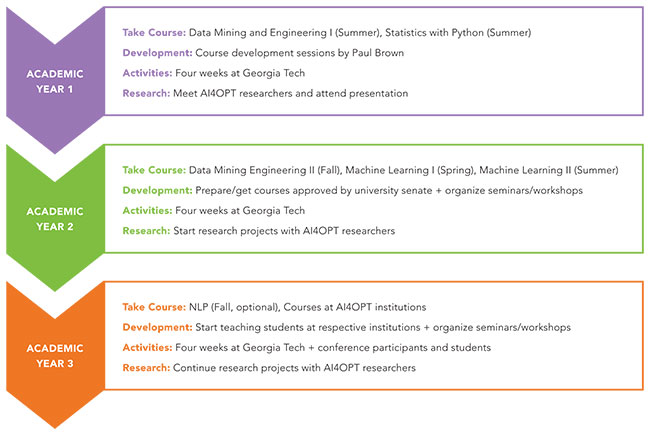
The overarching goal of the FTP is to prepare faculty at HBCUs and MSIs to develop, implement and teach undergraduate courses in data science, AI and optimization at their institutions, providing pathways into AI for their students. Again, the overall philosophy is to train the teachers to make the program scalable and replicable. A high-level overview is provided in Figure 1. The FTP is organized around cohorts and cycles of three academic years. In the first two years, the cohort participants take courses developed by AI4OPT with a specific audience in mind: STEM professors with a background in mathematics but no experience in AI. After two years, the participants will have obtained sufficient background in AI to matriculate into regular courses that are offered at AI4OPT institutions, including Georgia Tech, UC Berkeley and University of Southern California. The participants will be offered different minor or major course options and will complete their course work after a total of at least 18 credit hours (about half that of a master’s degree). In parallel with taking courses, the participants will be trained to develop their own minors or majors. Development starts in the first year, and in the second year, the participants will be supported to prepare an application and get their new courses approved by their university senate. If approved, each participant will start teaching courses to their own students from the third year onward.
Beginning in the second year, participants will be encouraged to organize seminars and workshops, an activity that continues into the third year. In the second year, the participants will scope a research project with AI4OPT faculty that continues into the third year. In the cohort’s final year, participants will bring a select number of students and hold a two-day participant and student conference. The summer of year 3 of the Institute will be particularly exciting, as it brings the first cohort, their students and the second cohort to Georgia Tech at the same time. This allows for new connections to be created and the new cohort to learn from the previous. After three years in the program, the participants graduate, but the Institute encourages continued research collaborations and participation in the AI4OPT seminar series.
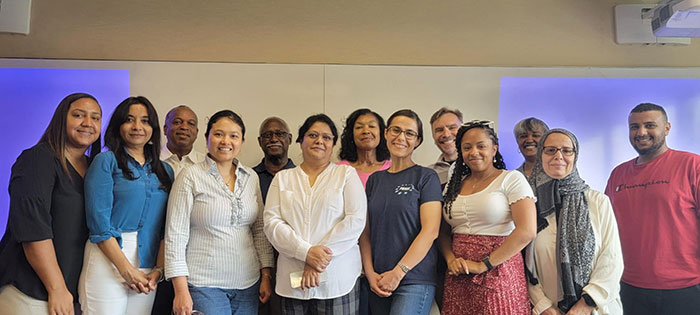
Partners: The first cohort of the FTP (Figure 2) consists of 11 university and college professors from four HBCUs and three MSIs, spanning the states of California, Georgia, Texas and Virginia.
Organization: The FTP officially began in June 2022, when the first cohort made a four-week visit to Georgia Tech (June 5 to July 2). A typical day started with classes in “Data Engineering and Mining” and “Statistics with Python.” After lunch, there were presentations by AI4OPT researchers and debriefing sessions. Friday morning sessions were dedicated to course design, and the participants worked on developing minors or majors to be implemented at their own institutions. The education program summer session consists of two four-week blocks: four weeks face-to-face at Georgia Tech and four weeks of virtual classes afterward. Participants will continue taking courses during the fall and spring semesters. Upcoming courses include Machine Learning I, Machine Learning II (deep learning) and Natural Language Processing.
Broader Partnerships
AI4OPT is also engaging in a long-term partnership with HerWILL, a global nonprofit organization with a mission to democratize data science for underrepresented women to bridge the diversity gap and talent shortage. AI4OPT helped HerWILL organize its 2022 Datathon, providing the data set (predicting taxi requests in New York City over time and space) and being part of the jury for the competition. The partnership will continue to expand beyond datathons, leveraging the SBC and FTP initiatives to offer new programs at HerWILL and solve workforce development problems around the globe.
Perspectives
The AI4OPT educational programs have the potential to democratize access to AI, data science and O.R. and will teach thousands of students in the next five years. With the help of the INFORMS community, it is possible to reach out to many more. AI4OPT will be delighted to work with those in the INFORMS community who are interested in partnering to deploy or adapt these programs for their own institutions.
Acknowledgments
The high school initiative is, and has been, partly supported by generous gifts of the Seth Bonder Foundation over the years. We are particularly indebted to Merrill Bonder for her vision and leadership. We are grateful to INFORMS and Pinar Keskinocak for creating the INFORMS DEI Ambassadors Program, which was the catalyst for the meeting between Charles Pierre and Pascal Van Hentenryck. And, of course, special thanks to NSF and its support for AI4OPT (NSF grant 2112533), which allows us to pursue our vision for democratizing access to AI.
References
- Jesse Polhemus, 2021, “Diverse career paths: Brown CS alum Sky Adams aims to increase diversity in K-12 CS,” Feb. 9, https://blog.cs.brown.edu/2021/02/09/diverse-career-paths-brown-cs-alum-sky-adams-aims-increase-diversity-k-12-cs/.
- https://sethbondercamp.isye.gatech.edu/
- https://connect.informs.org/diversity/ambassador-program
Charles Pierre is the thrust leader for the educational and diversity initiatives of AI4OPT. He also leads the Undergraduate Initiative with his team at Clark Atlanta University (CAU), including the delivery of many data science and artificial intelligence courses. Charles is an associate professor of mathematics at CAU and was a 2020 INFORMS DEI Fellow. Pascal Van Hentenryck is the director of AI4OPT. He also leads the high school initiative, including the Seth Bonder summer camps and high school classes in collaboration with high school faculty. Pascal is the A. Russell Chandler III chair and professor in industrial and systems engineering at Georgia Tech and the recipient of several teaching awards at Brown University and Georgia Tech. Kevin Dalmeijer is the managing director of AI4OPT, where he supervises all operations, including those of the educational and diversity initiative. Kevin has a Ph.D. in operations research from the Erasmus School of Economics and has worked on challenging problems in mobility, transportation and logistics. Tuba Ketenci helps organize and run the Seth Bonder summer camps for AI4OPT. She is director of education outreach in the School of Industrial and Systems Engineering at Georgia Tech.