


October 16, 2022 in 2022 INFORMS Annual Meeting
IFORS Distinguished Lecture: The Amazon Fulfillment Network: Topology and Capacity Planning
SHARE: PRINT ARTICLE: https://doi.org/10.1287/orms.2022.05.24n
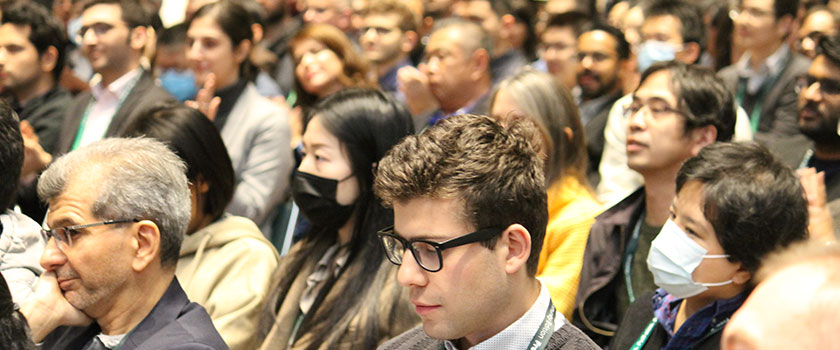
The IFORS Distinguished Lecture took place Sunday afternoon during the 2022 INFORMS Annual Meeting – and it was a packed house. Ironically, Luciana Buriol, principal research scientist at Amazon, gave a talk discussing the topology and capacity planning at Amazon Fulfillment Centers. Everyone loves Amazon, and it was apparent yesterday that everyone attending the INFORMS Annual Meeting wanted to find out what goes on behind the scenes of fulfillment and sortation centers and delivery stations.
The Amazon fulfillment network is comprised of Amazon buildings and transportation lanes among them. As noted, Buriol focused on the network with nodes representing Amazon Fulfillment Centers, Sortation Centers and the Delivery Stations, where the links are the truck and air lanes among them. The lanes of this network are highly dynamic: their capacity can be changed a few days in advance, and they can also be depreciated or launched with short notice. On the other hand, large buildings are planned years ahead. Designing and expanding this network, as well as adjusting the nodes and links capacities for everyday operation demands an orchestration of complex operations research (O.R.) systems. Buriol described this process to a packed house.
Amazon fulfillment centers are in dozens of countries around the world. From there, packages are sent to sortation centers, where customer orders are sorted by final destination. These are large buildings, however, inventory is not stored there. At the Amazon delivery stations, customer orders are prepared for last-mile delivery to customers. In addition, Amazon Air Gateway is also available, and there are at least a dozen planes in the U.S.
The Amazon operations supply chain network includes the inbound network – global vendors (FBA and retail), inbound cross dock and domestic vendors (FBA and retail) – and outbound network including middle mile (transport) to the fulfillment and sortation centers, to delivery stations and finally the last-mile destination. Interestingly, the fulfillment and sortation centers are planned years in advance whereas delivery stations are only planned months in advance. As far as truck lanes topology and capacity are concerned, Buriol said that long-term planning is about 6+ months, medium-term planning is three months and short-term planning is less than one month! The transportation objectives are to 1) minimize costs, 2) ensure speedy delivery and 3) improve sustainability measures.
Given a network, an origin-destination (O-D) demand matrix and set (in millions) of possible transportation paths between FCs and customer nodes should minimize cost when flow is sent in the network respecting speed, node and link capacity constraints. Ultimately, the goal is to identify lanes that can be deprecated. Buriol then explained the next imperative step of computing the shortest path speedup in which she considers the shortest path between the source and destination. Computational times of node capacity are less than 30 minutes.
Using machine learning for column generation, Buriol noted that the graph topology does not change much from the previous runs, demands also do not vary much from previous runs and 70% of the demand takes shortest paths. Also using machine learning, they set 50% of the demand to shortest paths using a random forest model. This way, the solution takes 1/3 of the time and there is a less than 1% gap from the optimal solution.
In a scenario in which items A and B were bought, the question is: which FC(s) will be selected to fulfill this purchase? The delivery speed given is set as an upper bound for the final delivery time and further optimization in transportation and consolidation is applied, and is also part of last-mile delivery. All in all, solving these complex and large problems demands a lot of internal collaboration. For more about this, there are several more talks happening during the Annual Meeting. Check the mobile app for times and room locations.
Prior to her role at Amazon, Luciana Buriol was a professor in the Computer Science Department of the Federal University of Rio Grande do Sul (UFRGS), Porto Alegre, Brazil, for 15 years. She joined Amazon in Seattle in May 2021. She earned her Ph.D. in computer science (optimization area) from State University of Campinas, Brazil. She was a visitor Ph.D. student for 15 months at AT&T Labs and a postdoc in the Computer Science Department at the University of Rome “La Sapienza.” She was president of the Latin-Ibero-American Association of Operational Research from 2012 to 2014 and vice president of IFORS (International Federation of Operational Research Societies) from 2016 to 2018.
SHARE: