October 18, 2022 in 2022 INFORMS Annual Meeting
Omega Rho Keynote: Artificial Intelligence and the Future of Universities
SHARE: PRINT ARTICLE: https://doi.org/10.1287/orms.2022.05.27n
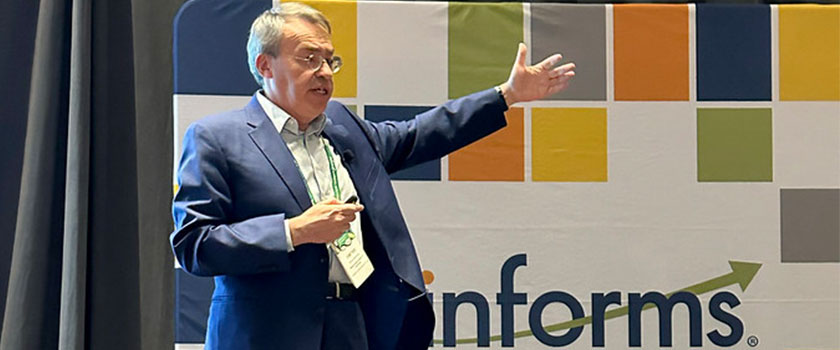
In his Omega Rho keynote session, Dimitris Bertsimas, the Boeing Professor of Operations Research and Associate Dean of Business Analytics at the Sloan School of Management at the Massachusetts Institute of Technology, talked about his work on multimodal artificial intelligence (AI) with applications in medicine and climate change. He also shared his views on the future of universities and proposed a number of exciting directions for young researchers to pursue.
Dimitris began his talk with some reflections on what he considers to be important: decision-making in medicine, agriculture and climate change. In particular, he posed the following questions:
- Can machines use multimodal data to make medical diagnoses and decisions?
- Can machines use multimodal data to make better decisions on the type of crops and timing to fertilize?
- Can machines use multimodal data to make better predictions on the magnitude and direction of hurricanes?
Dimitris motivated the use of multimodal data with the five basic human senses: eyesight, hearing, taste, touch and smell. He argued that if multimodality is a fundamental characteristic of human life, then why not for machines?
He then shared the successful stories of using multimodal data with holistic AI to improve the ability of models that make predictions and prescriptions in medicine and hurricane forecasting. Dimitris also quantifies the contribution of each modality and data source demonstrating the importance of heterogeneity in data type and the necessity of multimodal inputs across different fields. In addition, the generalizable properties and flexibility of the proposed holistic AI framework offer a promising pathway for future multimodal predictive systems in various applications such as detection of domestic abuse, human trafficking and cancer.
Given the success of his work, Dimitris proposed an inspiring research and education agenda for young researchers to pursue. He advocated making deep learning interpretable and that more work on the mathematics of optimization in very high dimensions is needed. He also promoted changing healthcare and medicine through analytics, affecting the training of medical doctors through digital medicine, and joint education in analytics/medicine.
Dimitris also shared his views and predicted the future development of universities. He started with three key observations:
- Universities are historically organized hierarchically and vertically. But is this the optimal structure?
- Real-world problems do not have labels. (They often do not fall under a specific discipline or field.)
- It makes sense to utilize all available data for better decision-making.
Based on these observations, he made the following predictions:
- The use of multimodal data in science, engineering and medicine.
- Multimodal machine learning will be the predominant method for prediction and decision-making in all fields.
- Universities of the future will be organized horizontally.
- Classes in multimodal machine learning and optimization will be the core basis of many fields, augmented by specialized topics utilizing specific knowledge of the field.
- New fields will be emerging: digital humanities, digital medicine, digital agriculture and digital meteorology.
To adapt to these predictions, he suggested the OR/MS community should embrace the change and should lead rather than follow. The field of OR/MS can also contribute to the horizontal organization of universities. Moreover, despite being sceptical at first, Dimitris highlighted that deep learning is making significant progress in some of the most challenging problems of our time. Yet, the lack of interpretability in deep learning is a major challenge, and the OR/MS community can help make deep learning more interpretable.
Finally, Dimitris ended his talk with the following key takeaways:
- A new paradigm for science, engineering and medicine: multimodality
- It will affect universities and our field to a first-order
- O.R. should adapt and embrace the positives of deep learning while addressing its challenges (interpretability)
- Optimization can learn from the success of deep learning
- Perhaps most importantly, we should broaden what our field can do. In his opinion, O.R. can do everything.
Jessica Leung is a lecturer in business analytics (U.S. equivalent of an assistant professor) at the Econometrics and Business Statistics Department at Monash University, Australia. Her research focuses on convex and combinatorial optimization in business applications. Jessica teaches undergraduate and postgraduate courses in business statistics, management science, optimization, applied linear algebra and visual data analytics.