
November 29, 2022 in Artificial Intelligence
AI-Enabled Future of Work
SHARE: PRINT ARTICLE: https://doi.org/10.1287/orms.2022.06.03
Will artificial intelligence (AI) take over my job? With repeated technology-enabled disruptions in our workplace, it is normal to wonder about the potential of AI. According to one estimate [1], automation might eliminate 73 million jobs by 2030, but another estimate [2] suggests that 85% of the jobs that will exist by 2030 haven’t even been invented yet. The delivery tasks will be automated by self-driving trucks and robots, but new jobs to monitor and control those self-driving trucks and robots will be created in the future. Software programs will be automatically generated based on specifications provided, but new jobs will require creation of new modules to enable new features. Checkout processes will be fully automated at stores, but new jobs will be created requiring knowledge in fashion and nutrition to help guide the customers. Thus, we will let AI take over the boring, repeated and redundant tasks and open doors for creative ways of work and collaboration. An AI-enabled future of work will be fascinating.
Composition of Jobs
Although technology can cause disruptions in the workplace, it has actually enhanced productivity over every decade in the recent past and is poised to enhance our productivity even faster now [3]. Workplaces adopt new technologies and innovative work solutions not only because they improve individual performance but also because they innovate the way we communicate and collaborate with others. Almost every job is some combination of independent tasks and collaborative efforts. Independent tasks can include creating reports, writing a piece of software application, diagnosing patients, delivering things and more. Collaboration requires an additional layer of understanding between two heterogeneous and diverse individuals to complete a job productively – creating reports with various data sources, developing a large-scale software, diagnosing unique symptoms associated with a new virus, or delivering packages on demand from multiple sources to multiple consumers. Collaboration requires two or more people to accept and understand (often ill-defined) working standards. To have a meaningful collaboration, companies create opportunities for teams to communicate and get to know each other.
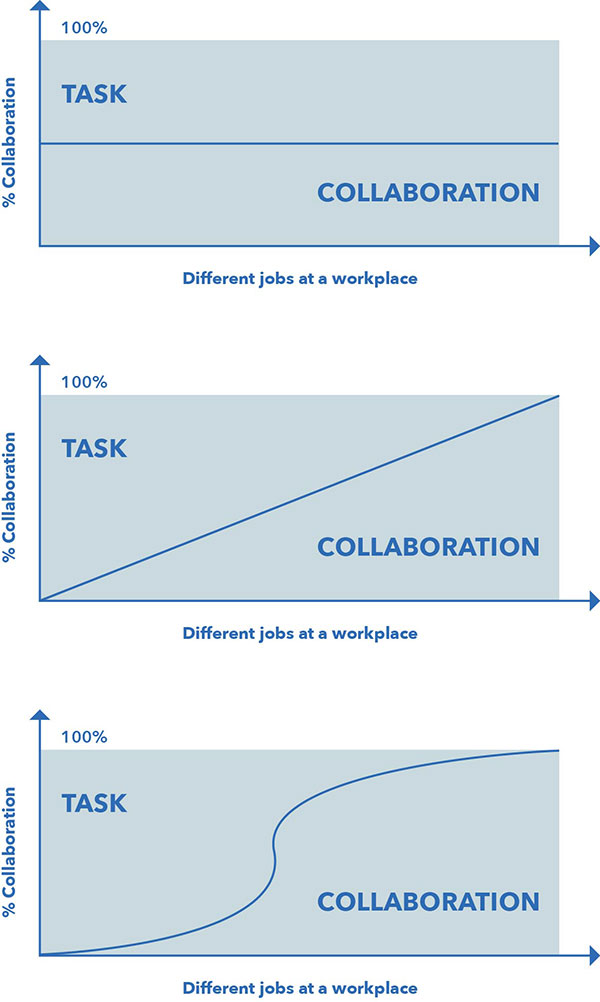
Any workplace is a collection of jobs with some distribution of individual tasks and collaborations (see Figure 1). For example, a bank will have an auditor who spends most of the time independently completing tasks, whereas a branch manager will mostly collaborate with everyone on the floor. A shipping company will have truck drivers complete all deliveries, whereas managers will collaborate heavily across teams to enable logistics. This distribution of tasks and collaborations in jobs at a workplace may be a uniform split (consulting), S-shaped distribution (manufacturing) or some other distribution. Distribution provides a guideline on how AI will impact work in that organization. A uniform split may suggest that every job has some automatable individual tasks and some collaborative roles that AI will augment. For a highly skewed distribution of roles (S-shaped), the industries will see that AI-enabled automation might eliminate some roles. In addition, AI will augment jobs that solely depend on collaborative decision-making. Thus, every company should consider the cognitive reappropriation – the distribution of jobs and decisions in their workplace – to prepare for AI-enabled disruptions and productivity gains [4].
AI in the Workplace
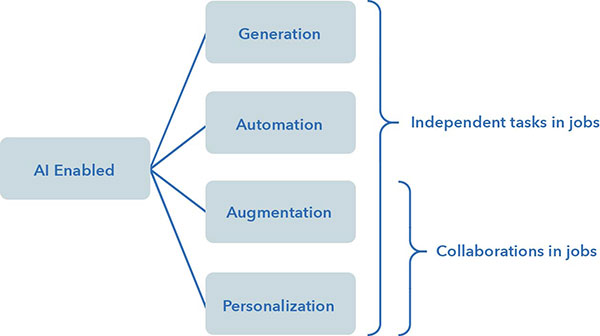
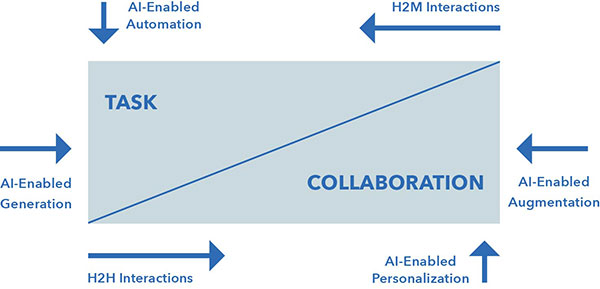
Almost every job can be broken into some combination of independent tasks and collaborative efforts, and technology innovation impacts each part of our job differently. AI is substituting individual tasks but complementing the collaborations. Thus, the future of our work will be enriched with AI-enabled generation, automation, augmentation and personalization (GAAP). Therefore, it is intuitive that AI will learn from an individual’s actions and continue taking over individual tasks to enhance worker productivity. On the other hand, collaboration is unique and not easily replicable because of the number of possible interactions between any two combinations of individuals – let alone the complexity of interactions between workers in a team. Thus, AI will enable content generation and task automation to substitute individual tasks but can only augment and personalize the collaborations to enrich and simplify the interactions. For example, AI will augment the workspace with objects and notes in a metaverse for effective collaboration, or AI will personalize the inputs and workspace itself to simplify the communication and collaboration between a group of individuals. The role of AI will disproportionately affect the two forms of interactions: human-to-machine (H2M) and human-to-human (H2H).
H2M interactions. Computers need input from users to process, analyze and act. However, smart and connected devices sense those inputs, proactively seek inputs and automate processing in the presence of a human. Innovation in technology that miniaturized and deconstructed traditional computing machines has enabled “aware” machines. Picture it: You walk into your house; the lights and temperature are adjusted to your needs. You start your car and your destination is already selected for directions. You ask for your house to be vacuumed, and your wish is granted. You start typing your email and the system autocompletes for you. You ask for a box of chocolates, and they are delivered the next day – by a robot. More recently, you think of what you want to tweet and your computer types and posts it for you.
Our world continues to evolve around us. Our interactions with computers, devices and other technology are not what they used to be – even compared with just last year! However, it is important to note that these H2M interactions are predictable, and thus, AI could take over individual tasks to simplify our lives.
H2H interactions. Humans are social animals; we love attention, recognition and kind words. Thus, our actions are driven by the social need to be liked as well as to be successful in our workplace. There is a reason that there are more admired and successful individuals at work. These individuals somehow understand the best way to communicate with peers. Can we learn from their actions and become equally admired? No. Because inherently, the attractiveness of H2H interactions is in their uniqueness and level of personalization of interaction between any two individuals. We can generate the most effective email to our peers; we can generate the best message responses to all questions in a meeting. But by learning those unique interactions, they become stale, causing humans to evolve and upgrade their interactions. This is the reason AI will not be able to substitute the H2H interactions but will augment and personalize our interactions to improve outcomes of our collaborations.
This evolution of interaction is enabled by innovation in technology – innovation that was possible because of ample computing power in a thumb-sized device, ubiquitous network connectivity and rapid development of a piece of algorithm called AI. AI algorithms use data sensed and generated from human interactions as well as data learned from desired actions. In a recent research project, we used machine learning to show that viral videos can be engineered [5]. This content engineering provides an understanding that AI can indeed generate content that could provide the desired wide consumption. The secret, we found, is to have videos with personalities high in neuroticism and low in agreeableness. Similarly, in other research, we found that users, when consuming certain types of information, are likely to interact with smart devices with specific voices. We found that ostentatious voices are more engaging, whereas seductive voices are less engaging. Machines can help us identify these insights and personalize our interactions. These personalizations for both H2M and H2H interactions will facilitate an AI-enabled future. Processes will evolve as human behavior evolves.
Analyzing LinkedIn profiles of more than 250,000 professionals, I found that career growth will be driven by exploring multiple functional areas in a workplace. We cannot assume to be working in silos and also assume AI will not disrupt our jobs. The future requires us to understand how AI can help us complete our jobs more effectively. This is an era in which businesses should strive to become more lean, more efficient, more profitable and more tech savvy. Preparing the workforce of today and tomorrow to effectively use AI by letting technology take on repetitive tasks and focusing instead on creative ways of working and collaborating is the key solution to enable digital transformation, to take our economy beyond.
References
- https://www.forbes.com/sites/niallmccarthy/2017/11/30/automation-could-eliminate-73-million-u-s-jobs-by-2030-infographic/?sh=51047aa8773d
- https://www.huffpost.com/archive/ca/entry/85-of-jobs-that-will-exist-in-2030-haven-t-been-invented-yet-d_a_23030098
- Sara Brown, 2021, “How to prepare for the AI productivity boom,” MIT Sloan School of Management, July 12, https://mitsloan.mit.edu/ideas-made-to-matter/how-to-prepare-ai-productivity-boom.
- Benn R. Konsynski and John J. Sviokla, 1993, “Cognitive Reapportionment,” The Post Bureaucratic Organization, Thousand Oaks, CA: Sage Publishing.
- https://www.emorybusiness.com/2021/01/28/personality-matters-the-tie-between-language-and-how-well-your-video-content-performs/
Rajiv Garg is an associate professor of information systems and operations management in the Goizueta Business School at Emory University. His research explores the economic and social implications of digital technologies and human-machine interactions. His research has attracted over $1 million in funding and has been published in journals such as Management Science, Information Systems Research, MIS Quarterly and Production and Operations Management.