


December 20, 2022 in What's Your StORy?
What's Your StORy? Kendra Taylor
SHARE: PRINT ARTICLE: https://doi.org/10.1287/orms.2022.06.15
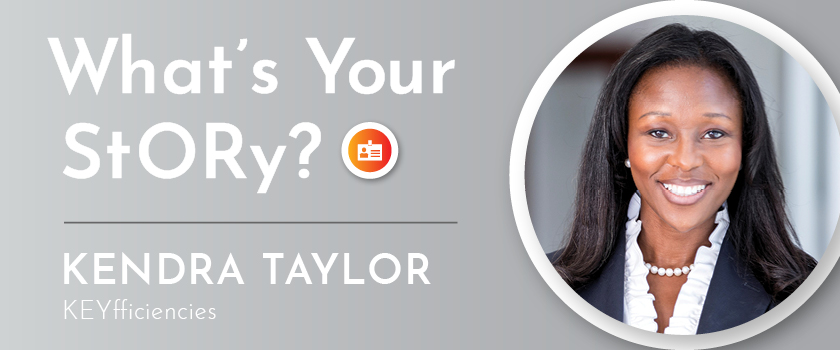

Name: Kendra Taylor
Employer: KEYfficiencies, Inc.
Job Title: President & CEO
INFORMS member since 2002
 When did you first become interested in operations research and analytics?
My initial exposure to operations research (O.R.) was as an undergraduate student in 1996 as part of a minority summer research program at MIT. I was a mathematics major at Hampton University and the program staff at MIT were not sure where to place me, so they placed me in the Operations Research Center. Robert Freund was my mentor and introduced me to the field of O.R. while he and Dimitris Bertsimas worked on developing a textbook for management students who were interested in becoming the business leaders of tomorrow. As a math major, I was excited to learn that I could use my degree to help businesses solve problems.
 Tell us about your consultancy firm KEYfficiencies, Inc., and your journey to start it.
My doctoral studies in industrial and systems engineering at Georgia Tech made the path of consulting a natural fit. I worked as a consultant for 10 years and did well with client delivery and business development. The idea of starting a consulting firm appealed to me and the opportunity came. KEYfficiencies works with clients seeking a clear path ahead and an efficient use of their resources, systems and data to maximize the outcomes of investments in people, technology and processes.
 Can you talk about your research initiative iSeeMe Society?
KEYfficiencies developed the curriculum for the iSeeMe Society as a research initiative into the use of decision sciences to reduce the vulnerability of teens to the tactics of child sex-traffickers. The hypothesis was that improved decision-making skills increase resilience in youth and young adults. The curriculum focused on teaching them to apply the DECIDE framework to make better life decisions based on the person they hope to become. The results of the pilot were published in the European Journal of Operational Research in 2018.
 Can you talk more about how we can promote analytics careers to high school students, or younger?
One way to promote analytics careers to high school students and youth is to show its relevance to what already interests them. High school students are faced with many practical decisions that will significantly influence the rest of their lives. INFORMS can continue to encourage youth to develop their critical thinking skills. For example, decision sciences has been used by INFORMS members to improve the decision quality of justice system-involved teens (see OR/MS Today, August 2007).
 What do you think are the most significant barriers for women in minority groups when it comes to OR/MS careers? How could we resolve these issues?
The most significant barriers have been the lack of funding for pursuits in higher education and programs to introduce them to OR/MS careers. Without the Office of Naval Research scholarship, Packard fellowship and minority summer research program at MIT, I would not have had the opportunities and exposure that have allowed me to have an OR/MS career and to give back as I have.
The resolution involves being intentional in providing funding and introductions to opportunities. Part of that means partnering with Historically Black Colleges and Universities (HBCUs), which have a history of preparing students to excel and give back.
 You are co-editor of an INFORMS Editor’s Cut on ending human trafficking with analytics, which has recently been updated. What can users find in the volume and how best should they use its contents?
Volume 7 of the INFORMS Editor’s Cut (now INFORMS Analytics Collections) on Ending Human Trafficking with Analytics provides a variety of resources including research papers, TED Talks, reports, articles, media references and data on human trafficking. It is structured into three sections. Users can peruse the sections to understand the issues and learn unanswered questions.
The first section is a general section with information to define the scope of the problem and provide an overview of O.R. methods used. The second section has content on efforts to reduce demand for products and services by focusing on the buyer profile using organization science, game theory and software algorithms. The third section has content on efforts to reduce the supply of victims by locating trafficking networks and victims using fuzzy graph theory, decision analysis, systems thinking and dynamic programming.
 What has been your favorite INFORMS experience thus far?
My favorite INFORMS experience has been attending the 2022 INFORMS Annual Meeting and learning of the latest research that is relevant to one of the new service offerings we are building for customers of KEYfficiencies to find and address human trafficking in their supply chains. INFORMS members are doing great work and making interesting discoveries.
 Tell us about your experience on the Edelman Award Committee, and what this competition means to the OR/MS/analytics field.
I have been honored to serve on the committee to award the prestigious Edelman Award to organizations that have demonstrated superior and sustained benefits through the widespread application of analytics. I consider the competition to be like the “Oscars of Analytics.” My fellow committee members have been a pleasure to work with, and demonstrate the best of applying decision-making skills to the difficult decision of selecting the award finalists and winner.
 You are a member of several other associations, including American Association for Advancement of Science and American Mathematical Society, why do you find this involvement so important?
These organizations were some of the first organizations I joined and I appreciate the role they play in the STEM ecosystem.
 When you aren’t attempting to end human trafficking or preparing youth for major life decisions, what do you like to do?
I train and compete as a masters athlete in the 100m dash at USA Track & Field (USATF) sponsored events in the U.S. and abroad, as part of Team USA. I started sprinting at a young age and learned early on that, thanks to USATF, it is a sport one can enjoy for life.
 If you could have dinner with one famous person from history who would it be?
There was a famous man from a small town in the Middle East who entered human history about 2,000 years ago. The rumor is that he died and came back to life. People today are still saying how he has changed their lives. I have read his biography several times but having dinner with him would be an experience I would not want to miss.
 Desert island question: what three things would you bring with you?
Assuming I want to get off the island, I would bring a satellite-enabled sailing yacht, matches and a knife.
SHARE: