


April 25, 2023 in Connected and Automated Vehicles
Massive CAV Experiment in Nashville Pits Machine Learning against Traffic Jams
Can automated vehicles help traffic flow?
SHARE: PRINT ARTICLE: https://doi.org/10.1287/orms.2023.02.05
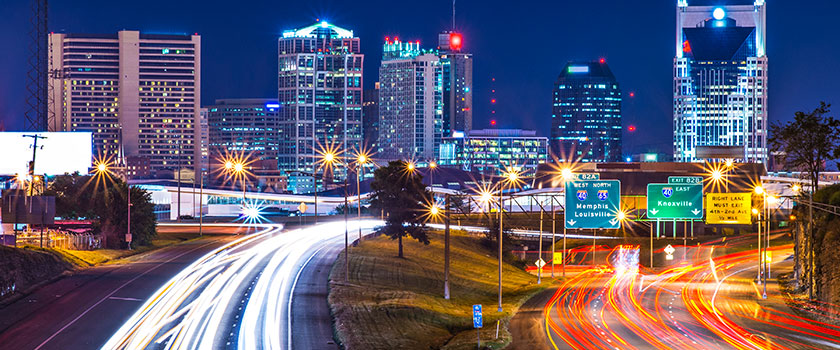
Many traffic jams are caused by human behavior: A slight tap on the brakes can ripple through a line of cars, triggering a slowdown – or complete gridlock – for no apparent reason. In a massive traffic experiment that occurred outside of Nashville on Interstate 24 (I-24) in late November 2022, an academic consortium, CIRCLES [1], tested whether introducing a specific proportion of artificial intelligence (AI)-equipped vehicles on the road could help ease these “phantom” jams and reduce fuel consumption for everyone.
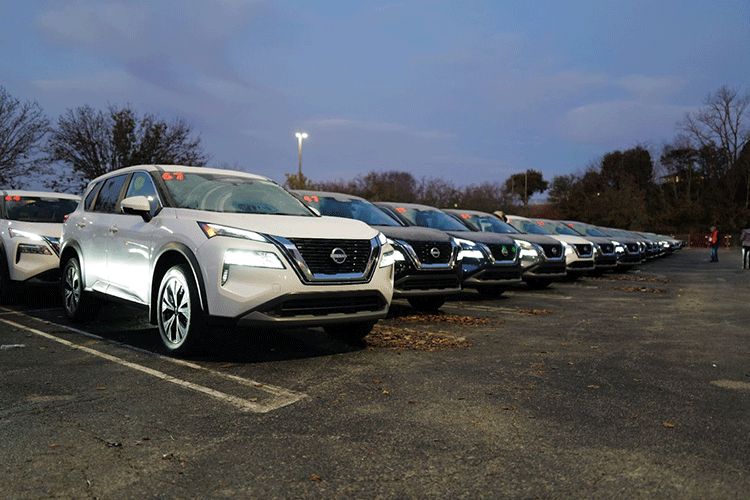
Over the course of five days, researchers conducted one of the largest traffic experiments of its kind in the world, deploying a fleet of 100 Nissan Rogue, Toyota RAV4 and Cadillac XT5 vehicles onto a busy stretch of Nashville’s I-24 during the morning commute. Each vehicle was equipped with a variety of control algorithms overwriting the cruise control system and was designed to automatically adjust the speed of the vehicle to improve the overall flow of traffic – essentially turning each car into its own “robot traffic manager” [2].
What is CIRCLES?
The CIRCLES Consortium is a multi-university research collaboration dedicated to using machine learning, optimal control and other optimization techniques to improve traffic flow and increase the energy efficiency of traffic flow. The massive Connected and Automated Vehicles (CAV) experiment, which was carried out in coordination with Nissan North America, Toyota, General Motors and the Tennessee Department of Transportation, was the first time the AI technology pioneered by CIRCLES has been tested at this scale [3].
This massive operation was planned over the course of the past three years in parallel with the development of the I-24 MOTION test bed [4], a stretch of the interstate that has been equipped with 300 4K digital sensors to monitor traffic. The CIRCLES project was led by seven principal investigators (PIs) from four universities: Professors Alexandre Bayen (main PI), Maria Laura Delle Monache and Jonny Lee (UC Berkeley); Professors Dan Work and Jon Sprinkle (Vanderbilt University); Professor Benedetto Piccoli (Rutgers University); and Professor Benni Seibold (Temple University).
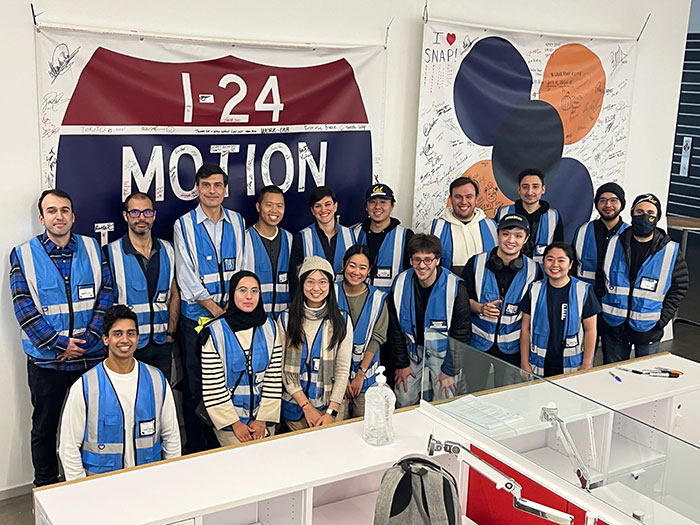
To achieve this tremendous undertaking, more than 50 CIRCLES researchers from around the world gathered in a large “command center” in a converted office space in Antioch, Tennessee. Each morning of the experiment, which ran Nov. 14-18, 2022, trained drivers took the AI-powered vehicles out on the recently opened I-24 MOTION test bed. As the drivers traversed their routes, researchers collected traffic data from both the vehicles and the I-24 MOTION traffic monitoring system. On Nov. 16 alone, the system recorded a total of 143,010 miles driven and 3,780 hours of driving. The I-24 MOTION system, combined with vehicle energy models developed in the CIRCLES project, will provide an estimation of the fuel consumption of the entire traffic flow during those hours.
How Do AI-powered CAVs Smooth Traffic?
Driving is very intuitive. If there is a gap in front of you, you accelerate. If someone brakes, you slow down. It turns out, however, that this very normal reaction can lead to stop-and-go traffic and energy inefficiency, which is precisely what AI technology is able to fix. It can direct the vehicle to do things that are not intuitive to humans but are overall more efficient.
As part of the CIRCLES Consortium, UC Berkeley researchers have taken the lead in developing the machine-learning algorithms that govern how fast AI-powered vehicles should go. These algorithms, also called “speed planners” and “controllers,” use information about overall traffic conditions and the vehicle’s immediate surroundings to determine the best speed for improving traffic flow.
The new control algorithms go a step beyond the adaptive cruise control systems that are already on the market [5]. In addition to adjusting the speed of the vehicle in response to local conditions, the algorithms also incorporate information about traffic conditions and adjust the speed to help smooth the overall flow of traffic.
Why Do We Need This Massive CAV Experiment?
To develop the speed planners, the CIRCLES team first had to define the mathematical models that describe how traffic behaves. The flow of traffic can be modeled using equations similar to those that govern the flow of fluids, but the human element of driving complicates it.
Capturing this human aspect of traffic flow is one of the reasons the massive experiment was so important. The team regularly runs computerized traffic simulations to train the machine-learning algorithms to smooth stop-and-go behavior and minimize energy consumption. Data from the experiment will be critical to refining these simulations and algorithms for real-world driving.
Testing the software in the field is also important to ensure that AI-powered vehicles don’t behave in ways that might be considered “socially unacceptable” to humans. For instance, vehicles may smooth traffic by maintaining a slow, steady speed rather than constantly accelerating and braking. However, slow driving may open large gaps in traffic, which could anger other drivers or allow other cars to cut in.
In addition to training the algorithms to follow the rules of the road, the software also must be compatible with the hardware and capabilities of actual vehicles. Although a simulated car can jump from 0 to 60 mph in an instant, even the most advanced sports cars can’t achieve that level of acceleration.
The experiment also demonstrated a new feature developed by the CIRCLES team: the ability to simultaneously push collaborative algorithms to different car platforms (Nissan, GM, Toyota). The team is in the process of planning how the technology can be deployed in California.
From a Ph.D. Student’s Angle (Zhe Fu)
I want to use the word “incredible” to describe this journey. Fascinated by the idea of utilizing automated vehicles (AVs) as mobile actuators to smooth traffic, I joined the CIRCLES project during the COVID-19 pandemic. Coordinating and conducting effective discussions through Zoom with researchers around the world is very hard, and even harder working this way weekly for nearly three years. But we persevered because we all share the common belief that this project is meaningful and impactful for future research and applications.
The spirit of this project is to excavate the potential of new technologies to solve real-world problems and gain systems-level benefits. With proper design and coordination, automated vehicles can not only ease the driving burden for AV drivers but also help smooth traffic flow and benefit the whole system with less energy consumption and a higher comfort level. This belief motivated me to design machine-learning algorithms that could achieve on average more than 15% energy savings in simulations.
The massive CAV experiment made this journey even more appealing. Very little AV-related research is able to be tested in the real world. By conducting the experiment at this large scale, we hope to show that our results can be reproduced at the societal level. Taking into account all the hardware limitations and considerations was a challenge, but it resulted in practical strategies that can be applied in the real world with on-the-market technologies.
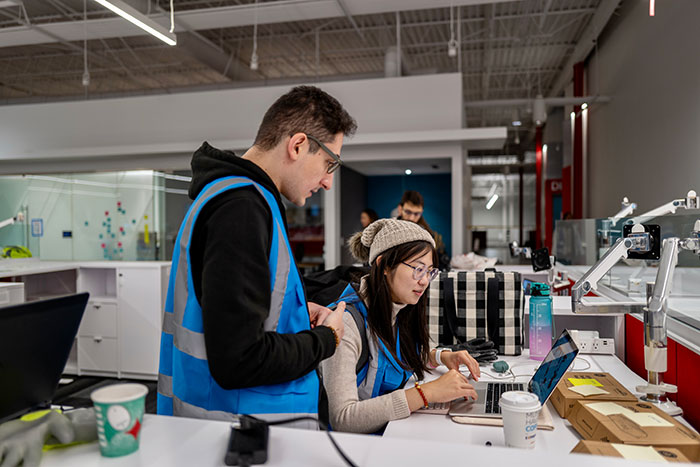
The test week was intensive. To catch the morning peak traffic, which usually begins around 6 a.m., to test our algorithms, we had to get up at 4 a.m. every day. Moreover, to create “socially acceptable” algorithms, we needed to spend extra efforts to make daily tweaks to our “speed planners” and “controllers” based on feedback from our drivers.
The experiment is not the end but the beginning of an incredible journey. Our vision is that, eventually, this technology will be deployed in many, if not all, vehicles, and we are working on ways to make it scalable to the public.
Authors’ note. A version of this article originally appeared on the UC Berkeley news website [6].
References
- https://circles-consortium.github.io/
- Ann Brody Guy, 2018, “Turning cars into robot traffic managers,” Berkeley Engineering, October 29, https://engineering.berkeley.edu/news/2018/10/turning-cars-into-robot-traffic-managers/.
- Matthew Hutson, 2018, “Watch just a few self-driving cars stop traffic jams,” Science, November 16, https://www.science.org/content/article/watch-just-few-self-driving-cars-stop-traffic-jams.
- https://i24motion.org/
- https://www.caranddriver.com/research/a32813983/adaptive-cruise-control/
- https://news.berkeley.edu/2022/11/22/massive-traffic-experiment-pits-machine-learning-against-phantom-jams/
Zhe Fu is a Ph.D. candidate in transportation engineering at University of California, Berkeley. She is one of the core algorithm contributors of the CIRCLES Consortium. Her research interests lie in traffic control and machine learning. Kara Manke is a science writer and media relations specialist at the University of California, Berkeley, where she covers engineering, climate change and public health. She holds a Ph.D. in chemistry from the Massachusetts Institute of Technology. Alexandre Bayen is associate provost for Moffett Field Program Development and the Liao Cho professor of electrical engineering and computer science at the University of California, Berkeley. He is the principal investigator for the CIRCLES Consortium.

