


April 25, 2023 in In Memoriam
A Tribute to Gordon Moore, 1929-2023
Intel co-founder, one of ‘the great inventor-entrepreneurs of all time,’ dies at 94
SHARE: PRINT ARTICLE: https://doi.org/10.1287/orms.2023.02.05n
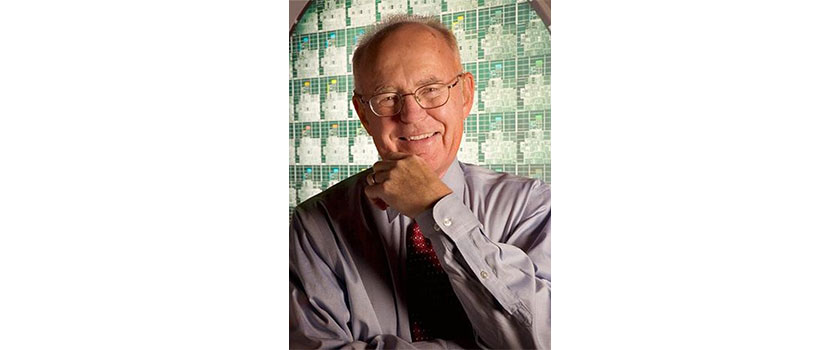
Gordon Moore, co-founder of Intel and giant of the semiconductor and technology industry, passed away on Friday, March 24, 2023, at his home in Hawaii. The Gordon and Betty Moore Foundation reported he died peacefully, surrounded by family (read the Intel news release). Moore was 94.
Moore co-founded Intel with Robert Noyce in 1968 after the two worked closely for a decade in the fledgling California semiconductor industry. They took a different approach from industry norms and built Intel on the idea of manufacturing complex, general-purpose chips in high volume – the basic model that still underpins Intel’s business.
While Noyce, nicknamed the “Mayor of Silicon Valley,” is often credited with setting Intel’s early vision and much of our culture, Moore was the technology wizard who guided Intel’s early lead in silicon memory, the invention of the microprocessor and the company’s shift from memory to microprocessors in the mid-1980s.
In the public eye, Moore is best known for Moore’s Law, the 1965 prediction that the number of transistors in a circuit would double every year. In 1975, Moore revised it to every two years, and it has since become shorthand for rapid technological change.
Moore’s larger contribution, however, is that he may be the computing industry’s most crucial contributor to ensuring his law actually held true – at first as a technologist, working with Noyce on the first integrated circuits, and later as a leader forging a new business designed to exploit it.
In this tribute, we examine Moore’s early career as a technologist, his rise as an admitted “accidental entrepreneur,” his legacy as Intel’s longest-serving CEO and chairman, and his retirement as a prominent philanthropist.
Seeds of Silicon Valley
A California native, Moore was born Jan. 3, 1929, in San Francisco, and grew up in Pescadero, a small town on the coast directly west of Intel’s modern-day headquarters in Santa Clara.
Moore’s education began at San Jose State University, where he met his wife of 72 years, Betty. He completed his B.S. in chemistry at the University of California, Berkeley, in 1950, and went on to earn a Ph.D. from the California Institute of Technology (better known as Caltech) in 1954.
After a psychologist hired by Dow Chemical told Moore, as he recalled, “I was OK technically but I’d never manage anything” and a research gig at Johns Hopkins University fizzled out, Moore was discovered by William Shockley, the co-inventor of the transistor.
Shockley had left Bell Labs to start his own semiconductor company on the West Coast, and Moore was employee no. 18. Despite Shockley’s technical prowess – winning the Nobel Prize in 1956 for his work on the transistor – he was not a great manager.
Moore, Noyce and their colleagues grew frustrated with Shockley’s methods and his plans for the company, and in 1957, they left Shockley with hopes of getting hired by some company as a unit.
The ‘Traitorous Eight’
The “Traitorous Eight,” as they were dubbed, eventually decided to start their own venture to build silicon transistors. They each invested $500 (about a month’s salary at the time) in the new company and received $1.3 million from Fairchild Camera and Instrument to form the Fairchild Semiconductor Corporation.
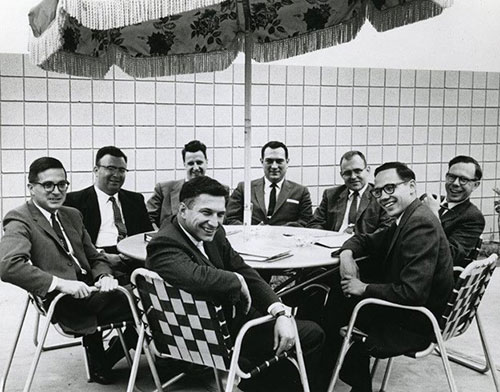
After the division’s first general manager left Fairchild to start a competitor, Noyce took the helm and Moore became head of research and development.
Over the next few years, Fairchild developed the planar transistor, and Noyce devised the first integrated circuit (Jack Kilby of Texas Instruments had built a more primitive integrated circuit a few months earlier, but Noyce and Kilby are credited as co-inventors).
“We had no idea at all that we had turned the first stone on something that was going to be an $80 billion business,” wrote Moore in 1994. By the late 1960s, Fairchild grew to be a $150 million business with 30,000 employees.
Meanwhile, the parent company on the East Coast developed management problems, went through two CEOs in six months, and Noyce was passed over to be the next CEO. Noyce left, and Moore decided he’d be better off with him.
Moore as Intel’s ‘virtuoso of technology’
“You could not have asked for a stronger founding team than those two,” said Leslie Berlin, author of Noyce’s biography, “The Man Behind the Microchip,” in a conversation with Circuit News. “There had only been a semiconductor industry as long as Bob Noyce and Gordon Moore had been in it.”
At that time, semiconductor products sold in low volume, were relatively simple and often customized for each customer. “We thought we saw in semiconductor memory an opportunity to make a product of almost arbitrary complexity that could be used in all digital systems, and that would change the leverage from low-cost assembly back to cleverness in processing silicon,” Moore wrote.
Based on this idea, Moore and Noyce wrote a one-page business plan, sought funding from venture capitalist Arthur Rock, and NM Electronics (later renamed Intel, for Integrated Electronics) was off and running. According to Rock, Noyce was the visionary, Moore the “virtuoso of technology” and Andy Grove, Intel employee no. 3, was the technologist turned management scientist.
Moore brought a propensity to try new things, and Intel investigated different methods to develop memory technology. Intel settled on silicon gate MOS, and gained a seven-year lead on the rest of the industry. “You can’t plan something like that,” Moore told PC Magazine. “We just hit a technology that was just at the right degree of difficulty to give a startup a really big kick.”
Using this approach, Intel was first to market with SRAM and DRAM memory, and later invented EPROM and the microprocessor. Intel led many of these markets, thanks in part to the relentless pursuit of progress that we now know as Moore’s Law.
The Origin of Moore’s Law
The year 1965 marked the 35th anniversary of Electronics magazine, which asked Moore to “predict the future of semiconductor components for the next 10 years.”
Moore looked back to 1959, the first year of the single planar transistor, from 1965 when they’d reached 64 transistors on a circuit. “I said ‘Aha, it’s been doubling every year,’” and in the paper titled, “Cramming more components onto integrated circuits,” Moore predicted that pace would continue for the next 10 years.
“For that 10 years we followed that doubling every year really quite precisely,” Moore said. In a 1975 speech, Moore revised his prediction to every two years, which has remained surprisingly accurate through today.
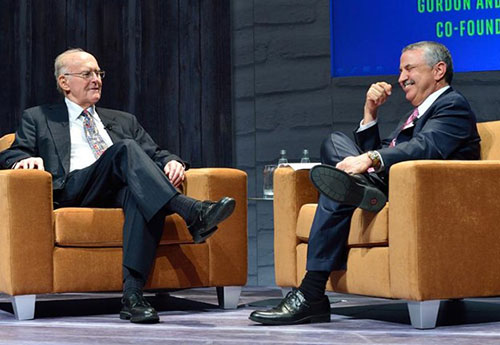
“Somebody else dubbed it Moore’s Law,” he noted, likely Carver Mead from Caltech. At a 2015 event celebrating the law’s 50th anniversary (see photo), Moore told Thomas Friedman that, “For the first 20 years, I couldn’t utter the term Moore’s Law. It was embarrassing. It wasn’t a law. Finally, I got accustomed to it where now I could say it with a straight face.”
Moore’s Law signifies not just ingenuity, but also persistence – a critical ingredient, Arthur Rock told Fortune, that Moore brought to Intel: “It was Bob Noyce who had strokes of genius. But he couldn’t stick to anything. Gordon was the opposite. He didn’t invent things, but he clearly saw the way to get somewhere. He more than anyone else set his eyes on a goal and got everybody there.”
Shaping Intel
As far as official titles, Moore initially served as executive vice president and became president of Intel in 1975, CEO in 1978, and was elected chairman and CEO in 1979. He remained CEO until 1987 and was named chairman emeritus in 1997, which he held until 2006.
Unofficially, much of how Intel runs its business can be traced to Moore, such as:
- The coupling of technology development and manufacturing. At Fairchild, Moore found it increasingly difficult to transfer technology from the labs to manufacturing. As manufacturing grew more competent technically, Moore wrote, “they were less willing to listen to the people in the laboratory as the experts.” At Intel, Moore fought to make the development-to-manufacturing transfer as efficient as possible, a tradition that carries through to this day.
- Investing through downturns. “One of my favorite things to say is that you never get well on the old products,” Moore said in The Art of Business. “You have to keep developing new products through the recession.” This strategy paid off for Intel several times, most recently by Craig Barrett in the early 2000s and by Paul Otellini through the latter half of the same decade.
- Speed, speed and more speed. Moore recognized early that the companies earliest to market with new technology were the ones that survived. And when doing so, because the price of semiconductors falls so consistently, it’s imperative to move volume quickly. “Inventory rots,” Moore noted. “You put the thing on the shelf and the value decreases at the same rate. It’s kind of like a fresh fruit business.”
There are countless more examples. With Noyce, Moore created one of the most successful companies in history. According to Moore, it was all by accident.
“The accidental entrepreneur like me has to fall into the opportunity or be pushed into it,” Moore wrote. “Then the entrepreneurial spirit eventually catches on.”
In the book, “Companies That Changed the World,” author Jonathan Mantle wrote, “Moore and Noyce must rank among the great inventor-entrepreneurs of all time.”
As for Intel and INFORMS, the corporation won the 2020 Franz Edelman Award for using advanced analytics to develop an innovative capability that spans product architecture design through supply chain planning with the dual goals of maximizing revenue and minimizing costs.
[For a timeline of Moore and Intel, click here.]

Philanthropist, Environmentalist, Honoree
In September 2000, Moore and his wife established the Gordon and Betty Moore Foundation with an endowment of $5 billion. In 2001, the Moores and the foundation donated $600 million to Caltech, then the largest donation ever to a U.S. institution of higher learning.
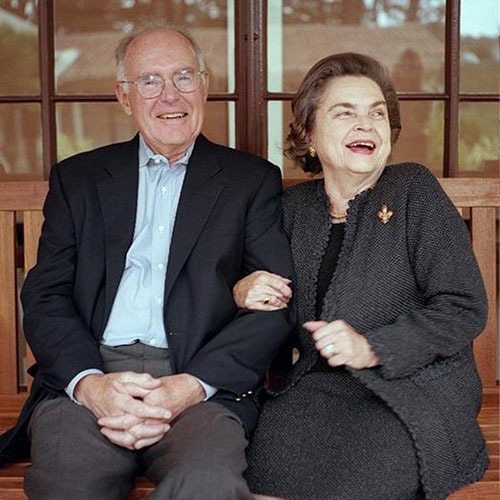
In 2004, Business Week put the Moores and their foundation in the No. 2 spot –behind Bill and Melinda Gates – on a list of the most generous philanthropists.
According to its website, the foundation is dedicated to advancing environmental conservation and scientific research, as well as helping to improve quality of life in the San Francisco Bay Area. In a television interview, Moore told Charlie Rose that “Giving money away is easy. Giving money away intelligently is not.”
Moore was a longtime outdoors enthusiast and is credited with instilling Intel’s now-industry-leading commitment to environmental stewardship.
Moore was soft-spoken and unassuming, but the world took notice of his great accomplishments. Moore received the National Medal of Technology in 1990, and in 2002, the Presidential Medal of Freedom, the highest civilian award in the United States. In 2008, Moore received the IEEE Medal of Honor.
In 2022, Intel CEO Pat Gelsinger announced the renaming of the Ronler Acres campus in Oregon – where Intel teams develop future process technologies – to Gordon Moore Park at Ronler Acres. The RA4 building that’s home for much of Intel’s Technology Development group was also renamed The Moore Center and its café, The Gordon.
“I can think of no better way to honor Gordon and the profound impact he’s had on this company than by bestowing his name on this campus,” Gelsinger said at the event. “I hope we did you proud today, Gordon. And the world thanks you.”
Editor's note. This tribute was originally published on Intel’s intranet for employees worldwide.
Jeremy Schultz is head of content strategy in Intel’s global communications group, helping bring the company’s Gordon Moore-inspired story of relentless innovation to employees and the public.