June 30, 2023 in In Memoriam
Remembering Harry Markowitz
SHARE: PRINT ARTICLE: https://doi.org/10.1287/orms.2023.02.11n
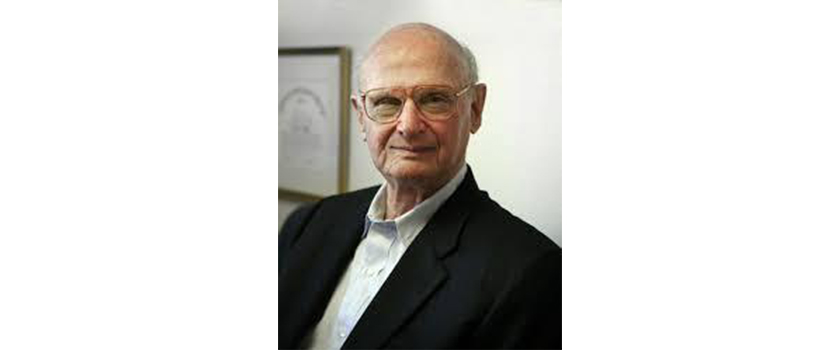
Harry Markowitz was:
- Co-inventor of the SIMSCRIPT Simulation Language
- Nobel Laureate in Economics
- Father of Modern Portfolio Theory
- Early proponent of (if not the first to use) Sparse Matrix Methods
- Co-founder of CACI International
- Recipient of the INFORMS John von Neumann Theory Prize
- All of the above
Yes, folks the answer is g. To enumerate: SIMSCRIPT was one of the first discrete event simulation languages; Harry won the Nobel Prize for his work on portfolio theory; sparse matrix methods optimize matrix calculations when most of the elements are zero; CACI is a 22,000 employee company that grew out of the SIMSCRIPT language; and Harry received the von Neumann prize for a, c and d, above.
How I Met Harry
I include this because it is a poster child for my motto that none of my successes have been planned and none of my plans have been successful. According to Harry, he had been indoctrinated in Rational Expectation Theory by my dad, Jimmie Savage, while a student at the University of Chicago in the 1950s. And although I knew Milton Friedman, a close collaborator of my dad’s and Harry’s advisor, I had never met Harry myself and was unaware of his work until the 1980s. But, in 1994, I was invited to present at a finance conference in London, the promotional literature for which said that Harry would be there. How cool to meet Harry Markowitz, I thought. Shortly before the conference, it became clear that Harry’s presence was sort of a bait and switch, and the attendees were informed that Harry would not make it after all. I was upset but planned to go anyway. However, I realized that if I left for London a day later, I would be jet-lagged for the conference (take that for your bait-and-switch deal). But leaving later also meant I would be able to attend the 80th birthday party of George Dantzig (inventor of linear programming) at Stanford University. And, who did I meet at George’s party? Harry Markowitz! “OMG,” I said, “It’s Harry Markowitz.” “OMG,” he said, “It’s Jimmie Savage’s son.”
We have remained friends ever since, and he joined me as a co-founding board member of nonprofit ProbabilityManagement.org in 2013. Harry spent much of his career in the area of computer simulation, in which there were inevitably questions around the input assumptions. The discipline of probability management represents uncertainty as auditable data. Harry used the word provenance to describe the pedigree of a probabilistic estimate, and this word has carried over into our open standard.
The Efficient Frontier
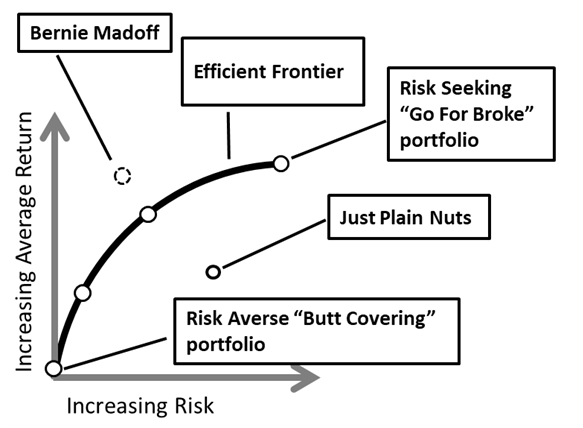
Harry’s most impactful work was in the area of portfolio theory, which divides investments into three categories: rational, irrational and impossible, depending on their relative risk and expected return as shown below. The rational portfolios lie along an “efficient frontier,” ranging from low return, low risk in the Southwest to high return, high risk in the Northeast. The correct portfolio for you depends on your risk attitude. Any portfolio to the right of the frontier is just plain nuts because there is a point on the frontier to its Northwest, which has more return and less risk. Risk return combinations to the left of the frontier are flat out impossible, and interestingly, this is how they caught the fraudster, Bernie Madoff.
The Long and Winding Road
Harry’s portfolio theory was so original that during his doctoral defense, Milton Friedman said, “This isn’t economics.” According to Harry, someone else on the committee said, “This isn’t mathematics.” Then a third quipped, “This isn’t literature.” It seems hilarious today, but anyone who has been on the receiving end of a doctoral defense will understand that Harry did not appreciate the levity at the time.
Later, Harry co-developed the SIMSCRIPT language while at the RAND Corporation and co-founded CACI in the 1960s to provide training and support for it. Again, it was not smooth sailing. According to Harry, “They fired me when I had 47.5% of the stock. This was shortly before we went public, so I didn’t do too badly. I did okay financially” [1]. Today, CACI has a market cap of $7 billion.
By 1980, Harry knew that he was pretty much in line for the Nobel Prize in Economics for his work on portfolios. So, when he heard in 1981 that James Tobin won the Nobel Prize for Portfolio Theory, it came as a blow. He told me that he figured this had been his best and only shot at the prize. So, he took a drive in the country to clear his head, and then got back to leading his life. In 1990, when he got off a plane in Tokyo and was mobbed by reporters asking him about his own Nobel Prize that had been announced while he was sealed in a metal tube over the Pacific, he was equally shocked.
Harry Markowitz on (Metaphoric) Steroids
Those who have worked with Harry know that he was like a man on steroids. He would jump between subjects, interjecting mathematical theorems with jokes, stories, economic insights, biology, evolution or whatever else came into his creative and powerful mind. When I last visited him in San Diego a couple of years ago, he was still extremely sharp and energetic. One of my favorite memories is a long-weekend phone call I had with him many years ago. It was just after he had undergone knee surgery and actually was on steroids! That Harry Markowitz would have won four Nobel Prizes.
Editor's note. Discover more about Harry Markowitz, his accomplishments and his life, through another heartfelt tribute of appreciation by INFORMS member John Guerard. Read "Harry Markowitz: An Appreciation" on the International Institute of Forecasters blog.
Reference
- Oral History of Harry M. Markowitz, Computer History Museum, 1986, http://archive.computerhistory.org/resources/text/Oral_History/Markowitz_Harry/102658332.05.01.acc.pdf.
Sam L. Savage is the author of The Flaw of Averages: Why We Underestimate Risk in the Face of Uncertainty, the book that started the probability management revolution. He is executive director of ProbabilityManagement.org, a 501(c)(3) nonprofit that has been cited in the MIT’s Sloan Management Review for “improving communication of uncertainty.” He is also a consulting professor at Stanford University and a fellow of the Judge Business School at Cambridge University. Savage is the inventor of the stochastic information packet (SIP), a data structure that lets simulations communicate with each other, and he is the chief architect of the SIPmath Modeler Tools. He holds a PhD in computational complexity from Yale University and is a longtime member of INFORMS.