
June 15, 2023 in Simulated Society
The Effect of Charismatic Influencers on Societal Polarization
Observations of a simulated society
SHARE: PRINT ARTICLE: https://doi.org/10.1287/orms.2023.02.12
Polarization in society seems to be increasing despite modern technologies making communication more convenient than ever before. The ease of communication at scale has given rise to the phenomenon of online influencers, who have become a common feature of social media platforms. There is a complex relationship between the role of influencers, the community, the social context and the message that influencers promote. Moreover, the effect of these factors on societal polarization is not well understood. For example, the specific factors that exacerbate polarization are difficult to determine. Is it the nature of the message or the ability to attract and influence others (i.e., charisma) that makes the most difference? What effect does the type of society have on polarization? Are influencers more or less effective in promoting their views in societies that have a greater openness toward the beliefs of others?
To answer these questions, we conducted a study in an artificial (simulated) society of individuals interacting with one another, exchanging views on a divisive issue, and forming or breaking social connections because of those interactions. We then introduced an influencer into this society. By varying the characteristics of the influencer and their message, as well as the properties of the communities in which they operate, we were able to observe the combined effect of these factors on societal polarization.
Our results show that the charisma of an influencer and the type of message the influencer promotes (extreme or moderate) play an important role in the process of polarization – in particular, the rate of polarization. Our results also suggest that the type of society in which the influencer operates has a less significant role.
Societal Polarization and Online Influencers
Societal polarization is a complex process of social division resulting from ideological disagreement followed by distancing between groups on significant issues. For example, climate change, Brexit, the COVID-19 pandemic, gender identity and the age of retirement (in France) have received a lot of media attention recently and have been the subject of intense public debate in which their potential to divide communities has been made apparent. Disagreement within the broader community can be amplified within closed groups, where members share the same position, owing to the echo-chamber effect, making the group position more extreme and increasing the ideological distance between the in-group (“us”) and the out-group (“them”).
Extremist influencers are a ubiquitous presence online and in social media. By definition, they promote a view that is closer to one end of the spectrum of belief held by the community at large. Although many can be characterized as promoting “conservative” or “right-wing” attitudes, influencers are found at both poles, with “liberal” or “left-leaning” influencers also shaping the public debate. There is evidence that extremist influencers on social media can spread polarizing content faster [1]; however, it is not clear whether this increases societal polarization.
Neutral influencers (i.e., those seeking to promote moderate, often fact-based, central views on an issue) are also contributors to public debate. These include public or government agencies and institutions, such as the Centers for Disease Control and Prevention, Office for Health Promotion in the U.K., and National Institute of Allergy and Infectious Diseases in the U.S. These agencies often seek to influence public opinion through online and social media campaigns. Again, it is not well understood whether this type of social influence is effective as a buffer against societal polarization.
Finally, because all debate and potential influence occurs in a social context, we investigate the impact of societal openness (or levels of acceptance) to the beliefs of others on the effectiveness of the influencer to increase or mitigate societal polarization.
Agent-based Modeling
We used agent-based modeling (ABM) [2] to study the way polarization might be shaped by the attractivity, reach and nature of the influencer’s message. To do this, we simulated an artificial society of agents (individuals in a closed society) who have differing levels of belief on an issue and interact within a society with various levels of openness toward the beliefs of others. By simulating successive interactions between agents, the complex net effect of individual interactions over time on a population could be observed, making this approach ideal to study the process of polarization in societies and the clustering of those who have extreme beliefs. We then introduced an influencer with varying levels of audience reach (charisma) taking either an extremist or neutral stance on an issue, thus enabling us to observe the role of influencers in these processes.
Computational models that help understand complex societal dynamics such as polarization are often derived from social psychological theoretical models, such as those on the spread of social influence. According to these models, influence or belief disseminates through a society as the result of interactions between individuals and is shaped by the variation in differing opinions. The ABM that we use in our study is based on three types of social influence models: (1) assimilative: individuals who are connected by a shared social identity always influence each other toward reducing the difference between them; (2) similarity biased: only individuals who are sufficiently similar can influence each other; and (3) repulsive: individuals who are highly different repel each other [3]. Our model assumes that individuals form a social bond with each other when they hold a similar level of belief [4]. These bonds strengthen over repeated interactions between individuals with similar levels of belief, but they also weaken over time if the individuals fail to interact or if they interact but now hold sufficiently different levels of belief [5]. Thus, agents in our model form bonds based on similar levels of belief, which evolve over time, reflecting changes in belief and interaction history. Within this artificial society, influencers are treated as zealots, advocating a point of view, who broadcast their position to others but do not form social bonds or change their own beliefs.
For our study, we created an artificial society in which each member had the same degree of confidence, or acceptance of the belief in one another, for assimilative interactions. We varied the level of confidence in our experiments to simulate closed, moderately open and very open societies. Thus, in very open societies, for example, individuals would be accepting of the greatest difference in the belief of others (for the purpose of an assimilative interaction and forming or strengthening a social bond). To examine the effect of the influencer on polarization, we also varied the influencer’s charisma or reach – that is, the confidence of non-influencers in the message of the influencer. In our simulation, a very charismatic influencer would be positively regarded by individuals with widely varying beliefs. They would have a wide reach. To test the effect of message content, we experimented with the influencer promoting either a moderate or an extremist point of view. Finally, we also varied the activity of the influencer – that is, the rate at which they broadcast their message.
Experiments
Because societies divided on a single issue will always tend to polarize [6], our experiments focused on the degree to which the activity of an influencer increased or slowed the rate of polarization. We used two indicators of polarization. The first was the degree to which individuals formed strong positive or negative beliefs (ideological extremitization), measured as the time at which 80% of individuals had completely polarized (+1 or −1 on our belief scale). The second measure was the time at which two distinct clusters had formed (indicating psychological distancing).
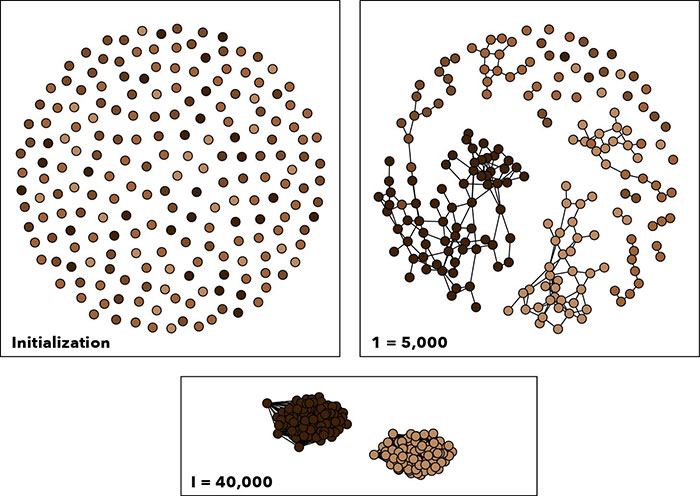
Our experiments started with agents having a belief on a single issue, set randomly between +1 and −1, and no social connections. During the simulation, interactions between pairs of agents led to changes in belief and the formation of social connections when these interactions were assimilative. Over time, a social network of agents emerged, and ultimately, polarized clusters formed. Figure 1 shows a typical simulation at initialization, partway through, and at the time two clusters had emerged.
Results
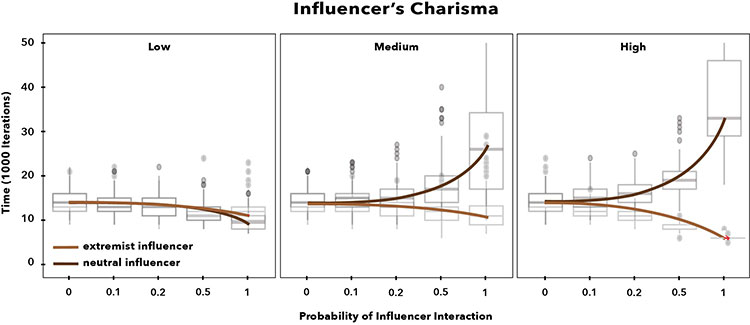
Our results show that extremist influencers always increase the rate of polarization due to both ideological extremitization and psychological distancing, regardless of the society’s openness to the beliefs of others. This confirms the commonly held concern that messaging by extremists of any political persuasion or ideology will increase the likelihood and speed of polarization within communities. Extremist influencers with a broader appeal (more charisma) are more effective in polarizing communities than those who have a narrow reach.
Interestingly, our research demonstrated that a neutral influencer who is not charismatic will also increase the rate of polarization. Analysis of our model showed that this was due to the largely repulsive influence of the interactions between individuals and the influencer. That is, rather than attract others to their point of view, their narrow reach meant that they were pushing people away. This finding is highly plausible because an unpopular (unconvincing) communicator is likely to be seen as an outsider, and hence unreliable, by both sides of the ideological divide, leading to increased polarization in both.
Finally, increased activity by a neutral and charismatic influencer will always reduce the rate of polarization. This effect is achieved by slowing the rate at which belief diverges. Figure 2 shows the time at which the artificial societies completely polarized (80% completely polarized) as a function of influencer type (neutral or extremist), their level of charisma (reach) and activity (frequency of influencer interactions). These results have been averaged over all levels of societal openness, which made only a small difference in the rate of polarization.
Implications
Our study shows that an influencer holding extreme views will always increase the rate of polarization, with this effect increasing with their reach and activity level. The effect of a neutral influencer varies with the openness to opposing beliefs in the society: slowing the rate of polarization for relatively open societies but increasing the rate when societies are more conservative or when the influencer has narrow reach.
These results have implications for the design of “influencer campaigns for social good.” For example, the credibility, the audience reach and the public capital of charismatic influencers can be used to achieve positive social change. In the U.K., the footballer Markus Rashford, a very popular athlete, used his influence as a platform to change policy on the availability of free meals for students [7]. This is a powerful illustration of the positive effect of influencers in bringing together people of various political orientations to achieve positive social change with clear benefits for some of the most vulnerable people in society (children facing poverty). That said, online influencers can also actively polarize society and harm its members. The effect of toxic influencers such as Andrew Tate on similarly vulnerable subgroups in society (young boys) highlights the dangers of charismatic influencers (with a high reach, in this case, due to a successful sports career) to polarize and even radicalize [8].
By contrast, many public good campaigns are well intentioned but use highly abstract, technical language that is off-putting to lay people, limiting influencer reach (due to low charisma). For example, the scientific community is often ineffective in this regard. Even when message content is neutral (based on facts) and driven by good intentions, scientific communication is often not trusted by segments of the public and can even create antagonism and further polarization. Historically, antismoking campaigns that were based on science but promoted fear were not very effective because they alienated their target audience (both nonsmokers and smokers alike) [9]. Scientific advice given during the COVID-19 pandemic divided public opinion on vaccination, despite the societal benefits [10]. These salutary lessons are keen reminders that how information is delivered is as important as the message itself.
References
- Asatani, K., H. Yamano, T. Sakaki and I. Sakata, 2021, “Dense and influential core promotion of daily viral information spread in political echo chambers,” Scientific Reports, Vol. 11, No. 1, pp. 1-10.
- Macal, C. M., 2016, “Everything you need to know about agent-based modelling and simulation,” Journal of Simulation, Vol. 10, No. 2, pp. 144-156.
- Flache, A., M. Mas, T. Feliciani, E. Chattoe-Brown, G. Deffuant, S. Huet and J. Lorenz, 2017, “Models of social influence: Towards the next frontiers,” Journal of Artificial Societies and Social Simulation, Vol. 20, No. 4, pp. 1-32.
- McPherson, M., L. Smith-Lovin and J. M. Cook, 2001, “Birds of a feather: Homophily in social networks,” Annual Review of Sociology, Vol. 27, No. 1, pp. 415-444.
- Skyrms, B. and R. Pemantle, 2009, “A dynamic model of social network formation,” Adaptive Networks, New York: Springer, pp. 231-251.
- Jost, J. T., D. S. Baldassarri and J. N. Druckman, 2022, “Cognitive-motivational mechanisms of political polarization in social-communicative contexts,” Nature Reviews Psychology, 1, pp. 560-576, https://doi.org/10.1038/s44159-022-00093-5.
- Tim Adams, 2021, “Marcus Rashford: The making of a food superhero,” The Guardian, January 17, https://www.theguardian.com/football/2021/jan/17/marcus-rashford-the-making-of-a-food-superhero-child-hunger-free-school-meals.
- Verma, R. K. and N. V. Khurana, 2023, “Healthy masculinities and the wellbeing of young men and boys,” BMJ, Vol. 380, p. 385, https://doi.org/10.1136/bmj.p385.
- Mahoney, J., 2010, “Strategic communication and anti-smoking campaigns,” Public Communication Review, Vol. 1, No. 2, DOI: 5130/pcr.v1i2.1868.
- Dudley, M. Z., R. Bernier, J. Brewer and D. A. Salmon, 2021, “Walking the tightrope: Reevaluating science communication in the era of COVID-19 vaccines,” Vaccine, Vol. 39, No. 39, pp. 5453-5455.
John Betts is director of education in the Department of Data Science and Artificial Intelligence, Faculty of Information Technology at Monash University. Ana-Maria Bliuc is a social and political psychologist. She joined the University of Dundee in 2019 as a senior lecturer in psychology, after working at universities in Australia since 2012. Mioara Cristea is a social and political psychologist. She joined Heriot-Watt University in 2015.