
June 13, 2023 in Issues in Education
Data Analytics Education with ChatGPT: Unlocking New AI-Powered Possibilities
SHARE: PRINT ARTICLE: https://doi.org/10.1287/orms.2023.02.14

In late 2022, OpenAI unveiled ChatGPT, its chat-based language model, and the world has been abuzz and filled with a cacophony of thoughts and opinions – everything from cries of doomsday prophecies and trepidation to elated expressions of excitement and awe as businesses and society have been scrambling to contemplate the vast array of possibilities the latest artificial intelligence (AI) technologies bring. For as many who are embracing its dazzling linguistic prowess, there are equally as many shuddering at its potential to set us back and compound myriad ethical and moral dilemmas that we are struggling to solve as it is – concerns ranging from the implications of erroneous responses, the ability to create imaginary companions, and the further deepening of the challenges of being able to distinguish fact from fiction in the never-ending battle of disinformation and misinformation.
The world of academia has been no exception. There was an immediate sense of alarm among faculty and administrators alike. Not only had yet another new tool erupted to help students cheat, this novel tool, within seconds of receiving a prompt, could produce humanlike responses in any narrative style requested. The consensus: ChatGPT was a game-changer. In addition to concerns with cheating, many academicians also expressed concerns that ChatGPT would put an end to critical and creative thinking, hinder development of oral and written communication skill development, and all but end the ability to think autonomously.
On the flip side, however, ChatGPT has captivated our minds and ignited our curiosity. We argue that ChatGPT can be used to encourage critical and creative thinking rather than destroy it; improve and enhance communication skills; and provide a vehicle for encouraging independent thought. We will acknowledge the dark side of ChatGPT (and similar tools sure to come) in the classroom, but the primary impetus for this article is to provide pragmatic ways in which these tools can add value and enhance the student and instructor experience. We aren’t alone in this endeavor; there has been much discussion about its use in education in general, but there has been little discussion about how it could be adopted for use in more specialized curriculum such as data analytics courses. Our goal for this article is to begin a discussion, and perhaps ignite a debate, about the opportunities AI-driven tools like ChatGPT provide for the data analytics student, educator and curriculum.
Potential Roles for ChatGPT in Data Analytics Education
After testing and evaluating the features and capabilities of ChatGPT, we believe this tool could potentially improve the student experience and facilitate learning and engagement in the data analytics classroom. Many data analysts and data scientists are already using AI as an aid in their daily work environment. ChatGPT promises to join the ranks as a valuable resource.
Among the knowledge, skills and abilities expected of new data analytics graduates, three key areas emerge as potential areas in which learning can be augmented by ChatGPT: coding, data analysis, and communication of the interpretation and insights from the analysis. The key to adding value with ChatGPT, as we will discuss, is providing thoughtful exercises that are laser-focused on key learning outcomes. From this approach, we believe that ChatGPT can, in fact, assist students in strengthening their coding abilities, data analytics skills, and ability to articulate analysis interpretation and data insights to technical and nontechnical audiences – all of which will enhance critical and creative thinking skills, communication skills and students’ ability to think autonomously.
Coding
Driven by natural language processing, ChatGPT’s specialty is text and language, including programming languages. When asking ChatGPT what programming languages it can write code in, the tool quickly responds with a sample list of 19 languages including SQL, Python, R, Java, C#, Ruby, Swift and even Scala. Although ChatGPT seems proud of its extensive knowledge, it does caution the user, “keep in mind that while I can provide assistance and generate examples in these languages, my proficiency might not be as extensive in all of them. If you need help with a specific language or task, feel free to ask, and I’ll do my best to help.”
ChatGPT can help students with writing simple codes in myriad programming languages, and it quickly becomes clear that complex code must be broken down into smaller pieces. Students must be familiar enough with a given language and its syntax and logic to put together the pieces to come up with a complex code that executes the instruction the student intended. Rather than being a hindrance, these limitations provide an opportunity to encourage students to think critically about how to assess the accuracy of output and work autonomously to determine how to use it most efficiently.
In the case of existing code, ChatGPT can debug, optimize and add comments. It can also explain what a block of complex code does in simple language. These features of ChatGPT provide an opportunity for students to dive into code to better understand its structure and logic while engaging their critical thinking skills. Assignments that require students to use ChatGPT to write and then examine code for bugs, or exercises that require students to input buggy code and assess the output for accuracy, could help students improve their coding skills while engaging in critical thinking.
Data Analytics
ChatGPT is not a specialized tool for analytics, but it can provide assistance given a data set and context. Students can copy and paste a data set into ChatGPT and ask for basic descriptive analytics (e.g., means, medians, standard deviation and correlations). ChatGPT can also create data dictionaries and tables and conduct sentiment analysis. Although these use cases are straightforward, students still need to understand the data set and the purpose of the analysis and perform more advanced analysis themselves in other tools. Providing assignments that require the student to input data analysis and prompts to critique and score ChatGPT’s output can help students think critically while fostering a deeper understanding of statistics and mathematical models.
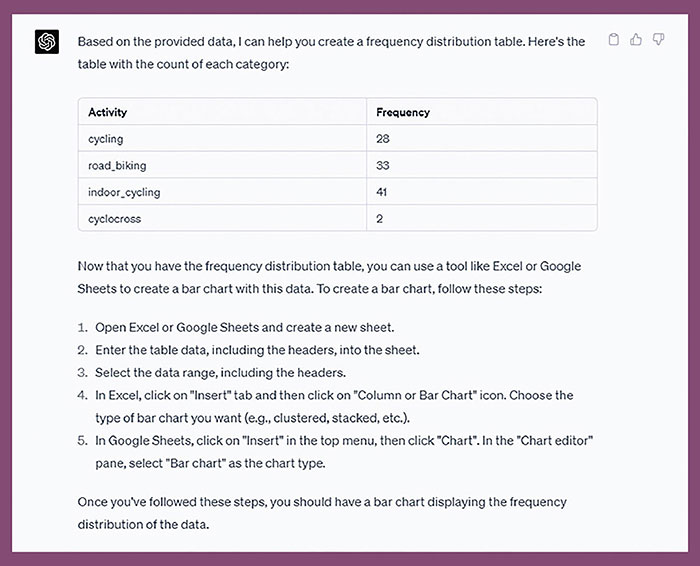
In addition to being limited to basic operations, it is important to note that on its own, ChatGPT cannot create data visualizations (at least not yet). However, it can provide guidance, instructions, code and insight on how to create visualizations. When asked about this competency, ChatGPT responded:
“Unfortunately, I cannot create visual elements like a bar chart as a text-based AI. However, I can help you prepare the frequency distribution table for your data. Please provide the data you’d like to analyze, and I can guide you through the process of creating the table. Once the table is ready, you can use a tool like Excel or Google Sheets to create the bar chart easily.”
We see this limitation as an opportunity. As you can see in Figure 1, when given the data, ChatGPT can create the frequency distribution table and provide instructions for creating the bar charts in another tool. A craftily created exercise can use ChatGPT to guide students through this process to help introduce and/or reinforce the connection between a visualization and its underlying data, as this case does with a bar chart and its underlying frequency distribution.
Articulation of Interpretation and Insights
As a chatbot, ChatGPT is very powerful and technically proficient in translating technical language for nontechnical audiences, whether it is explaining results presented in forms of graphs and tables or explaining the methodology used in an analysis in layman’s terms. It can also transform data analysis outcomes and insights into narratives for written documents, such as executive summaries, reports or white papers, and create content for presentation decks. In fact, this is ChatGPT’s specialty, and it does it well, particularly when it comes to organizational structure, grammar and form. Where ChatGPT falls short is in contextualization and originality – the writing is generic, much like a broadcaster’s tone in television news. This could provide an opportunity for educators to assign exercises with very specific content and style requirements that position ChatGPT as the starting point.
We recognize, however, that improper application or overuse of this capability could thwart students’ oral and written communication development. However, strategically applied, ChatGPT could function as a partner in learning and advancing students’ communication skills and abilities. Exercises that require students to generate narratives based on data analysis output and then require the student to dissect, critique and improve the output could provide a perspective that forces students to synthesize information to improve the narrative in context, ultimately advancing their skills.
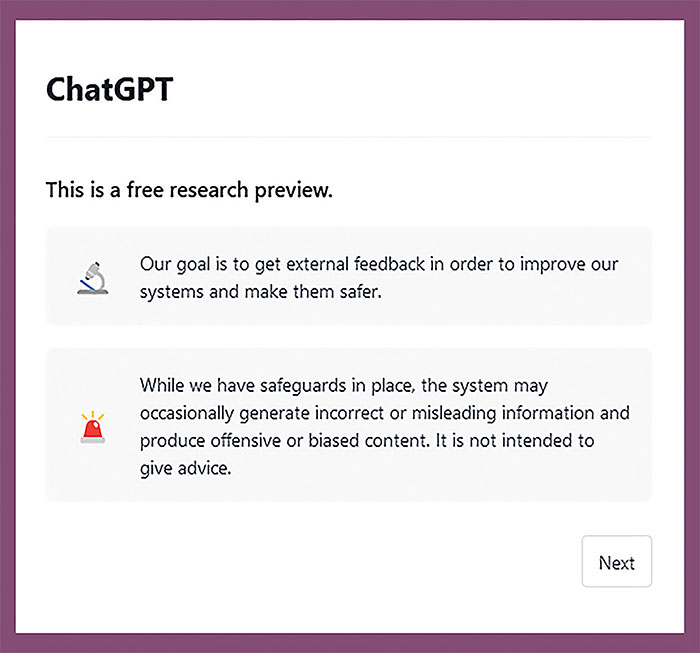
Another caveat essential to acknowledge is that ChatGPT can produce nonsensical, erroneous and inaccurate responses (see Figure 2). Understanding and considering the implications of this flaw is important for all users, but this does not negate its value. In fact, we argue that we can leverage this in specific exercises.
One way to guide students to use these capabilities is by assigning in-class team exercises in which students are allowed and encouraged to use ChatGPT. Partial points can be assigned to proper use of ChatGPT, finding mistakes in the output and refining the insights based on context. Allowing student teams to rank and grade peers would increase engagement. Another alternative is to ask students to come up with questions instead of having them answer our questions. In this way, educators encourage students to be smarter than the tool and master it. Their future may rely on this skill set.
ChatGPT as a Teaching Assistant
In addition to enhancing student engagement and learning, ChatGPT and similar AI tools can potentially help educators create new course content and build new assessments. Additionally, educators could use ChatGPT as a tutoring resource for students, which would be especially useful for larger classes or distant learning environments. However, as mentioned earlier, the accuracy of ChatGPT’s responses can be questionable at times. Thus, it will be critical, at least until this improves, to carefully vet all output before deploying it in a live classroom setting.
The Elephant in the Room: ChatGPT and Academic Integrity
It is no secret that ChatGPT poses ethical dilemmas and opens the door for cheating. However, with the nature of tasks for data analytics assignments, the level of concern does not seem as pressing as it may be in humanities courses. Regardless, there are AI solutions such as GPTZero for this AI-generated problem, which allows instructors to check students’ work. Instructors need only be aware there is no guarantee that the results are foolproof, and different AI-check tools might show contradictory results, so they should be used as a guide rather than as judge and jury.
Prevention of academic integrity violations, however, is preferable to detection of infractions that have already occurred. The pedagogical approaches we suggest in this article provide a launching point for developing assignments that are cheat-proof through their originality and integration of ChatGPT in the exercises. More complex problems and incorporating ChatGPT into assignments may be part of the solution.
Final Thoughts
The potential roles for ChatGPT in data analytics education seem endless. As the tool continues to learn and evolve – and reach the point at which its output is free from error and nonsensical ramblings – its place as an assistant, and perhaps even a partner, will become more salient. As accuracy improves, trust will improve, and educators will be more willing to lean in and fully utilize its capabilities. Meanwhile, for those who want more control of their data and privacy or want to train their own data for more accurate and contextualized models, OpenAI provides API support for application development and interfacing directly with ChatGPT.
It is too early to tell what the future of data analytics and data education in the rise of AI looks like, but it seems certain it will include AI in some form. In any case, we are thrilled to be along for the ride.
Elham Torabi is an assistant professor of computer information systems and business analytics in the College of Business at James Madison University. Rhonda A. Syler is the R. Jarl Bliss Faculty Fellow and department head for the Computer Information Systems and Business Analytics Department in the College of Business at James Madison University.