
June 20, 2023 in Roundtable Profile
Operations Research and Advanced Analytics at Dow
SHARE: PRINT ARTICLE: https://doi.org/10.1287/orms.2023.02.16

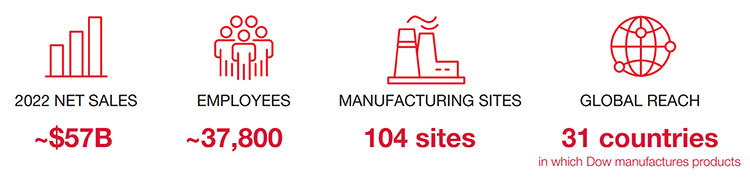
Dow (NYSE: DOW), ranked 64th on the Fortune 500 list, is one of the largest materials science companies and manufacturers in the world. Dow combines global asset integration and scale; focused innovation and materials science expertise; industry-leading business positions; and environmental, social and governance (ESG) leadership to achieve profitable growth and deliver a sustainable future.
Dow was founded in 1897 in Midland, Michigan, by chemist Herbert H. Dow, a pioneer in electrochemistry who was passionate about science and business, and equipped with a “do it better” mindset. Dow’s first commercialized product – bleach – helped shape the company’s long-standing tradition of rapid diversification of commodities. Within 20 years, Dow transitioned from inorganic chemistry to producing organic chemicals, which included phenol and indigo dye, and eventually magnesium metal. Dow continues to innovate to meet ever-changing demands of the market and society, and Dow’s current product offerings, including industrial chemicals, plastics, silicones and polyurethanes, impact nearly all aspects of everyday life. Dow made a commitment to its sustainability goals in 2015, which included becoming carbon neutral [1] by 2050. Furthermore, in 2021, the company announced plans to build the world’s first net-zero ethylene cracker in Fort Saskatchewan, Alberta [2].
Unlocking Opportunities across the Value Chain
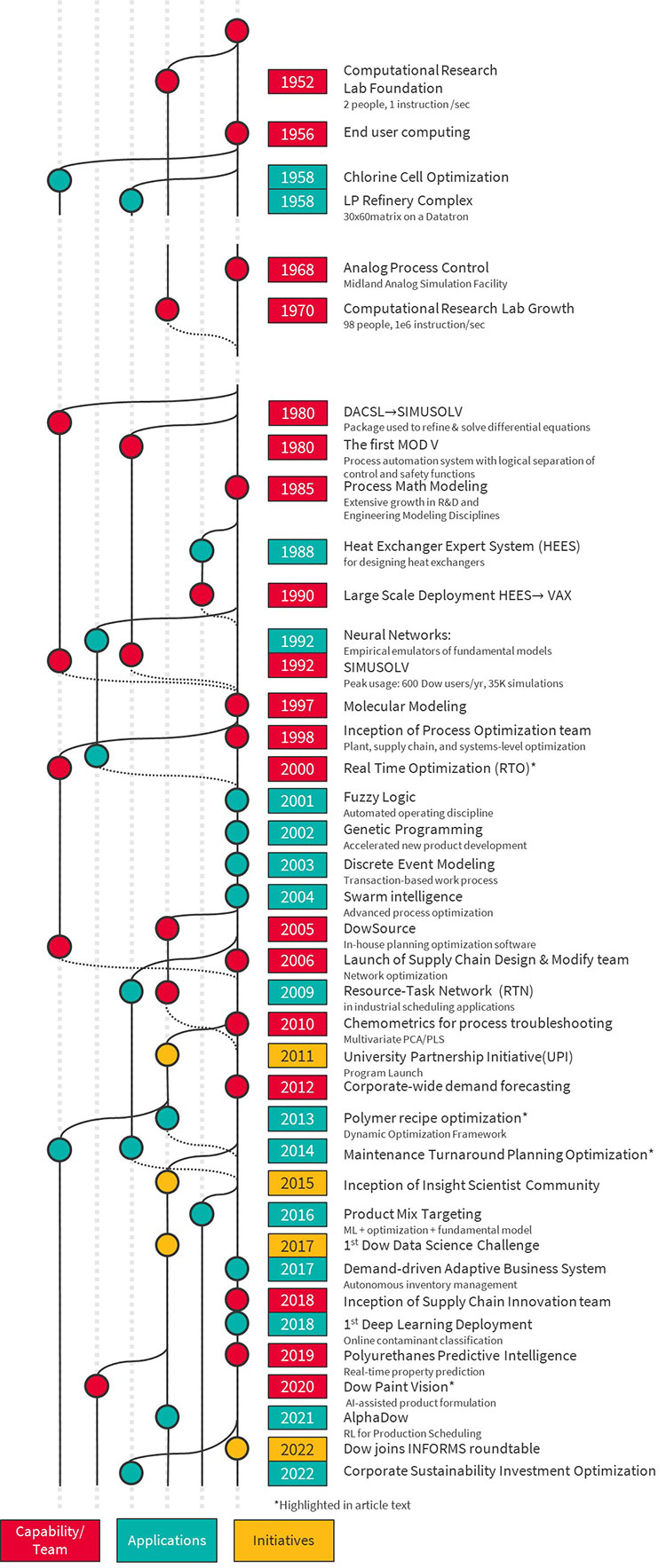 Dow was an early adopter of computing and analytics and migrated from linear programming applications in the early 1950s to enterprise-wide analytics applications today. The timeline in Figure 2 (right) depicts Dow’s digital trajectory and reflects the company’s continuous investment in computational research.
Dow’s vertical integration, magnitude of global operations, and position as a materials inventor and chemical process innovator host a thriving environment for applications across the analytics spectrum. The size of the company requires contending with staggering numbers, such as the fact that if all operations were based in the large state of Texas, it would use an estimated 4% of the state’s total power capacity, or that more than 20% of Dow’s commercial sales are made by products developed within the past five years – and this scale of operations comes with commensurate opportunities.
At the same time, Dow’s scientists are equally focused on researching phenomena at the molecular scale to invent the next generation of energy-efficient catalysts or intensify a production process to its thermodynamic limit. This offers an exciting array of addressable analytics problems, in addition to conventional supply chain applications such as planning and scheduling (see Figure 2).
The Original Digital Twins: Real-time Optimization and Power Scheduling
Since the early 2000s, Dow has strived to achieve operational excellence by using real-time optimization (RTO) with first-principle steady-state mathematical models that include material and energy balances, thermodynamic equilibrium relationships and reaction kinetics. Operating profit is maximized by considering pricing, as well as process constraints, with results implemented by using underlying model predictive controllers [3]. The optimization models, which are nearly always large-scale nonlinear programs (NLPs), are self-adjusting to process and ambient conditions and make the right trade-offs among feeds, products and energy based on total operating profit. An RTO implementation typically results in higher operating profit because of a combination of 1%-5% plant capacity increase, 1%-5% energy savings and 1%-2% overall improvement [4]. The technology is widely practiced across the company’s continuous plants, including the largest closed-loop Aspen RTO model worldwide, in terms of size and complexity at the time of deployment.
Dynamic Optimization at Industrial Scale: Polymer Recipe Optimization
In capacity-constrained situations, it is crucial to maximize the output of existing assets. In 2012, a Dow collaboration with Carnegie Mellon University led to the development of novel algorithms for off-line and real-time nonlinear dynamic optimization of semi-batch processes for polymer production [5]. This technology, along with Dow’s own experts and existing mathematical models, advanced its capabilities from simulation to dynamic optimization and yielded a 25% reduction in batch time for the chosen product. This effort highlighted the importance of Dow’s University Partnership Initiative, both as a source of new talent and economic benefit for Dow. This collaboration received the 2014 Innovative Manufacturing Leadership Award in the category of Engineering & Production Technology Leadership and is one of Dow’s outstanding examples of the transfer of technology in the space of analytics from academic collaboration to a capability that is routinely practiced today.
Breaking Decision Silos: Enterprise-wide Maintenance Turnaround Planning
Maintenance turnarounds for production plants are scheduled downtimes that can be costly, owing to both direct spending on maintenance activities and lost production time. Turnaround interval timing and scope of work are influenced by manufacturing reliability, supply chain and market demands, the economy, and labor, to name a few [6, 7]. Dow has developed mixed-integer programming (MIP) and mixed-integer nonlinear programming (MINLP)-based tools that enable economic optimization of turnarounds for individual business portfolios, in addition to Dow’s entire multibusiness portfolio. Short-term maintenance expenses and supply constraints can have a significant impact on operations, so finding a balance with long-term asset reliability risks and net present value (NPV) maximization opportunities is a must. Implementation of these models requires inputs ranging from asset-level technical models such as fouling and catalyst degradation [8], to business strategies for capital projects and long-term price predictions that require multifunction coordination across manufacturing, maintenance and reliability, supply chain, and finance teams.
AI-assisted New Product Formulation: DOW Paint Vision
Beyond the application of analytics in supply chain and manufacturing, Dow remains invested in the continuous application of data to product development. For example, the emergence of new formulations typically requires strong expertise to navigate an infinite number of combinations of ingredients, conditions, procedures, hypotheses and experiments.
DOW Paint Vision is a great example of how Dow is leveraging digitalization and machine learning in product formulations and sustainable materials to further innovation throughout the paint and coatings industry [9]. This platform empowers customers with the ability to derive new coatings solutions in a matter of minutes, accurately outlining ingredients and attributes required for specific applications. Paint Vision was recognized this year with an Artificial Intelligence Excellence Award by the Business Intelligence Group for its computer vision technology that identifies and predicts corrosion failures in metal coating applications [10].
Collaborating for Superior Results
Dow’s analytics experts span the enterprise and are organized in four ways:
- Deep analytics expertise groups within various functions.
- Global Research & Development (Machine Learning, Optimization & Statistics, Information Research – Data Science).
- Manufacturing (Chemometrics, AI & Statistics).
- Commercial/IT (Advanced Analytics).
- Embedded teams in areas of practice, such as advanced process control, real-time optimization and supply chain network design.
- Hubs for collaboration and piloting technology, such as the Digital Fulfillment, Digital Operations and Digital Marketplace Centers.
- Practitioners and teams with dual domain expertise within business units.
With analytics professionals across the organization, Dow relies on a strong practitioner network to grow talent, collaborate and share opportunities and accomplishments. Dow’s Insight Scientist Community brings together 600+ practitioners through internal poster sessions and conferences, monthly seminars that include internal and academic speakers, and the biannual Data Science Challenge, in which cross-functional teams pitch ideas to an executive panel to gain support for transformative projects.
A notable strength of Dow is its University Partnership Initiative (UPI) housed in Corporate R&D. Since launching the program in 2011, the company has pledged and invested more than $250 million in more than 10 engineering and chemistry departments in the U.S. This initiative aims to develop the next generation of leaders in consumer applications, energy, process development, transportation and modeling, while giving graduate students a chance to gain an industrial perspective on their research. The program’s outcome has ensured a robust project pipeline that extends beyond the initial 10-year time frame.
Dow’s Core Values and Ambition
Dow focuses heavily on strengthening its expertise and collaboration with industry partners, NGOs and more to help create a sustainable future for all. The company’s core values of integrity, respect for people and protecting our planet are coupled with its desired goal of delivering value growth and best-in-class performance.
Modern times call for leadership in environmental sustainability, as climate change aims to pose serious consequences for the global economy, people’s health and well-being of life. This is why Dow has set new targets in regard to advancing a circular economy and climate protection by focusing on two closely related issues: reducing carbon emissions and eliminating plastic waste.
As part of Dow’s action plan to be on a path toward carbon neutrality by 2050, it has committed to implementing and advancing technologies that enable product manufacturing by using fewer resources; improving collaboration with suppliers, customers and value chain partners; and holding itself accountable throughout the entire manufacturing and supply chain process.
Although plastic is beneficial to generating a low-carbon future, such as the reduction of vehicle weights and food waste, improved fuel efficiency and energy performance in buildings, the material is recognized as a major contributor to current global carbon emissions. Dow’s circularity mission is centered around creating a world where plastic waste ceases to exist through several steps, some of which include making key investments in technology, infrastructure and industrial ecosystems, as well as Dow’s commitment to redesigning and promoting reusable or recyclable packaging applications.
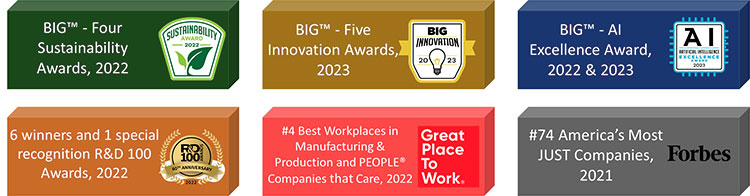
As a result of Dow’s efforts to power a sustainable future through innovation, it has recently been recognized with several awards and honors (see Figure 3).
For more than 125 years, Dow’s community of scientists and engineers has addressed some of the greatest issues that have faced people and the planet through sustainable, market-driven scientific and technical solutions. The company’s innovations helped solve challenges related to affordable and efficient food supply, housing and high-performing buildings that are suitable and long-lasting, improved personal health and comfort, and advancements in emerging technologies such as electric vehicles and smart devices. With the growing and the ever-changing complexity of questions that Dow strives to solve, the increased reliance on predictive and prescriptive analytics to find answers is certain.
Authors’ note. The authors would like to thank the following colleagues for their contributions to this article: Rahul Bindlish, Scott Bury, Leo Chiang, Ibrahim Eryazici, Jeff Ferrio, Philippe Hayot, Shachit Iyer, Sophie Kim, Sreekanth Rajagopalan, Carlos Villa, Birgit Braun, Jeff Tazelaar, Joe Czyzyk and Milan Revels.
References and Notes
- Scopes 1+2+3 plus product benefits.
- Dow Chemical Company, 2021, “Dow announces plan to build world’s first net-zero carbon emissions ethylene and derivatives complex,” October 6, https://investors.dow.com/en/news/news-details/2021/Dow-announces-plan-to-build-worlds-first-net-zero-carbon-emissions-ethylene-and-derivatives-complex/default.aspx.
- Bindlish, R., 2016, “Power scheduling and real-time optimization of industrial cogeneration plants,” Computers & Chemical Engineering, Vol. 87, pp. 257-266.
- Bindlish, R., 2018, “Operational excellence with real-time optimization,” Texas A&M Energy Institute, Texas A&M University, College Station, TX, April.
- Nie, Y., Biegler, L.T., Villa, C. and Wassick, J.M., 2013, “Reactor modeling and recipe optimization of polyether polyol processes: Polypropylene glycol,” AIChE Journal, Vol. 59, No. 7, pp. 2515-2529.
- Amaran, S., Zhang, T., Sahinidis, N.V., Sharda, B. and Bury, S.J., 2016, “Medium-term maintenance turnaround planning under uncertainty for integrated chemical sites,” Computers & Chemical Engineering, Vol. 84, pp. 422-433.
- Rajagopalan, S., Sahinidis, N.V., Amaran, S., Agarwal, A., Bury, S.J., Sharda, B. and Wassick. J.M., 2017, “Risk analysis of turnaround reschedule planning in integrated chemical sites,” Computers & Chemical Engineering, Vol. 107, pp. 381-394.
- Chiang, L., Braun, B., Wang, Z. and Castillo, I., 2022, “Towards artificial intelligence at scale in the chemical industry,” AIChE Journal, Vol. 68, No. 6, Art. no. e17644.
- https://coatings.specialchem.com/tech-library/article/dow-paint-vision-digital-innovation
- Dow, 2023, “Dow wins 2023 Artificial Intelligence Excellence Award,” March 29, https://corporate.dow.com/en-us/news/press-releases/dow-wins-2023-ai-excellence-award.html.
Maria Paz Ochoa is an associate research scientist within Dow’s Core R&D Machine Learning, Optimization, and Statistics team. She earned her B.S. and Ph.D. in chemical engineering from the Universidad Nacional del Sur, Argentina, and her postdoctorate at Carnegie Mellon University. Satya Amaran is an R&D leader for Operations Research, a group within the Machine Learning, Optimization, and Statistics team, part of Dow’s Core R&D organization. He earned his bachelor’s degree in technology from the National Institute of Technology in Karnataka, India, followed by an M.S. and Ph.D. in chemical engineering from Carnegie Mellon University.