June 20, 2023 in INFORMS Initiatives
From Numbers to Stories to Community: How DEI Ambassador Projects Led to Establishing INFORMS PRIDE Forum
SHARE: PRINT ARTICLE: https://doi.org/10.1287/orms.2023.02.20
In 2020, INFORMS launched a Diversity, Equity, and Inclusion (DEI) Ambassadors Program to empower members and fund initiatives to foster a diverse, equitable and inclusive INFORMS community. The program, now in its fourth year, has supported a variety of initiatives ranging from early outreach toward underrepresented students to an analysis of the diversity of editorial boards [1]. The projects in support of LGBTQ+ members have been a resounding success and demonstrate the importance of sustained institutional support to make the INFORMS community more inclusive.
By the Numbers: Understanding LGBTQ+ INFORMS Members
The first step toward building community was to identify the representation and distinctive support needs of LGBTQ+ members. During the inaugural year of the Ambassadors Program, Alison Murphy and Dwai Roy headed such a project. An anonymous survey was launched to gather information about (1) the demographics of INFORMS members, with a focus on gender identity, sexual orientation, and their intersection with ethnicity and national origin; (2) any negative experiences related to gender or sexuality at INFORMS conferences; (3) the awareness and use of existing DEI resources through INFORMS Connect; and (4) any additional resources that would help create a more safe and inclusive environment.
Although the response rate of the survey was low (175 INFORMS members initiated the survey, of whom 146 (~83%) completed the survey), there were still several important findings. As with the broader population, LGBTQ+ respondents skew younger (85% of LGBTQ+ respondents were under 40 compared with 65% of all respondents). We also found that LGBTQ+ respondents, especially those in early career stages, were concerned about “coming out” in an environment in which others may feel that issues of diversity and inclusion should not matter in a “society that cares about numbers.”
Several resources and practices identified through the survey have already been implemented by the INFORMS leadership team. Notably, members now have more gender identity options (beyond binary male or female) and can self-identify their sexual orientation and pronouns in their INFORMS account. These are the first steps toward providing a voice to the LGBTQ+ community at INFORMS, considering that even three years ago when this survey was launched, there was no formal way for LGBTQ+ INFORMS members to self-identify and build a community.
Another notable finding from our survey was signs that there is less acceptance, or even denial, of the transgender INFORMS community. To directly quote one of the respondents, “I [understand] lesbian, gay, and bisexual. But the whole trans thing seems made up to me.” Moreover, only 1 out of 146 respondents self-identified as a transgender person. Given these findings, we noted that future DEI Ambassador projects can make concerted efforts (possibly with support from the senior INFORMS leadership team) to shed more light onto the representation of transgender INFORMS members. Additionally, these projects can highlight the distinctive challenges faced by transgender people in INFORMS (and within broader STEM and academia) because these challenges are different and unique in comparison to those faced by LGB people.
Going Deeper: Stories and Unmet Needs
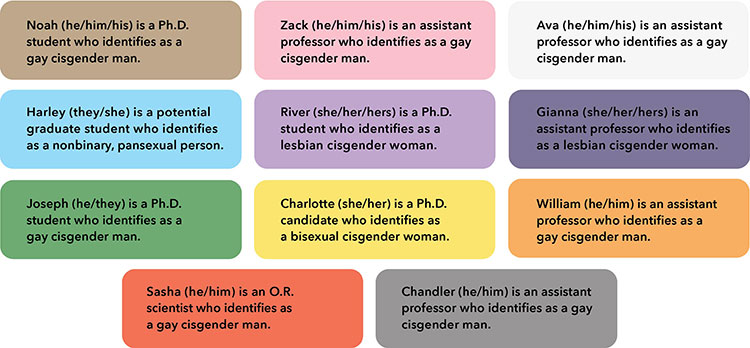
In the second year of the Ambassador Program, Tyler Perini initiated a project to capture the stories of 11 LGBTQ+ INFORMS members to underscore the human experience of being in academia by sharing, validating and empathizing with personal narratives. See Figure 1 to meet the participants (pseudonyms used). The stories highlight the unique challenges that come with an invisible minority identity. As such, “coming out” is an optional process that (1) comes with cognitive load, (2) causes emotional distress and (3) may limit how well professional relationships can form or last.
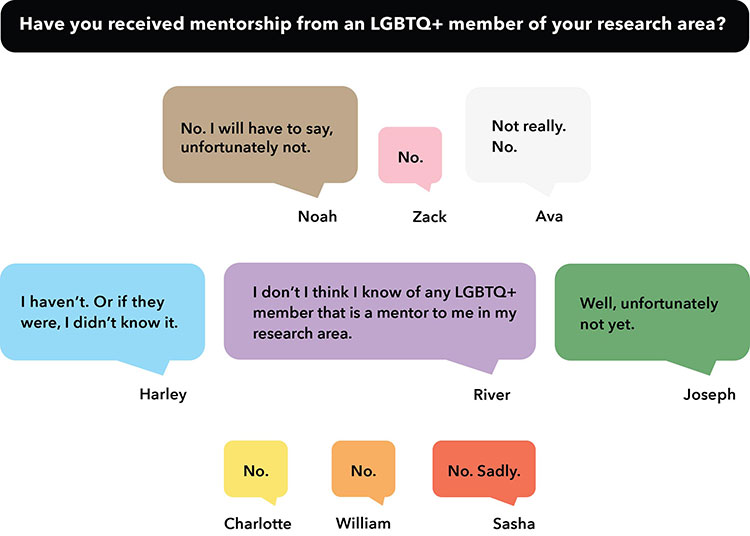
One clearly unmet demand of 9 out of 11 participants is the lack of mentorship from LGBTQ+ members of their research area (see Figure 2 responses). In fact, the majority of participants were totally unaware of LGBTQ+ researchers in their research area (at least at time of interviewing). This lack of visibility is a clear disparity between individuals in the majority and this minority group.
How “should” two LGBTQ+ individuals reveal this shared identity in a professionally acceptable manner? Consider the classic example of networking. Professional networking is important for all professionals. But many LGBTQ+ folk feel that “how they should come out” in this scenario, and many others, is an unanswered question. This question becomes increasingly difficult with rising tensions in the broader political landscape of the U.S. Therefore, establishing structures to facilitate these professional networks will be highly impactful.
Beyond networking, there are many more consequential professional relationships, in particular, those with advisors, students and colleagues. The participants displayed wide variability in which of the three relationships they were open about their identity. The majority of participants were open in two out of three, and for the third, they felt either uneasy about how to come out or apathetic about its importance. A small fraction of participants felt comfortable being out in all three.
Academia is not just an intellectual marathon but also an emotional one. Interviews suggested that, for such a taxing journey, authentic relationships are crucial to success. Participants pointed to the importance of mental health during graduate school and, often, the positive effects after having come out. For example, some relationships felt superficial or even distant until this identity was shared, after which they could bring their “full self” to the table. The details from this study can help make recommendations – on the individual and systemic levels – about what to do so that all LGBTQ+ members of INFORMS feel that they have complete freedom in bringing this identity to all of their workspaces.
New Connections: Annual Meeting Breakfast Reception
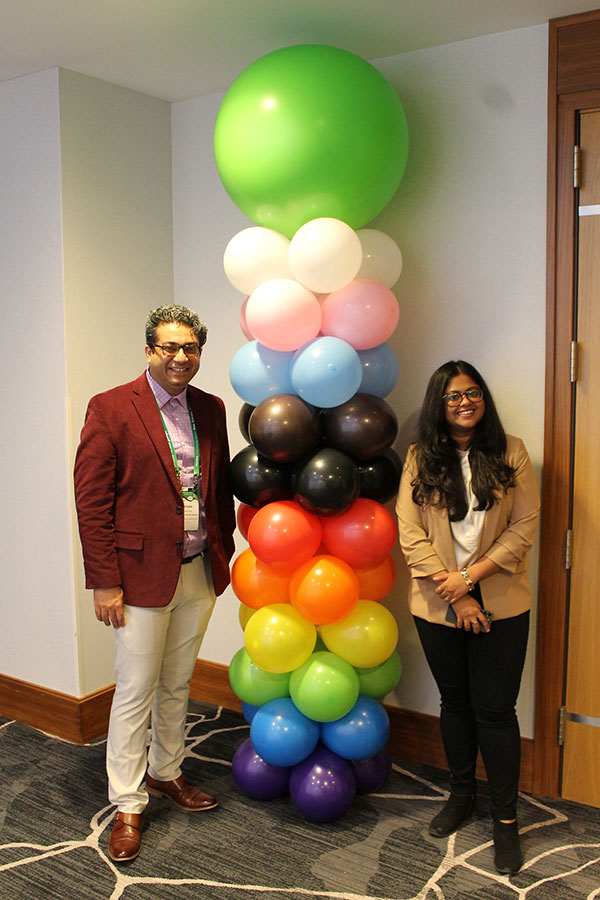 The successes of prior LGBTQ-centered DEI Ambassador projects and the connections made between Ambassadors and INFORMS staff led to the idea of a large-scale, visible event to provide a much-needed space for the LGBTQ+ community within INFORMS to seek solidarity and allyship. Priyank Arora and Pritha Dutta led the 2022 DEI Ambassador project to host an informal reception at the 2022 INFORMS Annual Meeting in Indianapolis (see photo on the right). The main objectives of the reception were to (1) celebrate and support LGBTQ+ members; (2) provide a safe space for LGBTQ+ members and allies to meet, network and seek solidarity; and (3) create a more interconnected professional community.
The breakfast reception, which took place on the morning of Day 2 of the Annual Meeting, was attended by approximately 50 members who were welcomed at the door with cookies with the INFORMS logo in rainbow colors. The reception was kicked off with a message of hope, joy and visibility of the LGBTQ+ community within INFORMS from Priyank Arora. This was followed by a speaker session in which 2023 INFORMS President Laura Albert and INFORMS Executive Director Elena Gerstmann spoke about the significance of the inaugural reception and expressed their support and commitment toward fostering a diverse, equitable and inclusive INFORMS community. The event continued with fun activities aimed at facilitating interaction among attendees and generating suggestions for future steps.
To the best of our knowledge, this breakfast reception was the first event of its kind to bring together (in a visible manner) LGBTQ+ members and allies at an INFORMS conference. The reception provided an opportunity for LGBTQ+ members to bring their full selves to the conference and mingle with other individuals self-identifying as LGBTQ+ members and allies. Hopefully, this reception also signals to individuals who may still be questioning whether to come out to their professional community that there’s a welcoming space waiting for them in the future. The breakfast also provided an opportunity to gather input from members in their own words and voices as to how to create an inclusive, equitable and safe environment for LGBTQ+ members.
The desire for more authentic interactions was immediately seen after the breakfast reception; many informal lunch meetings and get-togethers were held among some of the LGBTQ+ community members before departing the 2022 INFORMS Annual Meeting. The speed of these new connections underscored the strong demand and need for community and mentorship among the members (especially for finding senior LGBTQ+ members as mentors).
Building Community: Establishment of the INFORMS PRIDE Forum
Following the LGBTQ+ breakfast reception in Indianapolis, there was clear support to start a new INFORMS forum focused on LGBTQ+ members. Thus began the work to formally propose the creation of such a forum to the INFORMS board and leadership, which culminated with the new INFORMS PRIDE Forum officially being chartered on April 7, 2023.
The primary purpose of the PRIDE Forum is to encourage collaborative ties among individuals who share the objective of supporting and championing interests of the LGBTQ+ community. We believe that this forum will help foster an environment in which everyone is not only able to bring their whole self to the INFORMS community but also celebrated and valued for their unique identities. This diverse and visible representation of LGBTQ+ members will be of value to all members. The LGBTQ+ community at large will have healthy and positive connections and self-affirmations, and the broader INFORMS community will be able to see more perspectives within the profession and check their conscious and unconscious biases.
The PRIDE Forum will also serve as a safe networking channel for LGBTQ+ members so that they can rely on each other for support, guidance and information exchange. This is especially important because, without self-identification, it is generally not possible to identify LGBTQ+ members and allies. Hopefully, this forum will facilitate formation of a strong network of LGBTQ+ folks and allies within the INFORMS community and enhance the feeling of belonging for all. The resources, visibility and structure that come with an official forum would be particularly beneficial in organizing LGBTQ-focused tutorials, panels, mentorship programs and other social events. The forum will also proactively advise the INFORMS board on issues facing the LGBTQ+ community in the profession.
Creation of the PRIDE Forum signals strong support and conviction from the INFORMS leadership toward diversity and inclusion. We certainly believe that it is an important (and much-needed) step toward creating and ensuring a collegial, inclusive and professional environment. Although the official launch of the forum seems like a culmination of months of effort by several INFORMS community and staff members, it is in fact the beginning of our collective efforts toward creating a more interconnected and inclusive professional community. To ensure sustainability of the forum, Priyank Arora and Dwai Roy are leading a 2023 DEI Ambassador project to give momentum to the PRIDE Forum and to excite and energize the members. Planning for activities (such as a kickoff event at the 2023 INFORMS Annual Meeting in Phoenix) and programs (such as a safe zone coffee hour) during the first year of the forum is already underway.
Moving Forward
We encourage any member of INFORMS who self identifies as an LGBTQ+ community member or an ally of the community to join the PRIDE Forum. The launch of the PRIDE Forum is a milestone, full of enthusiasm and hope for the journey ahead toward more equity and inclusion in our leading international association for operations research and analytics professionals. We look forward to fostering an engaged forum that is at the forefront of supporting and uplifting LGBTQ+ members and allies within INFORMS.
Our story shows that the DEI Ambassadors Program is supporting meaningful steps toward making INFORMS a more equitable and inclusive society for a diverse range of OR/MS scholars and practitioners. We hope that the progress we have made over the past few years to build support for LGBTQ+ INFORMS members will encourage others to contribute to INFORMS as a community in their own way.
Reference
Priyank Arora (he/him) is an assistant professor of management science in the Darla Moore School of Business at the University of South Carolina. His current research interests focus on nonprofit and sustainable operations. Besides his research, Priyank is passionate about promoting the visibility and inclusion of LGBTQ+ individuals in university campuses, firms and society at large. He is the first (founding) president of the INFORMS PRIDE Forum. Pritha Dutta (she/her) is an assistant professor in the Department of Management and Management Science in the Lubin School of Business at Pace University, New York. Her research interests include sustainability, socially responsible practices, healthcare operations, agriculture and food supply chains. She is passionate about teaching and is committed to contributing to the advancement of a diverse, equitable and inclusive community in higher education. Alison Murphy (they/them) is a Ph.D. candidate in supply chain and operations at the Carlson School of Management, University of Minnesota. Their research interest is at the intersection of people operations and equity issues within healthcare. They are also passionate about increasing the diversity and accessibility of business school classrooms. Tyler Perini (he/they) is Pfeiffer Postdoctoral Instructor at Rice University’s Department of Computational Applied Mathematics and Operations Research. His research explores topics on multiobjective optimization and integer programming. He is passionate about humanizing the academic experience, platforming LGBTQ+ researchers and improving inclusivity of academia broadly. Dwaipayan Roy (he/him) is an assistant professor of business administration at the University of Virginia Darden Graduate School of Business. His research studies socially responsible operations, focusing on the ways in which organizations design, scale and sustain inclusive supply chains. Apart from being the inaugural vice president of the INFORMS PRIDE Forum, he also serves on the INFORMS Diversity, Equity and Inclusion Committee. His unique life experiences motivate his passion to create a safe and inclusive INFORMS for all.