
June 20, 2023 in Student Perspectives
Is Battery Swapping the Missing Piece of the Puzzle for Mass Electric Vehicle Adoption?
SHARE: PRINT ARTICLE: https://doi.org/10.1287/orms.2023.02.21
The phrase “as electric vehicle thrives, battery swapping revives” implies that with the increasing popularity and success of electric vehicles (EVs), the concept of battery swapping – which had lost momentum – is now being reconsidered and revived as a viable solution to improve the charging infrastructure and address the range anxiety concern of the consumer.
Electric Vehicle Landscape and Current Challenges
Bloomberg reports that the total value of electric cars sold in the passenger vehicle segment has surpassed $1 trillion [1]. The global sales of fully electric vehicles have increased by 68% percent in comparison to 2022, with a total of 7.8 million units sold [2]. EV manufacturers’ valuations have skyrocketed in recent years, which has enticed many new companies to enter the industry.
Despite this market growth and their potential, global EV sales remain at only around 10% of global car sales [3]. Although there is keen public interest in more sustainable modes of transport, consumers are not ready to own EVs on a massive scale because of several major hurdles. Three major challenges have been identified that are hindering the accelerated adoption of EVs: 1) a lack of charging infrastructure and access to and management of charging facilities, 2) high upfront purchase cost and 3) the performance of the batteries used in EVs, which presents opportunities to improve the sustainability of EV batteries throughout their life cycle [4].
How Battery Swapping Addresses the Challenges
The battery-swapping idea is an innovative business strategy; its function is akin to that of mobile service providers. It creates and manages the infrastructure network, such as charging adapters and battery-swapping stations, and provides a service for EV owners to “refuel” their vehicles [5]. Battery swapping has the potential to mitigate the obstacles impeding the widespread adoption of electric vehicles. As shown in Figure 1, battery swapping offers a feasible solution to each of the challenges previously mentioned.
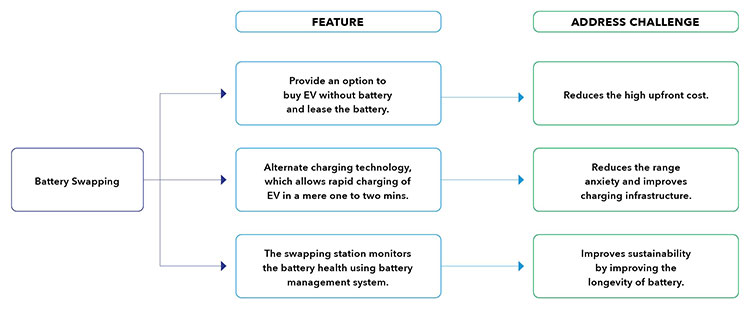
The battery is the costliest part of an EV, currently making up 35%-45% of the total cost [6]. Because of battery swapping, automakers such as NIO and Renault are able to sell EVs without batteries, which reduces the upfront cost of the vehicle. Swapping technology allows the EV owner to lease the battery and thus avoid paying the high upfront cost of the battery. Customers have the option to choose between a monthly or yearly subscription for battery-swapping services, or they can opt for a pay-per-use model based on their requirements.
Furthermore, battery-swapping stations provide a promising resolution to the issue of range anxiety among EV users during long journeys. These stations allow EV owners to replace their discharged batteries with fully charged ones that were previously stored and charged at the station. The replaced batteries are subsequently recharged and exchanged for other arriving EVs needing a battery swap. Additionally, battery-swapping stations have the facility to monitor battery health through the smart battery management system (BMS). They mount a smart BMS over the battery and monitor the temperature of battery packs, reducing battery degradation and improving battery age for application in the first and second life, contributing to sustainability. However, battery swapping has experienced a mixed level of success globally.
Failure in the U.S. to Success in China: What Lies ahead for India?
The concept of battery swapping for electric vehicles has gained renewed interest in recent years because of its potential to facilitate the mass adoption of electric vehicles. Although the U.S. has struggled to implement a successful battery-swapping model, China has emerged as a leader in this area, with several successful projects and initiatives. As India works toward promoting the adoption of electric vehicles, the question arises – what can India learn from the successes and failures of battery-swapping initiatives in other countries?
Failure in the U.S. (Past)
During the nascent phase of the battery-swapping technology, Tesla Motors and Better Place, a venture-backed entity headquartered in Israel, took the initiative to establish a network of battery-swapping stations. In 2013, the potential of widespread adoption of swappable EV battery packs in the U.S. was hindered by the collapse of battery-swap company Better Place. Subsequently, Tesla gave up on the idea a few years later [7].
One significant challenge impeding this concept was the need for a universal battery standard that multiple automakers could share. The battery packs needed to have identical dimensions and shapes to be compatible. Furthermore, during initial phases, the economics of battery swapping was not great; for example, Better Place was only offering the facility for one car, the Renault Fluence [8]. Consequently, the swapping was not sustainable.
Standardization is a key prerequisite for the commercial viability of battery swapping, and addressing this challenge is critical to the widespread adoption of the technology. China has successfully implemented a battery-swapping system for EVs by mandating battery size and shape, leading to a renaissance of battery swapping in the country. However, such a model may be difficult to implement in the U.S. and Europe due to the complexity of the regulatory framework and diverse stakeholder interests. Graham Evans, director of supply chain and technology at S&P Global Mobility, said, “It is not the same in the U.S. or Europe with its many different platforms and the battery itself becoming a unique selling point for some electric vehicles” [8].
If the U.S. and Europe intend to promote battery swapping as a viable alternative to traditional charging infrastructure, they must overcome this significant obstacle by bringing the change in strategy or regulations that require car companies to use common battery standards.
Success in China (Present)
Battery swapping has experienced a revival in China, where the technology has gained significant traction. The Chinese government has demonstrated a keen interest in promoting the adoption of EV battery swaps. China’s Ministry of Industry and Information Technology issued the following statement [7]:
“We will actively promote the demonstration application of battery-swap mode and improve the system and standardization. As the next step, we will optimize the development environment, guide enterprises to improve battery-swap technology, promote the formation of a more mature business model, and further improve the convenience of new energy vehicle usage.”
Forbes [8] reported that in 2022, only about 2% of EVs produced worldwide had battery-swapping capability, and most were found in China, accounting for 4% percent of China’s EV market. The standardization of battery has resulted in significant reductions in battery costs, and generous government leasing subsidies have also been instrumental in driving adoption. According to Bloomberg News reports [9], the Chinese government is intensifying its efforts to establish industry-wide standards that would enable EV drivers to replace their batteries in approximately three minutes. The goal is to make the process uniform across any car, any battery and any facility.
What about India? (Future)
The adoption of electric vehicles in India has experienced a sharp increase in recent years. In the fiscal year 2021-2022, more than 420,000 EVs were sold, a substantial increase from the 130,000 sold in the previous fiscal year. Notably, in December 2021, India recorded a milestone in monthly EV sales, with 50,000 units sold across all car segments for the first time [10]. This surge in EV sales is attributed to various factors, including government initiatives, tax incentives and the increased availability of charging infrastructure.
Recently, Government of India think tank National Institution for Transforming India (NITI) Aayog prepared a battery-swapping policy draft [11] and has made it available for public consultation. The proposed policy suggests allocating appropriate subsidies to battery providers in battery-swapping ecosystems, assigning unique identification numbers to swappable batteries and battery-swapping stations, installing battery-swapping stations at various locations, and prioritizing metropolitan cities with a population of more than 40 lakhs (4 million) for the development of battery-swapping networks.
The battery-swapping policy has been stalled due to strong opposition from industry stakeholders against the prescribed interoperability standards. The standards dictate the use of swappable batteries with specific outer dimensions as a prerequisite for accessing incentives. The Bureau of Indian Standards (BIS), responsible for formulating the specifications, was advised against releasing the standards because they were perceived to be biased toward a particular original equipment manufacturer (OEM). Additionally, there were concerns that standardizing battery dimensions would require substantial modifications to the existing operator and OEM platforms, making it impractical in the current business context.
Investor and battery-swapping companies such as Lithion and Gogoro India need clarity on the swapping policy. Kaushik Burman, general manager and managing director of Gogoro India (a unit of the Taiwan-based battery-swapping major), said, “India will need an investment of at least $100 billion and nearly 450,000 swap stations to handle existing requirements for two- and three-wheeler vehicle parks. So, it is a capital-intensive business and needs incentives and a firm policy direction” [12].
Timely government intervention is imperative for successfully implementing battery swapping as an alternative to traditional charging infrastructure. NITI Aayog and BIS may either release the policy without imposing strict interoperability standards or engage in further consultations with the Department of Science and Technology and relevant stakeholders to identify viable alternatives for achieving customer interoperability without mandating uniform battery pack dimensions. Such a collaborative approach can facilitate the integration of battery-swapping networks into the existing EV ecosystem while addressing the concerns of diverse stakeholders.
Acknowledgment
The author acknowledges Sofia Perez-Guzman for her valuable input and edits.
References
- Colin McKerracher, 2023, “Electric Vehicle Sales Top $1 Trillion in Wake-Up Call for Carmakers,” Bloomberg, February 14, https://www.bloomberg.com/news/articles/2023-02-14/electric-vehicle-sales-top-1-trillion-in-wake-up-call-for-carmakers.
- William Boston, 2023, “EVs Made Up 10% of All New Cars Sold Last Year,” The Wall Street Journal, January 16, https://www.wsj.com/articles/evs-made-up-10-of-all-new-cars-sold-last-year-11673818385.
- International Energy Agency, 2022, “Global EV Outlook: Executive Summary,” https://www.iea.org/reports/global-ev-outlook-2022/executive-summary.
- Frank Mühlon and Jonathan Eckart, 2020, “The Decade Of Electrification: How EVs Can Keep Us On The Road To Paris,” Forbes, September 9, https://www.forbes.com/sites/worldeconomicforum/2020/09/09/the-decade-of-electrification-how-evs-can-keep-us-on-the-road-to-paris/?sh=d805b4d7423f.
- Ho-Yin Mak, Ying Rong and Zuo-Jun Max Shen, 2013, “Infrastructure Planning for Electric Vehicles with Battery Swapping,” Management Science, Vol. 59, No. 7, pp. 1557-1575.
- James Eddy, Alexander Pfeiffer and Jasper van de Staaij, 2019, “Recharging Economies: The EV-battery Manufacturing Outlook for Europe,” McKinsey & Company, June 3, https://www.mckinsey.com/industries/oil-and-gas/our-insights/recharging-economies-the-ev-battery-manufacturing-outlook-for-europe.
- Bradley Berman, 2020, “EV Battery Swapping is Dead in US, but China Wants to Make it Happen,” Electrek, January 17, https://electrek.co/2020/01/17/ev-battery-swapping-is-dead-in-us-but-china-wants-to-make-it-happen/.
- Neil Winton, 2022, “Battery-Swapping Unlikely To Ruffle Fragile U.S., European Chargers,” Forbes, September 22, https://www.forbes.com/sites/neilwinton/2022/09/22/battery-swapping-unlikely-to-ruffle-fragile-us-european-chargers.
- Bloomberg News, 2020, “China Embraces Battery-Swapping System for Electric Vehicles,” Bloomberg, January 17, https://www.bloomberg.com/news/articles/2020-01-17/china-embraces-ev-battery-swap-technology-tesla-has-cooled-on.
- Barnik Maitra, Fabian Sempf and Prathamesh Chaudhari, 2022, “EV Batteries: To Swap or to Charge, That is the Question,” Financial Express, September 10, https://www.financialexpress.com/express-mobility/vehicles/electric-vehicles/ev-batteries-to-swap-or-to-charge-that-is-the-question/2661582/.
- NITI Aayog, 2022, “Battery Swapping Policy,” Government of India, https://www.niti.gov.in/draft-battery-swapping-policy.
- Alisha Sachdev, 2023, “EV Battery Swap Policy Stuck a Year After Draft,” Mint, March 28, https://www.livemint.com/companies/news/ev-battery-swap-policy-stuck-a-year-after-draft-11680024250547.html.
- Government of Andhra Pradesh, 2018, “Electric Mobility Policy 2018-23,” https://www.acma.in/uploads/doc/AP%20Policy_final.pdf.
- Nandan Kumar Singh and Vinay Ramani, 2022, “Battery Swapping Business Model: The Case of Lithion Power,” Cases on Circular Economy in Practice, Hershey, PA: IGI Global, pp. 28-50.
Nandan Kumar Singh is an assistant professor in the Operations Management and Decision Science Area at FORE School of Management, New Delhi, India. He was a postdoctoral fellow in Production and Operations Management Department at the Indian Institute of Management Bangalore. He holds a Ph.D. in production and operations management from the Indian Institute of Management Visakhapatnam and previously served as a Visiting Research Scientist at New York University. Nandan also holds a Micro Masters credential in Supply Chain Management from Massachusetts Institute of Technology (MIT), Centre for Transportation and Logistics.