
September 18, 2023 in Fast Delivery at Wayfair
Assessing the Environmental Impact of Fast Shipping: Toward Sustainable Ranking Solutions
SHARE: PRINT ARTICLE: https://doi.org/10.1287/orms.2023.03.09

Online retail has grown significantly in recent years, in part because of the convenience of shopping from anywhere and having goods delivered directly to one’s doorstep. Many consumers have come to expect fast shipping as a standard part of the online shopping experience, with 80% of consumers now expecting delivery within two days [1]. Policymakers are concerned that promises of fast delivery negatively impact the environment through inefficient shipping practices: especially when platforms send shipments that are only partially full in order to keep delivery promises [2]. This may result in additional trips and higher transportation- and packaging-related emissions. Despite the policy concerns, there is limited empirical evidence of the impact of fast shipping promises on environmental emissions, such as those related to greenhouse gases.
The first goal of our project is to assess the causal effects of fast delivery promises on consumer choices and shipping outcomes, for example, miles traveled by packages and resulting environmental emissions. To this end, we collaborated with Wayfair, a large U.S.-based online retailer of home goods and furniture. We quantify the causal effects of fast delivery promises on consumer choices using a large-scale field experiment in which Wayfair randomly removed fast delivery promises from the product ranking pages consumers saw online.
Empirical Setting and Experiment Description
When consumers arrive on Wayfair’s website and select a product category of interest, for example, dining chairs, they are shown a product ranking page, which features existing products in a matrix form (see Figure 1). On the ranking page, consumers observe products’ price, rating and shipping information. The latter includes an indication of whether the product is eligible for free shipping and/or fast shipping and an estimate of the delivery time to the consumer.

Products can gain fast shipping labels (badges) in two cases: 1) Products can be placed in Castlegate warehouses, which are owned by Wayfair or 2) products have a strong performance history of delivery times to guarantee that they can deliver products in a fast manner. Sellers’ incentives to provide fast shipping are driven by the fact that fast-shipped products are shown more prominently on the website, i.e., they are positioned higher in the product ranking results. The rationale is that potential consumers value fast delivery and therefore the platform more prominently features those products.
To measure the effect of fast shipping promises on consumer outcomes and environmental emissions, we use the experiment in which Wayfair randomly removed fast delivery promises and pushed get-it-by dates ahead by several days. The experiment ran for 1.5 months and spanned the entire website traffic. Consumers in the control group saw business-as-usual product rankings with all existing fast delivery promises. For the treated consumers, the platform removed 25%-75% of fast delivery promises (also called fast shipping badges), pushed back products’ get-it-by dates and changed the rankings of the affected products (see Figure 2).

As a result of the experimental intervention, the number of fast shipping badges consumers saw on the ranking pages decreased by 50%, as is illustrated in Figure 3. In the control group, approximately 23.6% of the products in the first pages of the ranking results had fast shipping promises. In the treatment group, however, only 13.2% of products had fast shipping promises. Partially, this was driven by the fact that the fast shipping badges were simply hidden, even though the product was eligible for it (8.6%), and the remaining effect was driven by the fact that fast shipping products moved down in the ranking page results (see Figure 3).
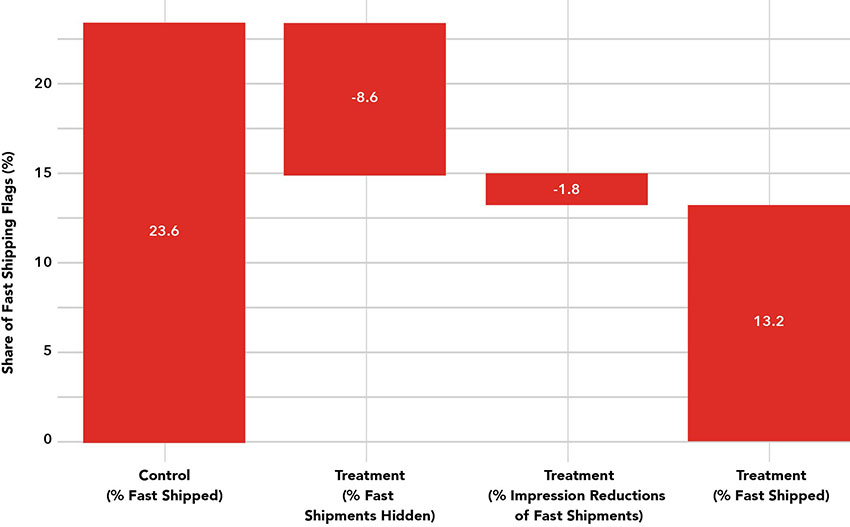
Due to the randomized nature of the experiment, we can compare the outcomes in the control and treatment groups to measure the causal effect of removing fast shipping promises. The experimental results suggest that removing fast delivery promises leads to unintended consequences. First, the experiment indicates that consumers who did not see fast delivery promises were 7% less likely to choose fast-shipped products located closer to them and instead substituted with products that were located in warehouses farther from them. This led to a 1% increase in the miles the product ultimately traveled, 2.4% longer delivery times and 2.8% higher shipping costs in the treatment group compared with the control (business-as-usual) group.
Next, using FedEx and UPS tracking data, we further document that, given the treatment groups’ product orders, the platform had limited ability to consolidate items for shipping, as measured by the number of orders that leave a warehouse at a given point in time. We find that this inability to consolidate orders led to an additional 2.5% increase in environmental emissions. Thus, removing fast shipping badges had a negative effect on consumer’s delivery experience, shipping costs and environmental emissions.
Sustainability-driven Ranking Algorithms
After establishing that removing fast delivery promises does not decrease environmental emissions, we propose an alternative multi-armed bandit-based product ranking policy to help online retail platforms reduce their environmental emissions. The proposed ranking policy balances two goals: 1) Minimizing the shipping distance to each consumer by placing products located geographically closer to a consumer higher up in the ranking page results and 2) maximizing conversion probability.
We build on the idea of a linear Upper Confidence Bound (UCB) algorithm that selects which products (arms) to show to the consumers given the expected utility (reward) of each product and the ability to explore other products. The algorithm calculates an index for each product given its past performance when shown to the consumers, such as the click-through rate. In each iteration, the algorithm updates its posterior index of the products and shows consumers the products with the highest indices.
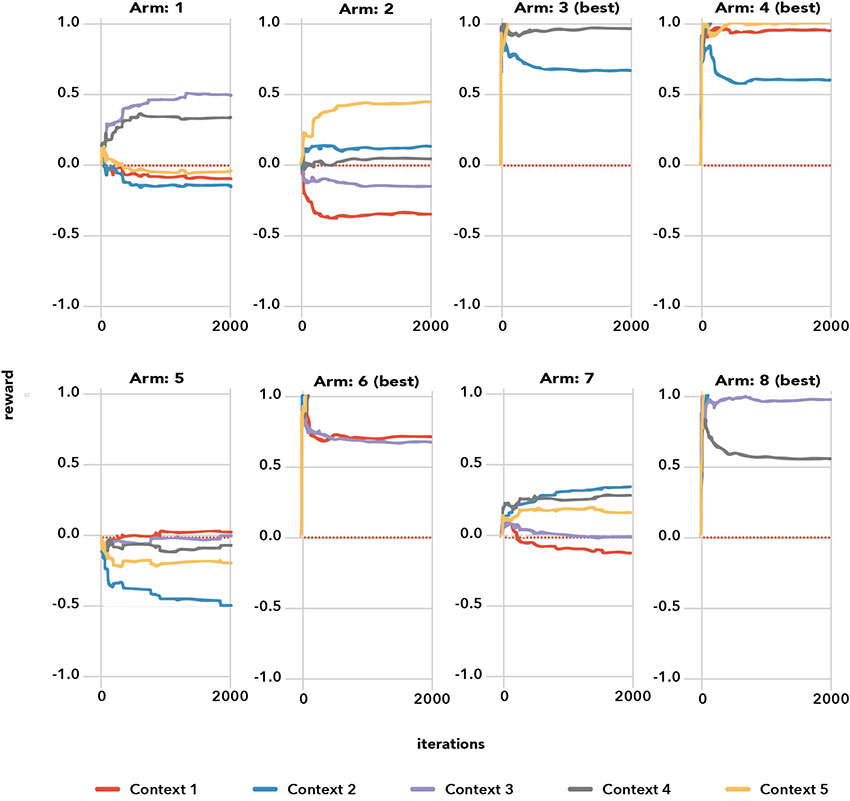
Figure 4 shows an example of an algorithm when there are eight products (arms) and five geographic regions. Suppose that products 3, 4, 6 and 8 are the best products to be shown in all regions. The algorithm starts by showing different products to the consumers. As it collects more clicks from the consumers, it gradually learns that the products 3, 4, 6 and 8 are the most-clicked ones and it converges to only showing those to the consumers.
To evaluate the proposed ranking policy and quantify consumer welfare, we estimate a sequential search model [3, 4] that captures consumer search behavior on the website and preferences toward observable product characteristics, such as price, ratings and fast delivery promises. We estimate the model on the data from the experiment described above. The experiment introduces exogenous variation in the (i) visibility of the fast shipping badges, (ii) product rankings and (iii) delivery day estimates. This variation allows us to identify the model parameters.
In the counterfactual simulations, we modify the product rankings that consumers see on the website according to the proposed ranking algorithm. We show the same rankings to all consumers living in a given state. In the simulations, consumers arrive one-by-one and sequentially search for a product. Information about previous consumers’ clicks and purchases is propagated to the algorithm so that it can update posterior indices of product relevance to the consumer. Thus, if the algorithm started by recommending an item that is eventually not clicked or purchased, the algorithm downgrades that product’s index and stops showing it to subsequent consumers. Consumers either leave the website or purchase at the end of the search process.
A unique aspect of our data that makes counterfactual simulations realistic is the observation of inventory information and history of supplier fulfillment rejection logs on the platform. The latter shows which supplier was selected to fulfill each historical order for a particular ZIP code and the full list of rejected suppliers. This information enables us to credibly identify which supplier is most likely to fulfill the order. In the cases in which the number of orders of a product exceeded average inventory levels of the favored supplier, we chose the historically next best supplier.
Using the simulations, we show that the proposed ranking algorithm achieves lower environmental emissions and reduces shipping costs by 7.84% without compromising conversion rates. However, we also document that there is significant heterogeneity among states, with some states achieving significant savings.
Overall, the results suggest that one way of decreasing environmental emissions is to nudge consumers toward more environmentally friendly products through product rankings on the retail platforms. An interesting future direction in this area could be experimenting with different messaging on the product ranking pages, which would make consumers aware of the environmental goals behind product rankings.
References and Notes
- See 2020 Flexe Omnichannel Consumer Survey and McKinsey Report “Retail Speaks.”
- For example, see, DePillis, L., 2019, “America’s addiction to absurdly fast shipping has a hidden cost,” CNN Business, July 15, https://www.cnn.com/2019/07/15/business/fast-shipping-environmental-impact/index.html.
- Kim, J., Albuquerque, P. & Bronnenberg, B., 2010, "Online demand under limited consumer search," Marketing Science, Vol. 29, No. 6, pp. 1001-1023.
- Weitzman, M., 1979, "Optimal search for the best alternative," Econometrica, Vol. 47, No. 3, pp. 641-654.
Malika Korganbekova is a Ph.D. candidate at Northwestern University. Aliya Korganbekova is a Ph.D. candidate at Boston University. Yasaman Khazaeni is a former full-time employee of Wayfair. She is currently the director of data science at Capital One. Cole Zuber is a former employee of Wayfair. He is currently the machine learning manager at Kensho Technologies. Vinny DeGenova is the associate director of machine learning at Wayfair.