October 15, 2023 in 2023 INFORMS Annual Meeting
Diving into the Deep End: 2023 INFORMS Annual Meeting Opening Plenary Drills Down on Optimal Transport and Linear Quadratic Control
SHARE: PRINT ARTICLE: https://doi.org/10.1287/orms.2023.04.01n
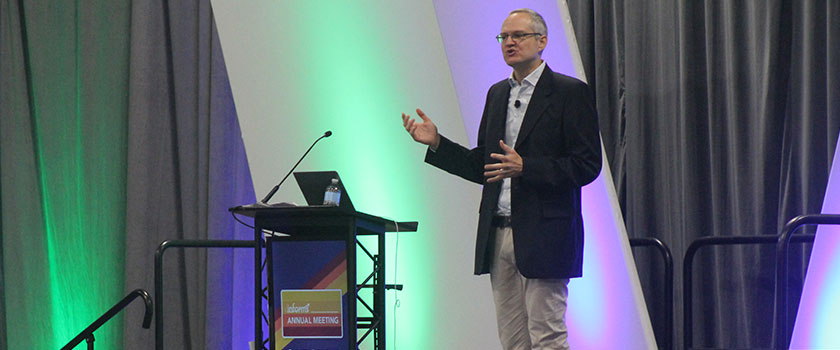
Diving right in at the 2023 INFORMS Annual Meeting in Phoenix, the opening plenary was given by Daniel Kuhn of Ecole Polytechnique Federale de Lausanne (EPFL). The IFORS Distinguished Lecture, “Distributionally Robust Optimization: The Science of Under Promising and Overdelivering,” took no time diving into the analytics and algorithms.
As a Risk Analytics and Optimization Chair at EPFL, Kuhn discussed the many decision problems in science, engineering and economics and how they are affected by uncertain parameters whose distribution is only indirectly observable through samples.
He said the goal of data-driven decision-making is to learn a decision from finitely training samples that will perform well on unseen test samples. This task is difficult even if all training and test samples are drawn from the same distribution, especially if the dimension of the uncertainty is large relative to the training samples size.
Wasserstein distributionally robust optimization (DRO) seeks data-driven decisions that perform well under the most adverse distribution within certain Wasserstein distance from a nominal distribution constructed from the training samples. It has a wide range of conceptual, statistical and computational benefits. Most prominently, the optimal decisions can often be efficiently computed, and they enjoy provable out of sample and asymptotic consistency guarantees.
Kuhn’s talk highlighted two recent advances in Wasserstein DEO. First, he spoke about the principled approach to leveraging samples from heterogeneous data sources for making better decisions. In addition, he proved the optimality of linear policies in Wasserstein discretionally robust linear-quadratic control problems with imperfect state observations, and showed that these policies can be efficiently computed using dynamic programming, Kalman filtering and automatic differentiation.
Kuhn is an obvious expert in optimal transport and transportation plans as well as linear quadratic control (LQC).
LQC has imperfect state measurements, and this method is common in our world. LQC control has been used in Apollo missions, to predict human movements, as well as treatment of neurological disease and controlling Parkinson’s disease. With the obvious importance of this method, it’s critical to make sure it’s functioning at its best possible level. This is where Kuhn tackled some new ideas. His research focuses on getting rid of the current uncertainty in LQC and creating more consistency. He focused on a possible solution involving reprioritizing controls. The original system is noisy and he proposes a noise-free system, which is possible using purified outputs. Kuhn says this possible evolution of the method can break the vicious cycle by re-expressing the formula. The “states” in the formula no longer impact the purified outputs.
His theorem findings concluded that the primal problem is solved by a linear policy and the dual problem is solved by Gaussian distribution. The plenary showcased his process of trial and error involving different changes to the algorithm. Kuhn’s summary findings scaled his process and results into the following statements:
As for the distributionally robust LQC problem, there is a zero-sum game against nature. Also, the Wasserstein ball around a Gaussian disturbance distribution results in an ambiguity set.
The structural results are that the optimal controller is linear in the purified outputs. The least favorable prior is Gaussian and strong duality holds.
Lastly, numerical solutions were that the Frank-Wolfe algorithm is used to solve nature’s problem. Also, the direction-finding subproblem decomposes into 2T + 1 simple SDP’s.