
December 12, 2023 in Decision Science
Distinguishing the Profession of Operations Research in the Age of Analytics, Big Data, Data Science and AI
SHARE: PRINT ARTICLE: https://doi.org/10.1287/orms.2023.04.06

What’s in a name? A question famously asked in the play, “Romeo and Juliet,” Shakespeare’s point is that a name by itself has no value or meaning, but rather is just a convention for distinguishing objects or people.
However, when we want to distinguish the INFORMS community and work in the age of analytics and artificial intelligence (AI), the name may matter. In a good discussion on the “Subject to” podcast about operations research (O.R.) “being the best kept secret,” Dimitris Bertsimas says, “names, unfortunately, have a tendency to carry a particular weight” [1].
And we couldn’t agree more. We want to see the INFORMS community get the recognition it deserves and attract the next generation of talent to this field. If history is any indication, what we call ourselves will always be nuanced, but now is a good time to catch the wave and distinguish what we do so that our profession stays at the forefront.
We are proposing that we call what we do decision science. We realize there are many legacy names (operations research), legacy academic departments (Industrial Engineering) and lack of consensus within INFORMS. Also, as we saw with the rise of analytics, it will likely keep evolving. Nonetheless, we are proposing the term “decision science” to get the conversation going and help people realize that these other terms are worthwhile in the age of analytics and AI.
Some Very Brief History and How We Got Here
Long before INFORMS, there was the Operations Research Society of America (ORSA) founded in 1952, and a similar group more focused on management, The Institute of Management Sciences (TIMS), founded in 1953. ORSA tended to be more military and engineering based, and TIMS was more focused on the applications of the same methodologies but to the functional areas of business. ORSA and TIMS became sibling societies and got along well for a long time, holding joint meetings twice per year. The journal Interfaces (now the INFORMS Journal on Applied Analytics) was born in 1971 as the first joint publication between the two societies.
The notion of merging ORSA and TIMS was proposed as early as 1956 [2]. For two organizations focused on efficiency, the merger sure took a long time to happen. INFORMS was not born for another 38 years when the members of ORSA and TIMS voted to merge in the summer of 1994.
In the early 2000s, there was enough interest in finding ways to better market the profession that INFORMS invested in “The Science of Better” campaign. The membership was somewhat divided on the need for this. One camp was of the opinion that “if we do good things, we’ll be recognized,” so there was no need for a campaign. The other camp recognized that most people have no idea what operations research is, which is not good for the longevity of the profession.
The rise of analytics really started in the mid-2000s. Many credit the growth in the interest and use of analytics to Tom Davenport, who published “Competing on Analytics” in the Harvard Business Review [3] and then published a book by the same name with Jeanne Harris. Not long after that, driven by demand in industry, the number of master’s degree programs in analytics and business analytics increased dramatically. INFORMS responded to this demand in analytics by developing the Certified Analytics Professional (CAP) program. It is interesting that while “The Science of Better” was a push to get more societal recognition for O.R., the demand for analytics probably did more to increase the demand for O.R. than any campaign could have. The demand for analytics, particularly prescriptive analytics, was really a pull from industry, giving O.R. more recognition and visibility.
Of course, there was a lot of confusion and different views at the time when demand for analytics was skyrocketing. Liberatore and Luo [4] surveyed INFORMS members (n = 1,892) with the question, “What is the relationship between O.R. and analytics?” The results were: O.R. is a subset of analytics (30%), analytics is a subset of O.R. (29%), advanced analytics is the intersection of analytics and O.R. (28%), analytics and O.R. are separate fields (7%) and analytics is the same as O.R. (6%). As you can see, we aren’t a group that is likely to agree on common names!
Nonetheless, the annual spring meeting at INFORMS became the INFORMS Meeting on Analytics and Operations Research and now is the INFORMS Business Analytics Conference. Sometime during the rise of analytics, within INFORMS, the use of “operations research” as a defining term seemed to take hold and “management science” seemed to be used less frequently.
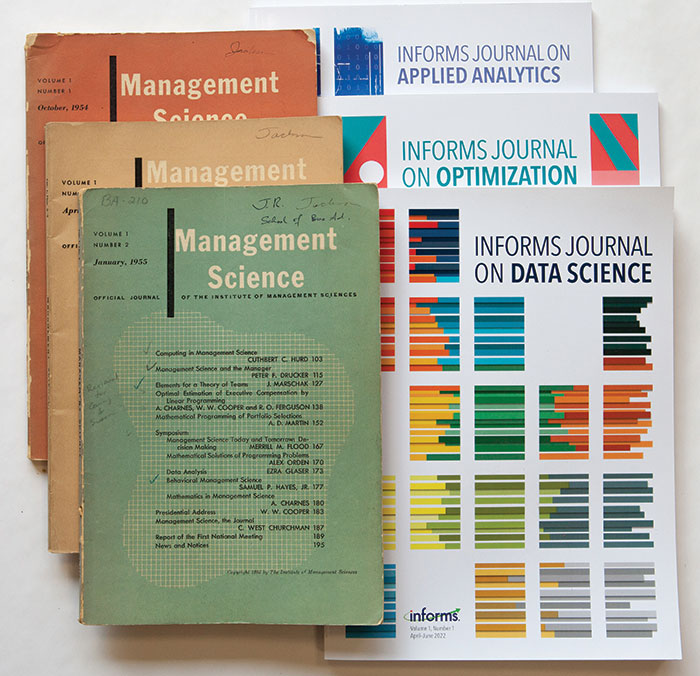 Simultaneously in the mid-2000s, prompted by the explosion of big data, demand for data science began to grow in all sectors of the economy and gave rise to interest in machine learning. Whereas the academic programs in analytics tend to contain a mix of coding, data management, statistics and some O.R., data science programs tend to be a more technical mix of computer science and statistics. In reaction to data science, INFORMS created its newest journal, INFORMS Journal on Data Science.
And now, in 2023, we see AI everywhere and want to be part of that movement. Recall we mentioned that the first proposal for a merger between ORSA and TIMS was in 1956. That was a very active year, because it was also the year of the Dartmouth Summer Research Project on Artificial Intelligence, which is generally considered to be the birth of AI as a field. In 2021, INFORMS reacted to the growth in AI and how O.R. is part of AI by creating the INFORMS AI Initiative to “Advance and promote O.R. and analytics within the AI community” and “Advocate for O.R. and analytics among policymakers and other constituencies” [5].
An Opportune Time to Make a Branding Decision
As our very brief march through INFORMS history seems to indicate, we have reacted to and undoubtedly benefitted from the movement of analytics, data science and AI into mainstream society. However, there is some danger that O.R. – because of its lack of recognition – will be lost in these movements. That is, the best talent and funding will go to other disciplines that are seen to be doing more modern AI work.
Alternatively, we believe INFORMS and its members can distinguish our O.R. profession and describe our distinctiveness in a way that will be understood by as many people as possible.
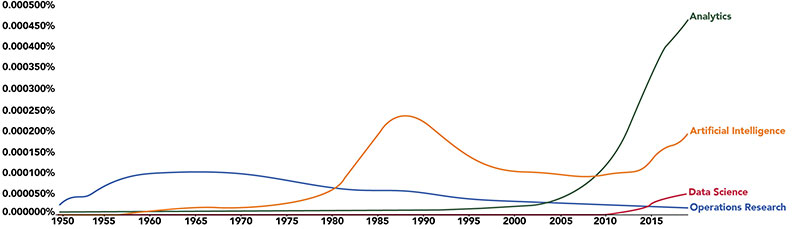
Five years ago, the first author would have strongly advocated for rebranding the profession simply as analytics (or advanced analytics). As shown in Figure 1, there is some name-recognition value in that. But the reality is, prescriptive analytics, which is where we believe O.R. resides, is the least recognized type of analytics (as opposed to descriptive or predictive analytics).
More recently, the second author advocated for rebranding to AI. Like the first author with analytics, he advocated for AI because of its popularity and because people were using it to describe predictive and prescriptive analytics work [6].
Although we believe INFORMS members play a big role in analytics and AI, both terms have many definitions, and we need a way to describe what we do as part of these movements.
Many of us in INFORMS have used the term data scientist to describe what we do and fit in with the overall movement. “Data scientist” was always an uneasy fit. On one hand, the term is used generically, so it includes what we all do at INFORMS. On the other hand, the more intuitive way to understand the term is that it focuses on analyzing data and finding patterns.
Fortunately, the term decision science is emerging from the overall analytics and AI movement [7]. We’ve known for a long time, but others are catching on, that the goal is to use data to make decisions. The term decision science is perfect for us. O.R. has always been problem-centric and decision-focused. We could be the leader in defining the field of decision science. In the O.R. profession, we do not start with the data – we start by defining the problem. We model the decision problem using tools such as optimization models, simulation models, decision analysis, rule-based systems and game theory. These models need data science for the model inputs to solve problems.
Given the societal understanding and recognition of data science, we believe decision science is an easy extension. A natural career title is decision scientist. And just like with data analyst (versus data scientist), decision analyst might be a less technical title in the decision science space. Explaining the difference between data science and decision science can be simplified to this: data scientists model data, but decision scientists model decisions. To be effective, they need each other. Furthermore, going back to 1956 for a moment, decision science is equally descriptive of the purpose of both ORSA and TIMS.
One of the reasons often cited for the failure of data science projects is there is no clear problem definition. This can happen when you become too focused on the data – seeking the hidden treasure or building predictive models that are not needed for inputs to a decision model. Hence, data science needs decision science to generate solutions to problems, and decision science needs data science for business insights and model inputs.
Now is the time for change. We believe INFORMS should take the lead in pushing the term decision science. The job title is easy to explain: A decision scientist is a natural complement to data scientist. It also better defines our contribution to the analytics and AI movement by highlighting our long history and approach to problem-solving. INFORMS could become the largest professional society for decision science. INFORMS has recently taken a step in this direction with a new tagline: “Smarter Decisions for a Better World.” Let’s jump on this opportunity and make sure our profession captures the attention it deserves.
References and Notes
- Podcast: Subject to: Dimitris Bertsimas, https://www.youtube.com/watch?v=cifspW4gLwA. The quote is after the 46:00-minute mark; the full section on O.R. being a well-kept secret starts at 43:32.
- Lathrop, J.B., 1957, “A Proposal for Merging ORSA and TIMS,” Operations Research, Vol. 5, No. 1, pp. 123-125.
- Davenport, T., 2006, “Competing on Analytics,” Harvard Business Review, January, https://hbr.org/2006/01/competing-on-analytics.
- Liberatore, M. and W. Luo, 2011, “INFORMS and the Analytics Movement: The View of the Membership,” Interfaces, Vol. 41, No. 6, pp. 578-589.
- Kulkarni, R., 2021, “INFORMS AI Initiative and the AI-OR Workshop,” OR/MS Today, December.
- Watson, M., 2021, “INFORMS Does AI, Why artificial intelligence is the best term to describe what our members do,” OR/MS Today, February.
- For example, see this video (https://www.youtube.com/watch?v=pRtGqfYLCFk) from Cassie Kozyrkov, the chief decision scientist at Google. In this video, she mentions many different disciplines doing decision science. O.R. is not mentioned.
Jeffrey D. Camm is a decision scientist, associate dean for faculty, Inmar Presidential Chair in Analytics, and academic director of the Center for Analytics Impact in the Wake Forest University School of Business. Michael Watson is a decision scientist and faculty member at Northwestern University, and an entrepreneur. His last company was Opex Analytics, which was acquired by LLamasoft and then Coupa.