December 4, 2023 in Presidential Punk Rock O.R.
On George Dantzig, “Good Will Hunting” and Tackling Hard Problems
SHARE: PRINT ARTICLE: https://doi.org/10.1287/orms.2023.04.07n
George Dantzig invented the simplex algorithm and contributed to linear programming. He introduced the world to the power of optimization, which has led to massive increases in productivity and drives the global economy (Read more in Prof. John Birge’s article here.)
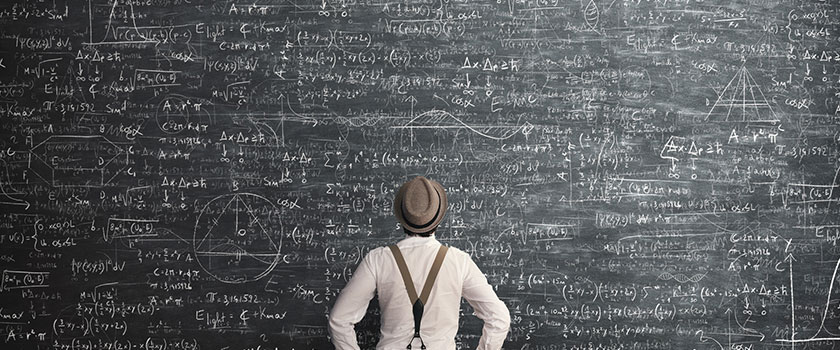
The movie “Good Will Hunting” has a scene that is inspired by the life of George Dantzig. In the movie, Matt Damon plays an MIT janitor who anonymously solves a difficult math problem that a math professor posted on a hallway blackboard.
In real life, George Dantzig once arrived to Jerzy Neyman’s class late when he was a graduate student at the University of California, Berkeley. He wrote down what he believed were two homework problems posted on the blackboard, not knowing that the problems were unsolved math problems, because he had missed the announcement at the beginning of class. He then solved the problems, apologizing to Prof. Neyman that it took longer to do the homework. The “unsolvable problems” later became the foundation of Dantzig’s thesis.
“If I had known that the problems were not homework but were in fact two famous unsolved problems in statistics, I probably would not have thought positively, would have become discouraged, and would never have solved them.” – George Dantzig
I like this story.
I reflected on this story after returning from the 2023 INFORMS Analytics Conference and again after the Annual Meeting this fall.
I have always been impressed by how the operations research (O.R.) community has never shied away from hard problems in theory, computation or practice. In fact, the O.R. community has been tackling hard problems since its early days during World War II, prior to George Dantzig’s solutions to the (then) unsolved problems in statistics. Moreover, the term “wicked problem,” which refers to problems that are difficult or impossible to solve because of incomplete, contradictory and changing requirements, was first introduced in the journal Management Science by C. West Churchman in 1967.
We are still at it.
Our dedication to solving hard problems is evident during the INFORMS Awards Ceremony at the Annual Meeting and Edelman Gala at the Analytics Conference, where we celebrate the biggest achievements in operations research and analytics. INFORMS prizes such as the Franz Edelman Award, Daniel H. Wagner Prize, Lanchester Prize, John von Neumann Theory Prize, Saul Gass Expository Writing Award, Philip McCord Morse Lectureship Award and the Fellows award recognize major achievements in the theory and practice of O.R. The winners of these awards embody the spirit of George Dantzig, and they reinforce that we solve wicked problems and make a real difference in the world.
Laura Albert is a professor and the David H. Gustafson Chair of Industrial and Systems Engineering at the University of Wisconsin-Madison. She is the 2023 INFORMS president. She is the author of the blog Punk Rock Operations Research. You can find her on Twitter at @lauraalbertphd.