
March 7, 2024 in Generative Intelligence
Transforming Generative Intelligence with Disruptive Thinking
SHARE: PRINT ARTICLE: https://doi.org/10.1287/orms.2024.01.07

The Emergence of Generative Intelligence and the Nature of Problem-Solving
The practical availability of generative intelligence on a relatively broad basis is a significant sociotechnical phenomenon – probably on par with graphical computing (GUI) and the World Wide Web. Although such inflection points/paradigm shifts are technically seismic, they coevolve with significant social implications in the context of sociotechnical systems. Technical innovation is 80% social. As a practitioner of systematic innovation/technology forecasting and an active participant in each of these revolutionary phases, I observe the present development through a particular lens. Most broadly, I aspire to improve human problem-solving and the way that we approach it by leveraging systematic innovation and “ways of thinking” (particularly “disruptive thinking”). The practical emergence of generative intelligence poses some significant problems but also offers some significant potential to improve problem-solving.
Although I’m presently exploring the relevance of generative intelligence for systematic innovation/disruptive thinking, I will focus here on the inverse proposition – the relevance of systematic innovation/disruptive thinking for generative intelligence. Language matters; ontology matters. Both orientations will ultimately reinforce one another in a recursive manner. Separating the orientations promotes the advancement of each. In exploring the relevance of systematic innovation/disruptive thinking for generative intelligence, we will adopt the premise that we need to “think differently” about this emerging domain and the problems that it poses, channeling the guidance that Albert Einstein so astutely offered: We cannot solve our problems with the same thinking we used when we created them.
We will explore a method for “thinking differently” (i.e., thinking disruptively). The first step in effectively solving a problem is effectively identifying it and defining it. Again, we’ll channel the astute (purported) guidance of Einstein: If I had one hour to save the planet, I would spend 55 minutes defining the problem and five minutes solving it.
Although perhaps a bit extreme, this illustrates an important principle. The definition of a problem often contains or suggests the solution, which may be “hidden in plain sight” if the problem is not well defined. A rigorous approach to unambiguous problem definition makes solutions more accessible and enables the solution of problems that may seem to be intractable. We will use the concept of opposing forces to define problems rigorously and solve problems unconventionally by invoking disruptive thinking. We will use the concept of a contradiction to frame sets of opposing forces and adopt a general model for problem-solving (see Figure 1). In this general model, we’ll plot an existing problem that is solved in the lower-right quadrant (Quadrant 2, or Q2). Then, we’ll introduce a “new” problem that is not solved – a problem in generative intelligence – in the upper-left quadrant (Quadrant 3, or Q3). Finally, we’ll use the combination of Q2 and Q3 – an existing problem that is solved and a “new” problem that is not solved – as a “crucible” to derive a “new” problem (our problem in generative intelligence) that is solved in the upper-right quadrant (Quadrant 4, or Q4).
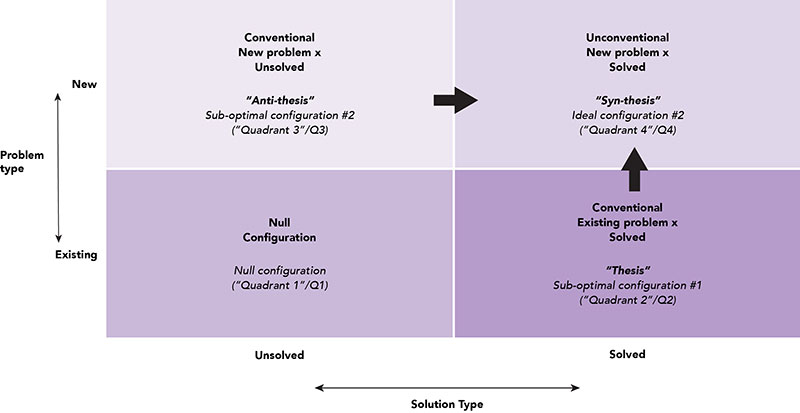
In the next section, we’ll identify a problem in generative intelligence.
Problem-Solving in Generative Intelligence
Which problem in generative intelligence shall we explore? Let’s start with the advantage of generative intelligence. Advantages and strengths are often indicators of disadvantages and weaknesses. We could cite various advantages, but we’ll focus on the essential value (and differentiation) of its generative nature – we’ll call this property generativity. We define generativity as novelty or creativity – the ability to produce something new. A new (unpredictable, nonlinear) output from a given set of inputs, beyond a predictable or linear extension of those inputs. In practice, this generative nature or nonlinear behavior can become a slippery slope: It can produce results that are random, chaotic and unhinged from reality. Such unreliable results are typically irrelevant and antiproductive. The degradation in reliability and relevance that accompanies generativity is sometimes called “hallucination.” Even casual users of a common large language model (LLM) such as GPT-3 or GPT-4 as offered by OpenAI have experienced the phenomenon of nonsensical, apparently chaotic and even fabricated output, which presents a practical quandary for users: How to make use of generative intelligence in view of such irrationality. Let’s call the property of producing reliable and relevant results fidelity. How can we preserve the generativity of outputs while enhancing the fidelity of those outputs?
Figure 2 illustrates this problem using the frame of a contradiction or tension between opposing forces. I call this problem-solving method Matrix Morphology. The null hypothesis indicates that the unconventional solution – high generativity combined with high fidelity (in Q4) – is not a possibility. High generativity combined with low fidelity (Q2) is a conventional solution; high fidelity combined with low generativity (Q3) is a conventional solution with the opposite attributes. Each of the conventional solutions compromises one of the attributes in favor of the other attribute. We aspire to both attributes – we reject and invert the null hypothesis that we must compromise one of the attributes, proposing that high generativity combined with high fidelity is a possibility. By rigorously framing the problem in this way and proposing the ideal solution as a possibility, we increase the probability of solving it and we accelerate/compress the path to resolution.
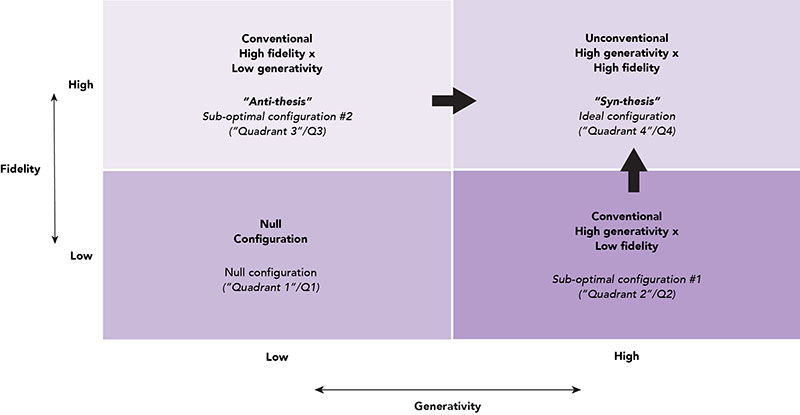
This represents our “new” problem from Q3 of Figure 1.
Problem-Solving in Analogous Domains
Of course, opposing forces occur in many domains besides generative intelligence. The method of using opposing forces for problem-solving has proven effective in numerous applications. The general approach has proven effective unconsciously (“looking backward”) – illuminating situations in which practitioners effectively used it to solve the tension between opposing forces, although they didn’t intentionally frame it that way. The general approach has also proven effective consciously (“looking forward”) – illuminating situations in which practitioners intentionally used it to frame the tension between opposing forces and solve the contradiction.
As noted, interactive computing is a significant sociotechnical phenomenon on par with the recent emergence of generative intelligence. Doug Engelbart (https://www.dougengelbart.org/) and his lab at Stanford Research Institute, the Augmentation Research Center, invented and operationalized the significant elements of interactive computing as we know it, including graphical computing and the graphical user interface (GUI). I had the good fortune to collaborate with Doug in a later era around social computing – the roots of what eventually evolved into social networking and social media as we know it.
Before graphical computing, computers were arcane devices with a text-based (“command line”) interface that were used only by technicians. Doug wanted to make computers accessible to the vast nontechnical population. He saw the world as an increasingly complex place that required more powerful tools and broader access to those tools. Doug was not a technocrat; he had a passion for the human side of technology – what he called human augmentation, or augmenting human intellect. The purpose of technology was not to replace humans – it was to augment humans. Doug was the original proponent of human-centric design as we know it and practice it today. He used a technical innovation – transcending the conventional text-based interface with a graphical interface in a hyper-text paradigm – to launch a social revolution.
Figure 3 illustrates this problem using the frame of a contradiction or tension between opposing forces. Doug proved the hypothesis that the unconventional solution in Quadrant 4 – high technical capability combined with high social accessibility – is a possibility.
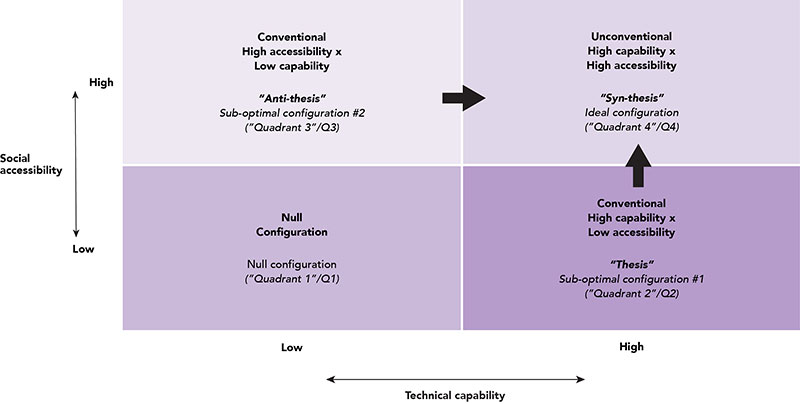
Doug didn’t explicitly claim to identify and solve a contradiction; even after becoming familiar with the mental model, I realized only gradually (“looking backward”) that Doug had solved a contradiction. I started with the premise that, if Doug had solved an important problem, he must have solved a contradiction. By adopting that premise, I eventually (meta-cognitively) discovered the contradiction that he had solved. Just because he didn’t use the mental model explicitly doesn’t mean that he wasn’t expressing it implicitly (meta-cognitively); and it doesn’t mean that we can’t become more deliberate about applying it. This problem represents an “existing problem” in Quadrant 2 of Figure 1.
As an additional reference point, let’s consider a contradiction that I identified and solved on my technical journey early in the 21st century involving the World Wide Web. Web search was progressing – AltaVista was waning, and Google wasn’t yet prominent. Web presentation and viewing was a different story; users were stuck between clunky, monolithic streaming formats and tedious, point-and-click plodding. Inspired by my collaboration with Doug Engelbart, and his frustration with social access to technical environments, I was impatient with the tension between opposing forces that was limiting human access to the web. According to the technical experts around me, resolution of the contradiction was impossible. Until it was possible. Unlike the contradiction that Doug implicitly solved in interactive computing, I explicitly identified and solved a contradiction – “looking forward.”
Figure 4 illustrates this problem using the frame of a contradiction or tension between opposing forces. I proved the hypothesis that the unconventional solution in Q4 – high experience continuity combined with high content granularity – is a possibility.
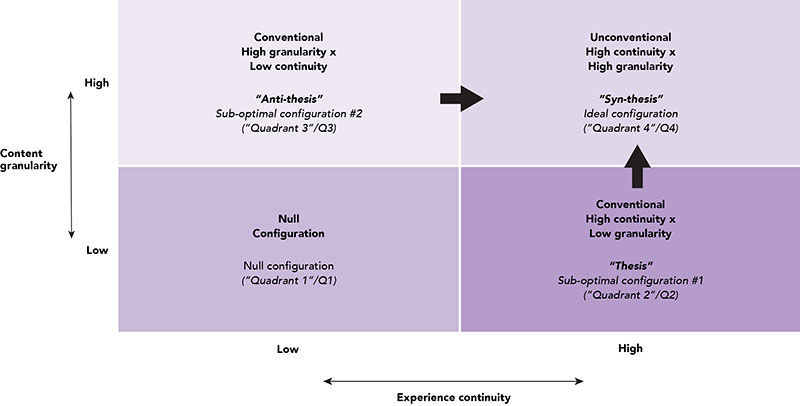
I challenged the apparent tension between Q2 (conventional media distribution; high continuity × low granularity) and Q3 (conventional web presentation; high granularity × low continuity). The two configurations were presumed to be mutually exclusive; we could achieve only one in any particular implementation. The world was constrained by the null hypothesis, which dictated that Q4 was not a possibility – the contradiction between the opposing forces couldn’t be solved. I aspired to the best of both worlds – continuous experience with granular content. I practiced disruptive thinking by “inverting” the null hypothesis. The synthesis of the two dimensions is not a compromise – by decomposing each dimension into its elements and recomposing those elements into a unified mesh, adaptive presentation expresses the strengths of both dimensions.
I earned four U.S. patents on this “impossible” solution, which I have successfully licensed for improved web experience. It earned an endorsement from Doug Engelbart for its dynamic delivery of modular content and was published as the feature article on next-generation web presentation in XML Journal – the prominent technical journal of web services and architecture at that moment in computing history. This problem represents another “existing problem” in Q2 of Figure 1.
Applying the Model to Generative Intelligence
Returning to the general model in Figure 1, we have existing problems that are solved in Quadrant 2 and a “new” problem that is not solved – generative intelligence – in Quadrant 3. We’ll use the combination of Quadrants 2 and 3 as a crucible to derive a “new” problem that is solved (again, our problem in generative intelligence) in Quadrant 4.
Of course, the problem is not solved – yet. We can use the model to transform our problem in generative intelligence – generativity × fidelity – from a relatively unsolved state to a relatively solved state. We’ll invert the null hypothesis that it can’t be solved – that Q4 in Figure 2 is not possible – and we’ll propose that it is possible. We’ll channel the confidence and momentum that we gain from inverting the null hypothesis and solving the contradiction in interactive computing (Figure 3) and web presentation (Figure 4). Although we won’t actually solve the contradiction within the four walls of this composition, we can use the model to suggest a direction. The solved contradictions in Figures 3 and 4 began with confidence that the contradiction could be solved and nudges in that direction, which reflected persistent and iterative imagination, experimentation and improvisation.
The problem of fidelity is well recognized; various approaches for mitigating it are being pursued. We might broadly refer to such practices as “grounding” or “bounding.” As we know, the LLM and corresponding transformer architecture as a design pattern is a form of neural network architecture that is trained on large data sets of input classes using unsupervised learning. Large data sets increase the diversity of language and enable more precise vectorization of language units (although linguistic precision, as we have observed, does not necessarily produce rational precision). Due to obvious scalability issues, large data sets necessarily correspond to unsupervised learning. The relative irrationality that we observe is at least partly rooted in this combination of large/random data sets as input classes.
Two approaches that aspire to improve fidelity from the perspective of input classes are retrieval-augmented generation (connecting the LLM to an external data source that is aligned systematically with a specific functional objective) and the related concept of customer-defined memory (limiting the input classes to smaller and more systematic data sets). Customer-defined memory is somewhat extensible in the sense that it may increase the scale and diversity of input classes by aggregating/integrating multiple models that correspond to multiple data sources. Let’s call this design pattern “SLM,” or small language model. Unfortunately, both retrieval-augmented generation and customer-defined memory suffer from the inherent constraint of not even reasonably approximating the scale of input classes that correspond to LLMs. An extension of the SLM concept to model networks, or aggregating large numbers of interconnected models, may provide feasibility for improving fidelity. In a sense, generative intelligence emerged from the concept of generative adversarial networks or integration of models that challenge, align and correct each other.
Another design pattern that is worth mentioning is the sense in which natural-language conversational interfaces to LLMs such as ChatGPT have already solved a contradiction – the same contradiction that Doug Engelbart solved by combining technical capability with social accessibility. OpenAI has even taken social accessibility to another level – beyond mere use – by enabling development of custom GPT instances by nontechnical users. Its GPT builder creates application-specific GPT instances over a visual interface without supervised learning on large data sets of input classes.
Leveraging Systematic Innovation for Generative Intelligence
The practical emergence of generative intelligence represents opportunities and threats in both the technical and social dimensions. Let’s aspire to decouple the threats and opportunities – enabling the opportunities while disabling the threats – and accelerate the path to resolution. Rigorously identifying and defining the problems using the method described here as Matrix Morphology will accelerate resolution. Inverting the null hypothesis and proposing that the “impossible” solution is possible will invoke a meta-cognitive orientation and reveal possibilities that are “hidden in plain sight.” Articulating the dimensionality of the problem space will enable decomposition of existing configurations into their essential properties and recomposition of those essential properties into new configurations, exposing the solution itself – or elements of the solution.
David Quimby is a principal at Innovation Radiation, where he practices systematic innovation, experimental design, and technology forecasting. He is a patented inventor in Web architecture and user experience. He assisted a multitude of U.S. and international clients with environmental scanning and technology forecasting at Stanford Research Institute. He assisted an array of manufacturing and service enterprise with technical and economic feasibility analysis at Deloitte Consulting. He assisted Best Buy and Bank of America with adoption of emerging technologies. He is a co-founder of Minnesota Change Management Network. He earned a bachelor’s degree in mathematical economics and developmental economics at UCLA and a master’s degree in organizational behavior and socio-technical systems at UC Berkeley.