
February 29, 2024 in Forum
An Interview on Neuro-Operations Management
SHARE: PRINT ARTICLE: https://doi.org/10.1287/orms.2024.01.11
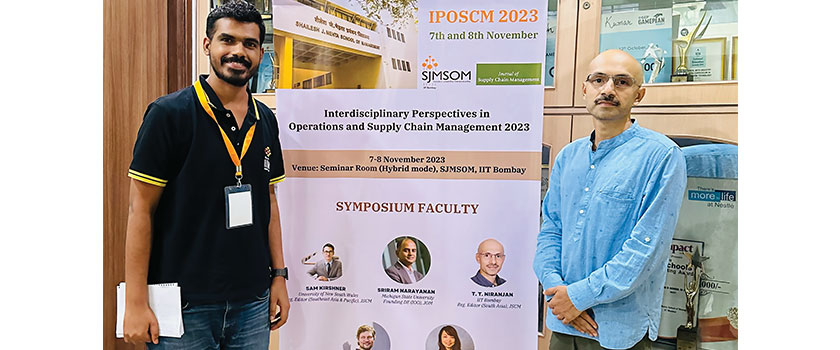
Embark on an intellectual odyssey as we navigate the transformative landscape of neuro-operations management (neuro-OM). In a world where traditional operational strategies have long been the driving force, neuro-OM emerges as a groundbreaking paradigm shift. This article shares an insightful conversation with Professor T. T. Niranjan from Indian Institute of Technology Mumbai, a luminary in this innovative field, in which we explore the nuances of how understanding the intricacies of the human mind can revolutionize operations and supply chain management. Together, we delve into the intricacies of how decoding the human mind can reshape the landscape of operations research and management science (OR/MS) and uncover the untapped potential and profound implications inherent in neuro-OM’s direct exploration of psychophysiological processes. This departure from traditional behavioral observation marks the dawn of a new era, inviting researchers to explore uncharted territories and decipher the underlying psychological processes that influence decisions in operations and supply chain management.
What is neuro-operations management, and how does it differ from behavioral operations management?
Niranjan: The concept of “neuro-operations management” struck me like a brainwave during a moment of reflection. I realized I hadn’t encountered this term anywhere before. This led me to ponder why such a term hadn’t been used earlier, considering all other business disciplines, namely neuroeconomics, neuro-strategy, neuro-finance, neuro-information systems and neuro-accounting, have been flourishing.
Delving into the landscape, I observed the immense influence neuromarketing has had on both academic and industrial fronts over the last decade. Strikingly, operations management was the only field that hadn’t yet embraced this terminology, making neuro-OM a new and innovative term in this context. For me, the introduction of neuro-OM signifies the beginning of a new era, attracting researchers to delve into the uncharted territory of the psychological processes underlying operations and supply chain management decisions.
Let me explain the differences between behavioral OM and neuro-OM:
Behavioral OM focuses on studying observable behaviors, such as order placements, supplier selection or contract choice to infer the psychology behind those behaviors. In contrast, neuro-OM takes a direct approach, emphasizing the psychophysiological processes occurring within individuals. This perspective shifts away from solely relying on observable behavior and delves into the intricate workings of the human mind and, dare I say, heart.
For example, think of a romantic encounter. We use phrases like “butterflies in the stomach,” “heart pounding,” “ weak in the knees” and “eyes lighting up.” While these might seem just poetic language, from a modern scientific perspective, they also represent real physiological responses of one’s true feelings and thoughts. Measurements of the heart rate, pupil dilation, sweating (skin conductance), eye movement, etc., provide insights into the emotional and psychological aspects influencing decision-making, which even the decision-maker may not be conscious of or willing to admit to oneself, let alone share with others, even if they knew it.
Thus, while behavioral OM focuses on observable or overt behavior, which can be deceptive, neuro-OM directly investigates the “black box” of the human mind using neuroscience tools.
What are some of the biggest research and practical challenges in neuro-OM right now?
Niranjan: There have been vast advances in leveraging smart watches and artificial intelligence for health predictions as well as eye tracking in neuromarketing, for example. But adapting them to OM poses unique challenges. Marketing experiments can be relatively easy to devise and consumer-participants easy to recruit. OM tasks involve intricate cognitive processes and numerical computations that are not easily translated into visual representations, like heat maps of gaze fixations commonly seen in consumer research. Thus, correlating neurophysiological responses with the relevant cognitive processes is much more challenging in OM. The lack of a critical mass of neuro-OM studies to serve as benchmarks for research practice makes things more challenging. Academic scholars and Ph.D. students are crucial in addressing these challenges, investing years in understanding and developing solutions for OM. The initial skepticism from industry can be overcome by collaborating with the industry and demonstrating the value of these technologies through academic research with practical applications. The growing market for eye-tracking devices, with a large fraction of it coming from the industry using it independently to study consumers, underscores the urgency of developing neuro-OM.
What are the technologies/devices currently available that will be used to collect data? Where do you see eye tracking going in the future?
Niranjan: Functional magnetic resonance imaging (fMRI), galvanic skin response (for sweat rate), heart rate, salivary testosterone levels, eye tracking and pupillometry have all been used in neuroscientific business research. The pioneer in neuro-OM is Elliot Bendoly, who studied physiological measures of eye dilation and blink rate as markers of arousal and stress in subjects in an OM task. I’ll specifically touch upon eye tracking, a methodology I am well acquainted with. It holds profound significance in research, particularly in addressing blind spots that conventional methods may miss. While behavioral experiments and surveys dominate empirical OM research, eye tracking offers a unique advantage by providing direct insights that may challenge statistical models by capturing the dynamic evolution of decision-making over time. Think of a video and how much more it conveys than a still picture. This approach, enhanced by qualitative analysis, yields a rich understanding of human behavior, offering higher credibility than traditional methods. Looking ahead, the future of this methodology appears very promising.
What types of raw data do these devices provide? And, as a researcher in OM, what are the challenges associated with analyzing this raw data into meaningful insights?
Niranjan: The data obtained from eye-tracking devices is extensive and high-frequency, reaching gigabyte sizes per participant. However, I typically utilize only around 1% of it, focusing on the key measure, namely, gaze duration on areas of interest. It is tempting to do more. However, I would emphasize retaining focus on the OM problem rather than delving deeply into the intricacies of the methodology or analysis, lest we become neuroscientists!
Some of your research includes eye-tracking experiments. Could you please explain what it is and the challenges with these experiments’ design?
Niranjan: My first eye-tracking experiment was inspired by my field case study that focused on participants’ dynamic interaction with suppliers. The intriguing finding was that, despite shifting from a bad to a good supplier, participants preferred to work with the bad supplier due to the familiarity developed. This counterintuitive behavior was corroborated by a nuanced analysis of eye-tracking data, showing how participants perceived and processed unfilled orders of bad versus good suppliers. This research showcased the application of a neuro-empirical method to shed light on a real-world supply chain phenomenon.
A significant challenge for neuro-OM today is sample size. Unlike, say, consumer studies, OM tasks are cognitively very involved and require substantial preparation of each participant. Each participant serves as a case study because we triangulate their behavioral data with verbal protocol analysis and eye-tracking data. Thus, even small numbers of participants provide adequate rigor. An instance of this is observable in our recent newsvendor research published in the Production and Operations Management journal. We initially had seven participants per experimental group. During the review process, we were asked to increase the sample size to 25, overlooking the fact that collecting data for one participant following our methodology requires more time and effort than for 25 participants in a traditional behavioral experiment. Nevertheless, we executed it across studies, and unsurprisingly, the results did not change in any way, confirming the validity of our original findings. Thus, I feel one of the challenges right now is journal reviewers’ unfamiliarity with the nuances of eye tracking specific to OM. We shouldn’t force norms from other disciplines upon OM.
Scenarios involving interorganizational dynamics or interactions among multiple individuals, as is common in supply chain management (SCM), for example, the beer game dynamics, require the use of multiple eye trackers, and this will remain a significant hurdle in scaling up research efforts in OM and SCM.
If a student were interested in studying these fields, what recommendations would you give to them? How can they start the conversation?
Niranjan: Normally, I would say let the problem guide the methodology. But the uniqueness of neuro-OM adds a layer of complexity. Managers may not be well versed in providing problems amenable for neuro-OM research. Therefore, I recommend that students collaborate with colleagues specializing in consumer behavior or psychology. Initially, there might be skepticism because of differing perspectives, but starting small and gradually building a critical mass of studies can help gain an appreciation for the value of neuro-OM. Additionally, students should maintain a balance of traditional OM methods, ensuring a comprehensive and pragmatic approach. It’s crucial not to be swayed by the allure of neuroscience, as the primary focus should remain on the OM problem.
Is there anything else you would like to share about neuro-OM, in particular to those working in industry?
Niranjan: I’d encourage industry professionals to delve into neuro-OM and recognize its unique potential. Although machine learning is widespread today, neuro-OM offers a distinctive perspective to blend with behavioral science. Collaborating with academics and those with machine learning backgrounds can pave the way for groundbreaking neuro-OM research. Engaging with doctoral students is vital, offering industry professionals the opportunity to explore a new research agenda at a depth that the industry may find challenging to achieve independently. As we move forward, the future of neuro-OM involves wearable eye trackers and online web-based eye tracking, providing real-time insights into human behavior without geographical boundaries. I implore the industry to embrace this evolving field, collaborate with academia and seize the substantial opportunities that neuro-OM brings.
Interviewee Bio
 T. T. Niranjan is an associate professor of operations management at the SJM School of Management (SJMSOM), IIT Bombay. Prior to this, he was a postdoctoral researcher at ETH Zurich, where he is still affiliated as an extramural research fellow. One of the pioneers and key contributors to the emerging research domain of neuro-OM, he is a founding member of the SJMSOM Neuro-Behavioral Lab. He communicates his research via business periodicals including, most recently, Harvard Business Review. He serves on the editorial review boards of the Journal of Business Logisticsand Journal of Operations Managementand is a regional editor for the Journal of Supply Chain Management.
Nandan Kumar Singh is an assistant professor in the Operations Management and Decision Science Area at FORE School of Management, New Delhi, India. He was a postdoctoral fellow in Production and Operations Management Department at the Indian Institute of Management Bangalore. He holds a Ph.D. in production and operations management from the Indian Institute of Management Visakhapatnam and previously served as a Visiting Research Scientist at New York University. Nandan also holds a Micro Masters credential in Supply Chain Management from Massachusetts Institute of Technology (MIT), Centre for Transportation and Logistics.