


March 1, 2024 in Digital Transformation
The Impact of Analytics and AI in Digital Transformation for the University of the Future
SHARE: PRINT ARTICLE: https://doi.org/10.1287/orms.2024.01.14

Analytics and artificial intelligence (AI) seem to be omnipresent in today’s society. Generative AI, with the ChatGPT, Bard/Gemini and Copilot craze, seems to be all the rage. DALL-E3 and Forever Voices for, respectively, creating digital images from text and AI-powered clones of public figures and celebrities are changing the landscape for the future of technology [1, 2]. This is all part of the melting pot of the digital transformation (Dx) movement. Specifically, a key focus for universities of the future will be the application of digital transformation efforts, including online learning, analytics and AI.
According to one of the leading software companies, Salesforce, digital transformation is the process of using digital technologies to create new or modify existing business processes, culture and customer experiences to meet changing business and market requirements [3]. In the 2022 book “Digital Transformation Demystified,” Dx extends beyond the technology stack and must include the organization’s culture, its operating processes and virtually every facet of how it functions [4].
For this article, the focus will be on the university of the future and how online learning, analytics and AI will continue to play a key role in Dx efforts.
According to the International Data Corporation [5], we are in the “Infodemic Era.” By 2025, the Global DataSphere (which is the sum of the world’s data) will be 175 zettabytes. For comparison, 1 zettabyte is all the grains of sand in the world! Even though we are bombarded with data and information, still one-third of the U.S. workforce has no/limited digital skills [6]. In addition, as we look into the future, there will be continued VUCA (volatility, uncertainty, complexity and ambiguity).
Although digital transformation has become a popular term as of late, research indicates that only 13% of U.S. colleges and universities are engaging in Dx efforts [7]. According to the European Union (EU) [8], Europe also needs a stronger education and greater contribution from universities and higher education institutions to address major challenges, starting with digital transformation. Toward this goal, their fourth call for proposals on advanced digital skills under the Digital Europe Programme opened on May 11, 2023.
Looking even further ahead to the future of higher education, we must consider some of the pressing concerns on higher education institutions. The Board of Trustees survey in the U.S. looks out 10 years, and the results indicated that the top 2 concerns, whether for a public or private nonprofit institution, are (1) the financial sustainability of higher education institutions and (2) the price of higher education for students and their families [9]. Already, some of the leading U.S. universities have a price tag of $95,000/academic year (2023/2024) for tuition plus room and board. More than 40% of trustees are very concerned about the future of higher education, up 14 percentage points from the previous year, according to the Association of Governing Boards survey [9].
To help advance digital transformation efforts, a relatively new position has been created in many organizations, namely the chief transformation officer. In their Chief Transformation Officer Study in 2022 Monitor, Deloitte surveyed more than 300 chief transformation officers, and the secrets to digital transformation were cited as C-suite engagement, chief transformation officer dedication and financial investment. The survey findings indicate that big thinkers who are also good storytellers are more likely to succeed in the role.
Incorporating Analytics and AI in Universities
An essential part of Dx efforts in universities is incorporating analytics and AI. We have seen learning analytics and AI play an increasing role in education over the years, and this trend will certainly continue, as evidenced by OpenAI’s ChatGPT, the AI-based quiz generators Kwizie and Kahoot, and other AI-powered software emerging over the years. We are already witnessing the power of generative AI tools. ChatGPT, for example, rated higher in quality and empathy of written medical advice (better “bedside manner”) than some doctors, which raises the possibility of a medical assistance role for such generative AI aids [10].
During the COVID-19 pandemic, an interesting article appeared from collaborators in Europe regarding online learning, which emphasized the importance of collaboration, especially in challenging times [11]. I’ve also stressed the need to apply online learning analytics because online and hybrid learning environments will continue to be pervasive at universities worldwide [12].
We will also see a continued growing trend for data and evidence-based reasoning in universities. In Sweden, as shown in the U.K. and U.S., there is an increasing trend toward “evidence-based educational practice.” Of course, ethical and moral concerns should factor into the use of learning analytics. Such considerations include the location and interpretation of data, informed consent, privacy, deidentification of data, and classification and data management [13]. Researchers propose a framework that includes (1) understanding learning analytics as a “moral practice,” (2) addressing students as agents, acknowledging that student identity and performance are temporal dynamic constructs, (3) asserting that student success is a complex and multidimensional phenomenon, (4) putting the focus on transparency and (5) acknowledging the fact that higher education cannot afford to not use data [13].
In looking ahead at the landscape for work environments, various senior leaders from IBM, Meta, McCann and others proposed some near-term trends that would affect university professors, including:
- Digital will become the norm.
- Individualism now includes “we.”
- Ingenuity and quick thinking will be critical.
- Diversity and inclusion will continue to be paramount.
- Students will need to have agility and the ability to adapt as important “new” skill sets (i.e., learning how to learn) continue to arise.
- People may start to get “digital fatigue,” so engagement (with both content and experience) will be even more critical than before.
- We will also see Apple, Google and others developing partnerships with universities for online higher education.
- Advanced techniques, such as data analytics, AI and machine learning, will be used as part of the online student learning process.
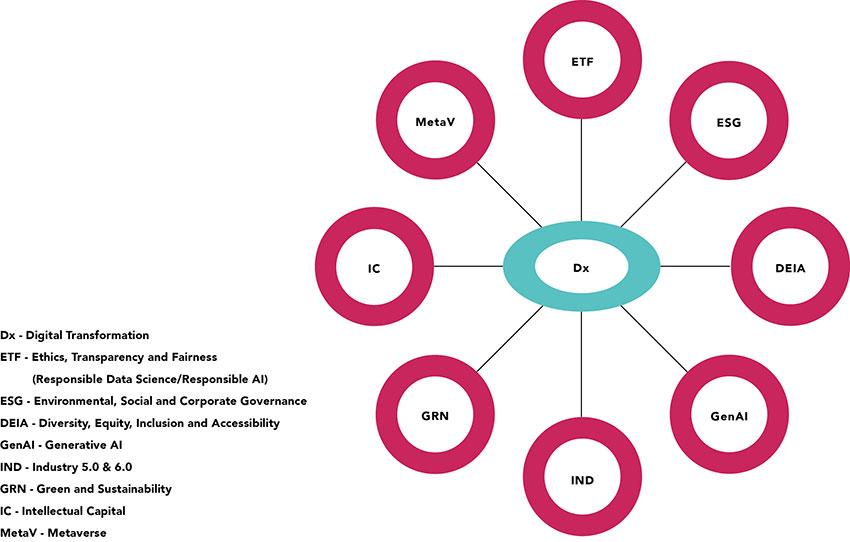
These trends are already here and will continue to be important in the future. Today’s fast-paced society is upon us, and we are trying to keep up with the hot topics and trends that are facing us. Specifically, as shown in Figure 1, we will see specific areas continue to emerge and take precedence as organizations embark on their digital transformation journeys (e.g., diversity, equity, inclusion and access (DEIA); Metaverse; generative AI; ESG and more).
In looking ahead, we must also determine the key skill sets that graduates should possess in (what some call) Industry and Education 4.0. The World Economic Forum conducted a study of the top skill sets for 2025 and found that the top 3 skills needed are (1) analytical thinking, (2) creative thinking and (3) resilience/flexibility/agility [14]. Curiously, AI and big data skills were rated as No. 15. Also surprisingly, “ethics” was not a skill set listed (perhaps it was a “value” versus a “skill”). We should also focus on educating “T-shaped professionals” who make vertical deals with domain-specific knowledge and horizontal deals with transferable skills such as ability to learn, digital skills, systems thinking, people skills, etc. These skills seem to be a winning combination.
In our “new normal” environment, perhaps we need to look differently at how we, as faculty, are evaluated. For research, certainly bibliometrics (such as citation analysis) will continue to be important, but we should also bring “altmetrics” (alternative metrics – for example, the number of followers or likes on professional social networks, etc.). In terms of teaching online, there has been some interesting research over the years. For example, research by Marzano and Allen (2016) indicates that student evaluations are lower in online courses versus face-to-face, with courses even taught by the same instructor using the same content [15]. Brown et. al. (2022) found that teaching online becomes less about teaching information and more about facilitating student efforts to think critically and apply and make sense of new knowledge [16]. So, perhaps we should include more online-tailored questions on our student evaluations for courses, such as:
- Did your instructor effectively use discussion forums to stimulate thinking?
- Did the online course allow you to explore different pathways through the course content, depending upon the level of your understanding of the material?
- Did the online course allow you to be an active participant in the class?
One way to improve the satisfaction of online courses is to apply digital transformation techniques, such as learning analytics, adaptive learning and personalization, and machine learning to enhance the student’s interaction, engagement and comprehensibility of the course material and tailor it to the individual learner’s style. Chris Millet and colleagues (2022) at Penn State University apply in-depth learning analytics to their online courses to help in this regard [17].
Nworie (2021) looked at what’s next for teaching and learning in higher education beyond COVID-19 and found that institutional culture was the key to encouraging innovation in teaching and learning, experimentation and creativity [18]. In addition, Nworie suggests a great need to continue applying existing quality standards, such as Quality Matters, to online course development.
Effective Components for a Digital Transformation Strategy
There are three key components for an effective Dx strategy: (1) active participation of the “consumers,” (2) change management and (3) data and analytics.
Without active participation of the ultimate users of the Dx effort, the likelihood for success will be greatly minimized. Let me present a personal example: At one of the major top universities where I was teaching, there was a university-wide digital transformation effort through the creation of an ERP (enterprise resource planning) system, which would revolutionize the way we did business at the university. After a failed attempt by a major consulting firm who was designing the system, another company was hired to pick up the pieces. The bottom line – it took 14 years to actually design, develop, test, field and roll out this enterprise-wide system throughout the university. However, due to failing to adequately reach out to the faculty in designing the system (such as how the faculty can use the system to get reimbursed for conference travel expenses), the system was almost impossible to use. There were other modules that were equally difficult to navigate and use, and this caused more confusion and aggravation on the part of the users. The key then is to capture the requirements of the users up front (or incrementally) and involve them throughout the digital transformation process.
Many executives feel that digital transformation is only about “technology.” However, to be successful, having the right culture, people and processes in place will greatly outweigh technology [19]. Careful attention to these factors will help ensure successful digital transformation efforts in the future.
Per the third component for an effective Dx strategy – data and analytics – we are already seeing the impact of AI, machine learning and data analytics as part of large Dx efforts at universities. The C3.ai Digital Transformation Institute (https://c3dti.ai/) was established in 2020 to be a research consortium with leading universities and industry to conduct research and educate practitioners in the science of digital transformation. We have also witnessed over the years how intelligent chatbots can be very successful in serving as teaching assistants to help students with their course-related questions [20]. And now with generative AI, the possibilities are endless. Certainly, the milieu of data, analytics, AI and advanced computing techniques will continue to be an important part of university digital transformation efforts in the near future.
In applying online learning, here are some of the lessons learned for online education based on experiences of the author and others:
- Faculty engagement is key (actually, student-faculty engagement).
- Use chunking (average attention span for students online is about 5-7 minutes).
- Build a sense of community and belonging before the course starts (good to “see” the students but be careful of bandwidth issues).
- Encourage active student participation (case studies, article presentations, group projects, critiquing peer comments in discussion forums, etc.).
- Use a portfolio of multimedia techniques.
- Need articulated student learning outcomes.
- Beware of “ghosting” – when someone signs in but isn’t really present in the virtual classroom.
- Engage in “online learning analytics.”
- Front-end work is key!
The University of the Future
As we look toward the university of the future, some interesting work with Erasmus University and EU projects have looked at trying to develop a blueprint. One project, led by the University of Porto in Portugal, along with a number of universities, companies and public entities, emphasizes what they call Industry and Education 4.0, which includes challenges such as a lack of understanding how to prepare for future work (in terms of a more agile, flexible way – although we have been capitalizing on this over the past few years due to COVID-19); the lack of a skilled workforce; and a lack of vision on technology (with the resistance to change issue) [21].
From this EU project, various desirable scenarios were developed for learning and higher education institutions in 2040. The envisioned focus is on interdisciplinary education, personalized learning, collaboration with industry/government/nongovernmental organization partners, and reskilling and upskilling. We now talk about “knowledge as a service” as well as “school as a service” emphasized by Aalto University in Finland. School as a service is an idea in which activities and the physical structure of the school are kept separate. Based on social and theme-based learning, the upper secondary school becomes a natural part of the university campus and its culture [22]. These types of new developments are happening every day. For example, some universities are already accepting cryptocurrency to pay for tuition [23].
We can also see some potential vulnerability of intellectual capital in the age of AI and disruptive technologies [24]. Intangible resources are often more vulnerable than physical resources [24]. For example, losing key critical knowledge of experts when they retire or leave an organization can be a great loss if that knowledge isn’t properly captured and managed for access within the organization after their departure. In addition, with the rapid development of generative AI, various intellectual property issues are emerging. Cases involving potential copyright and trademark infringement due to the training and development of generative AI tools are already in the courts [25].
However, the future looks bright for those institutions willing to invest in digital transformation and exploring new technologies. Of course, as previously pointed out, we must continue to enhance the skill sets of our future workforce. If we work in tandem on applying digital transformation to universities and keep promoting student learning outcomes, the university of the future will become a reality!
References
- Raiola, R., 2023, “Future Tense: ChatGPT, Can You Tell Me a Story?”, Communications of the ACM, Vol. 66, No. 5, May.
- Marcus, G., 2023, “Hoping for the Best as AI Evolves,” Communications of the ACM, Vol. 66, No. 4, April.
- https://www.salesforce.com/products/platform/what-is-digital-transformation/
- Granito, F., 2022, “Digital Transformation Demystified,” Digital Transformation: Accelerating Organizational Intelligence, Singapore: World Scientific Publishing.
- IDC, 2022, “Worldwide IDC Global DataSphere Forecast, 2022-2026: Enterprise Organizations Driving Most of the Data Growth,” Report US49018922, May.
- Ezell, S., 2021, “Assessing the State of Digital Skills in the U.S. Economy,” Information Technology and Innovation Foundation (ITIF), November 29.
- Brooks, D.C. and M. McCormack, 2020, “Driving Digital Transformation in Higher Education,” EDUCAUSE, June 15, https://library.educause.edu/resources/2020/6/driving-digital-transformation-in-higher-education.
- EU, 2023, “Advanced Digital Skills 4th Call for Proposals Announcement,” May 4, https://digital-skills-jobs.europa.eu/en/latest/news/4th-call-proposals-under-digital-advanced-digital-skills-apply-may-11.
- Association of Governing Boards (AGB), 2020, “The AGB 2020 Trustee Index,” January 29, https://agb.org/reports-2/the-agb-2020-trustee-index/.
- Ayers, J.W., A. Poliak, M. Dredze, E.C. Leas, Z. Zhu, J.B. Kelley, et al., 2023, “Comparing Physician and Artificial Intelligence Chatbot Responses to Patient Questions Posted to a Public Social Media Forum,” JAMA Internal Medicine Network, Vol. 183, No. 6, pp. 589-596.
- Henze, N., V. Schwind, K. Wolf, M. Kocur and A. Schmidt, 2020, “Preparing an Online Lecture that We Wouldn’t Hate to Attend,” IEEE Pervasive Computing, Vol. 19, No. 3, July.
- Liebowitz, J. (ed.), 2022, “Online Learning Analytics,” New York: Taylor & Francis.
- Pargman, T. C. and C. McGrath, 2021, “Be Careful What You Wish For! Learning Analytics and the Emergence of Data-Driven Practices in Higher Education,” Digital Human Sciences: New Objects—New Approaches, Stockholm: Stockholm University Press.
- World Economic Forum, 2023, “The Future of Jobs 2023 Report,” May, https://www3.weforum.org/docs/WEF_Future_of_Jobs_2023.pdf.
- Marzano, M. and P. Allen, 2016, “Online vs. Face-to-Face Course Evaluations: Considerations for Administrators and Faculty,” Online Journal of Distance Learning Administration, Vol. 19, No. 4, Winter.
- Brown, A., J. Lawrence, M. Basson and P. Redmond, 2022, “A Conceptual Framework to Enhance Student Online Learning and Engagement in Higher Education,” Higher Education Research & Development Journal, Vol. 41, No. 2.
- Millet, C., J. Resig and B. Pursel, 2022, “Democratizing Data at a Large R1 Institution: Supporting Data-Informed Decision Making for Advisers, Faculty, and Instructional Designers,” Online Learning Analytics, Philadelphia: Taylor & Francis.
- Nworie, J., 2021, “Beyond COVID-19: What’s Next for Online Teaching and Learning in Higher Education?”, EDUCAUSE Review, May 19.
- Tabrizi, B., E. Lam, K. Girard and V. Irvin, 2019, “Digital Transformation is Not About Technology,” Harvard Business Review, March 13.
- https://pe.gatech.edu/blog/meet-jill-watson-georgia-techs-first-ai-teaching-assistant
- https://universitiesofthefuture.eu/wp-content/uploads/2021/07/UoF_blueprint_FINAL-published.pdf
- Vladykina, N., A. Uribe and A. Ahlava, 2019, “School as a Service: Platform for Learning in Upper Secondary Education Operating on Aalto University Campus,” IEEE International Smart Cities Conference, IEEE, October.
- Liebowitz, J. (ed.), 2023, “Cryptocurrency Concepts, Technology, and Applications,” New York: Taylor & Francis.
- Uziene, L., 2020, “Vulnerability of Intellectual Capital in the Age of Artificial Intelligence and Disruptive Technologies,” European Conference on Knowledge Management Proceedings, doi:10.34190/EKM.20.240.
- Appel, G., J. Neelbauer and D. Schweidel, 2023, “Generative AI Has an Intellectual Property Problem,” Harvard Business Review, April 7.
Jay Liebowitz recently served as the inaugural Executive-in-Residence for Public Service at Columbia University’s Data Science Institute. His main role was to infuse data science and analytics into the U.S. federal government, with support from the Partnership for Public Service. His recent books are “Pivoting Government Through Digital Transformation” (Taylor & Francis, 2024) and “Digital Transformation for the University of the Future” (World Scientific Publishing, 2023). His newest book, due to be published in mid-2024, is titled, “Regulating Hate Speech Created by GenAI” (Taylor & Francis).
([email protected])