


March 12, 2024 in Viewpoint
Ethical Decision Quality: Teaching Students to Make Great (and Ethical) Decisions
SHARE: PRINT ARTICLE: https://doi.org/10.1287/orms.2024.01.20
Decision analysis is amoral. You can use the tools of decision analysis (and many other tools of operations research, or O.R.) to decide on the best way to rob a bank. The tools are insensitive to the morality of their application. Should there be an ethics focus on the teaching of decision analysis and O.R. in general? And should there be a method to assess the ethical quality of a decision? If the desire to advance ethical decision-making is by itself not a sufficient motivation for doing this, then the following might be: A scan of thousands of media articles identified common decision-making pitfalls that existed in organizations before a large collapse [1]. Most of these pitfalls involved ethical considerations related to the decision.
Ethics courses have long been taught in business schools in isolation from analytics or decision analysis courses. But the efficacy of this approach has been questioned following an ongoing history of organizational ethical collapses [2, 3]. Indeed, decision-making under uncertainty can be a challenging task without relying on appropriate tools and processes. There is no reason to believe that decisions involving ethical considerations (such as quantifying the benefit and harm in a utilitarian approach) are simpler or require less rigor.
As we approach increasingly sophisticated decisions every day and their ethical implications, including the ethics of artificial intelligence (AI), climate change, energy, misinformation on social networks and self-driving vehicles, several questions surface. Is there a need to embed ethics into the teaching of decision analysis? And is there a method to assess the ethical quality of a decision? The focus of this article is on lessons learned from ethical pitfalls that may be integrated into the teaching and practice of decision analysis.
Learning from Ethical Decision Traps
Decision traps (such as the sunk cost trap or the decision vs. outcome trap) have long provided insights into the teaching and practice of decision analysis. Similarly, lessons from ethical pitfalls in decision-making may also provide insights into the teaching, research and practice of decision analysis. Examples of media articles portraying ethical decision traps concur:
- The concept of a decision frame is widely taught in decision analysis. It identifies decisions to be taken as given, decisions to be decided now and decisions to be decided in the future. An ethical examination of the implications of the scope of the frame should also be considered. When the Department of Justice (DOJ) began its investigation into Volkswagen (VW) diesel fuel, an executive from VW emailed the board about an important decision moving forward: “It should first be decided whether we are honest. If we are not honest, everything stays as is.” Being honest was not taken as given but was to be decided when an investigation occurred.
- When the DOJ started their investigation into Enron Corporation and the intentional blackouts that increased the demand for electricity and led to a surge in prices and the Hypothetical Future Value Accounting (valuations based on projections about future revenue that were subject to manipulation), Enron’s CEO mentioned their rationalization: “Andersen and our lawyers had taken a very hard look at this structure, and they believed it was appropriate.”
- Valeant’s CEO was questioned about the surge in drug prices and its impact on consumers. He replied, “All I care about is our stakeholders,” exhibiting a trap of focusing only on shareholders vs. stakeholders of the decision.
The Elements of Ethical Decision Quality
The scanned media articles were also categorized to define the elements of Ethical Decision Quality (EDQ) (Figure 1). EDQ aims to recognize, assess and mitigate the impact of “ethics traps” when making a decision. Lessons from these traps can also be used in the teaching and practice of decision analysis by focusing on their ethical implications.
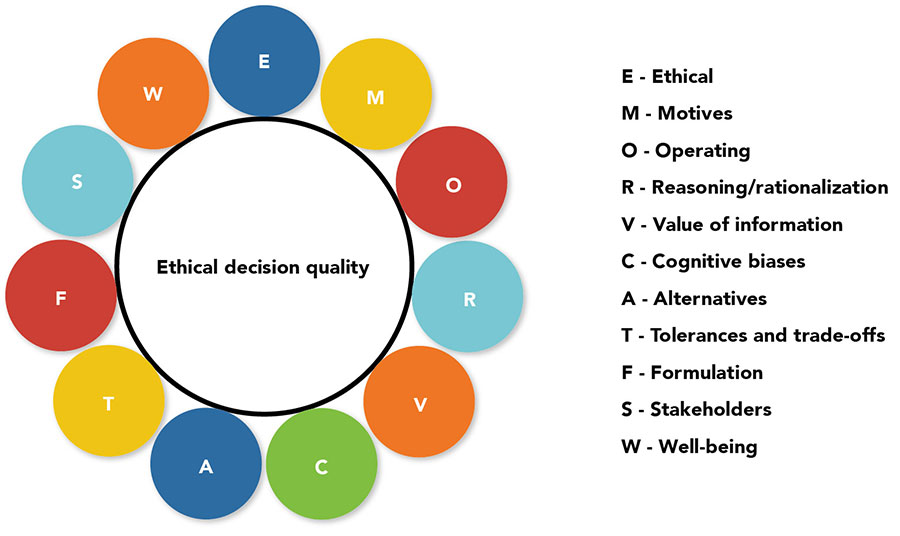
Here are some examples related to the elements of Ethical Decision Quality.
Ethical awareness is an essential element in understanding and assessing the ethical implications of a decision. We cannot expect decision-makers to make an ethical decision if they are not aware of the ethical implications in the first place. New technologies will require a deeper understanding of the ethical implications they pose. Ethical awareness is challenging, however, because ethics is not a universal standard. Further, the legal system is not the moral standard, and neither are compliance policies within organizations. If we learn from the data, ethical collapses have involved one or more of the following aspects: deception, harming and stealing. Variants of these three items (such as fraud, embezzlement and murder) were also used in the literature scan to define the other elements of EDQ.
Motives of individuals involved in decision-making impact EDQ, which can lead to outcome-predetermined analysis, the desire to publish incorrect results to receive more funds, and even opening bank accounts and charging hidden fees to meet incentives. Understanding motives can help raise a red flag about the decision when a situation occurs. Benjamin Franklin once noted:
“For when you assemble a number of men to have the advantage of their joint wisdom, you inevitably assemble with those men, all their prejudices, their passions, their errors of opinion, their local interests, and their selfish views. From such an assembly can a perfect production be expected?”
The operating environment affects decision-making in many ways. Examples of ethical traps to look for include exchange of favors, obedience to authority, coercion, or use of media, politicians and celebrities to enable ethical violations. Theranos was a good example of the latter. In the famous Bay of Pigs invasion, none of the members of the cabinet expressed any opposing views to John F. Kennedy. Following this incident, JFK later changed the decision environment and formed a decision council that held some meetings without him to minimize the effects of obedience to authority.
Sound reasoning is an essential element in the teaching and practice of decision analysis. It is also important to highlight the ethical implications of analyses, such as outcome-predetermined analyses or other flawed methods. Many ethical collapses arise from human rationalizations, which should also be identified and addressed because they often dominate the reasoning.
Assessing, updating and calculating the value of information are essential aspects of decision analysis. There is room for addressing the ethical implications of information gathering. The Tuskegee experiments are an example of unethical information gathering that involved deception and harm. The data shows that there is also the need to discuss privacy concerns, methods of handling information during data breaches, or coercion by powerful entities to “shadow-ban” individuals on social networks. Acting on incorrect information has also led numerous individuals to spend decades in jail following false information.
Cognitive and motivational biases are widely taught in decision analysis, with a focus on decision impairment. There is also room for focusing on the ethical implications of cognitive biases (such as the ethical implications of confirmation bias by ignoring evidence that does not support your views). The Netflix documentary “American Nightmare” is an example of confirmation bias dominating the reasoning of law enforcement and delaying the capture of a criminal. Benjamin Franklin noted:
“I have experienced many instances of being obliged by better information, or fuller consideration, to change opinions even on important subjects, which I once thought right, but found to be otherwise.”
Focusing only on maximizing value given the first few alternatives you consider can have ethical implications. Additional alternatives that resolve the ethical issue, even if they yield less profit, might also need to be considered. Some alternatives might need to be disregarded because of aspects of deception, harming or stealing. Ethical implications of not considering sequential decision alternatives in the light of new information should also be considered.
The other elements of EDQ include recognizing the ethical trade-offs and tolerances to unethical acts, understanding the ethical implications of the formulation and recognizing the various stakeholders (vice shareholders) impacted by the decision. There are also factors besides the analytical aspects that impact ethical decision-making, such as well-being (which includes fear, stress, addiction and mental health), and should also be considered. The Washington Post noted how addiction may lead to unethical decisions in an example of an 80-year-old “Southern California nun [who] struggled to maintain her promise to the Catholic Church because of a gambling addiction that was out of control for a decade. The Los Angeles native embezzled more than $835,000 from the Catholic school in Torrance, Calif., where she was principal to pay for 10 years of personal expenses, including her many gambling trips to Las Vegas and Lake Tahoe …” [4].
As you make your next decision or teach decision analysis, I invite you to review the elements of EDQ and assess how well you are doing on each. Organizations may also conduct an ethical decision quality audit to better understand the impediments to EDQ and address them to build a better organizational ethical decision culture.
References
- Abbas, A. E., 2023, “Ethical Decision Quality: Building an Ethical Decision Culture,” Cambridge, U.K.: Ethics Press.
- https://www.wsj.com/articles/SB106365505376228100
- https://www.nytimes.com/1989/11/25/opinion/ethics-courses-useless.html
- https://www.washingtonpost.com/religion/2022/02/08/california-nun-gambling-school-prison-kreuper/
Ali E. Abbas is professor of industrial and systems engineering at the University of Southern California. He is author of numerous books, including “Foundations of Multiattribute Utility” and “Ethical Decision Quality: Building an Ethical Decision Culture”; co-author of “Foundations of Decision Analysis” with Ronald A. Howard; and editor of numerous books, including “Next-Generation Ethics” published by Cambridge University Press.
([email protected])