June 25, 2024 in International O.R.
Democratizing Forecasting
A challenging and rewarding journey
SHARE: PRINT ARTICLE: https://doi.org/10.1287/orms.2024.02.01
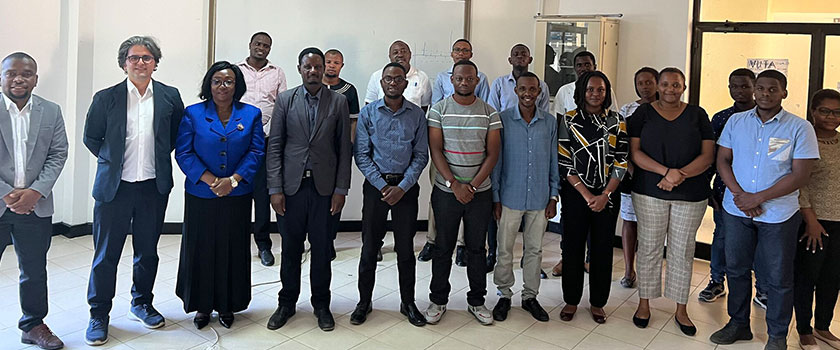
The Democratizing Forecasting (DF) initiative, launched in 2018, aims to provide high-quality forecasting education to underprivileged communities worldwide, addressing a critical demand for forecasting skill sets as one of the most widely used OR/MS approaches, particularly in developing countries. This story describes the origins, goals, delivery and accomplishments of the DF project, including in-person workshops in 14 countries and the development of the AFRICAST online platform.
Building the Initiative
In 2017, upon joining Cardiff University, I began collaborating with several national and international organizations in high-income countries to investigate the use of forecasting tools to inform policy and decision-making. However, these collaborations revealed a significant lack of knowledge and skills in this field. Around the same time, an enlightening article published by the World Economic Forum [1] highlighted the absence of universities from developing countries in global rankings. This disparity drove me to investigate the state of skills and knowledge in developing countries, and I quickly concluded that the situation is even worse than in high-income countries [2]. I felt inspired to tackle this issue because I am passionate about forecasting, committed to knowledge distribution and understand the significant role of forecasting in decision-making processes. Therefore, in 2018, I launched the DF initiative, which received full support and sponsorship from the International Institute of Forecasters (IIF).
The DF initiative aims to provide high-quality education on forecasting to underprivileged communities by fostering skill development, raising awareness about the benefits of forecasting, and empowering participants to mentor others and organize workshops in their respective countries to drive change. However, it extends beyond mere education to focus on direct capacity building, with the objective of empowering future forecasters and enhancing decision-making. The project responds to the need for enhanced data-driven analytical skills and greater predictive modeling capacity to support societal transformations toward sustainability by offering education and training on forecasting using the open-source software R [3].
“IIF recognized the profound impact and importance of this program from its inception. I would like to commend Prof. Bahman Rostami-Tabar for his dedication and extraordinary commitment to the noble mission he embarked upon, despite the fact that it has not been all smooth sailing. Over the years, he has had to navigate through risks during his travels to bring this vision to fruition – IIF is committed to continue the support of this important task.” – Prof. George Athanasopoulos, President of the International Institute of Forecasters
The initiative involves developing a curriculum and delivering in-person workshops for academics and practitioners in developing countries, which involves coordination and traveling. The training covers the entire forecasting workflow, from identifying decisions that require forecasting to generating and evaluating forecast quality [4], and examines the theoretical basis of forecasting approaches, emphasizing their advantages, limitations and practical applications in R. Training is based on the book “Forecasting: Principles and Practice,” which is available for free online, accompanied by R packages [5]. This book was instrumental in the development of workshop materials.
The workshop training is structured around a project that involves developing and analyzing forecasts for hospital admissions and vaccine distribution. Participants spend most of their time in the sessions identifying forecast-required decisions, defining forecasting requirements and related data needs, analyzing data, visualizing data and forecasts, and creating R code to generate and evaluate forecasts.
The workshops have mainly focused on educating participants on how to generate and evaluate forecasts. As a result, the workshop’s major audience consists of academics and professional forecasters, analysts and modelers. Furthermore, the workshops are intended to be inclusive, with the objective of boosting participation from a diverse range of geographic locations, demographic profiles and academic disciplines. Countries are selected based on World Bank data, and partnerships are developed with universities, research institutions and organizations from lower- and lower-middle-income countries, as well as from middle-income countries on occasion.
The Democratizing Forecasting workshops are free of charge for attendees and host organizations, thanks to generous funding from the International Institute of Forecasters covering most travel expenses. My time for developing, coordinating and delivering material is also offered for free. This is especially significant for learners in low- and lower-middle-income countries, who may face financial barriers to educational possibilities. These workshops are for novices with little or minimal forecasting experience. However, a basic grasp of statistics and R programming is recommended.
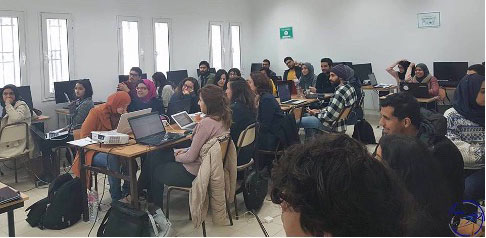 Since 2018, I’ve designed, coordinated and delivered 14 three-day workshops, totaling 294 hours of direct interaction. In-person trainings have been offered in Tunisia (right), Senegal, Iraq, Indonesia, Uganda, Rwanda, Kenya, Malawi, Ethiopia, Tanzania, Georgia, Nigeria, India and Turkey.
Additional Service
Following an overwhelming response from our in-person training sessions, I led the development of AFRICAST [6], an online platform that provides forecasting education to learners, regardless of their geographical location. AFRICAST is an extension of the Democratizing Forecasting project that aims to distribute forecasting best practices to a wider audience, with an emphasis on lower- and lower-middle-income nations in sub-Saharan Africa. The project aims to democratize forecasting education by providing online courses in both R and Python, bridging the knowledge gap and empowering learners in resource-constrained areas. I conducted an in-person workshop in Kenya in January 2023, which sparked this creative idea. During the visit, two professors from Jomo Kenyatta University of Agriculture and Technology (JKUAT) expressed a great willingness to work to enhance access to forecasting education. We developed a collaboration to develop and provide online forecasting training and collaborated with Mitchell O’Hara-Wild, a Ph.D. student at Monash University and the main developer of many forecasting packages in R, to design, develop and deliver the online training program in October 2023. A second cohort is planned for October 2024. The online training sessions last five days and include three hours of teaching via Zoom each day. JKUAT manages all administrative tasks, including advertising and recruitment.
AFRICAST online training differs from in-person training in several ways. It includes:
- 𝐋𝐢𝐯𝐞 𝐬𝐞𝐬𝐬𝐢𝐨𝐧𝐬:10 sessions, each lasting 90 minutes via Zoom.
- 𝐋𝐢𝐯𝐞 𝐜𝐨𝐝𝐢𝐧𝐠: Live coding demonstration in each session.
- 𝐃𝐞𝐝𝐢𝐜𝐚𝐭𝐞𝐝 𝐦𝐞𝐧𝐭𝐨𝐫𝐬𝐡𝐢𝐩: Experienced mentors recruited from previous cohorts provide guidance through Slack in small groups, along with five additional meetings via Zoom/Google Meet.
- 𝐋𝐚𝐛 𝐞𝐱𝐜𝐞𝐫𝐜𝐢𝐬𝐞𝐬: The program includes two types of exercises: (1) Learning: Participants gain hands-on experience by working with diverse data sets; (2) Application: Exercises involve applying the forecasting workflow to a single data set from Africa, ending in the creation of a final report.
- 𝐅𝐫𝐞𝐞 𝐚𝐜𝐜𝐞𝐬𝐬 𝐭𝐨 𝐦𝐚𝐭𝐞𝐫𝐢𝐚𝐥𝐬: All presentation slides, code, exercises and workshop recordings are accessible to the public online.
International Benefits (and Blunders)
The initial goal of the DF initiative was to educate 400 individuals across 20 countries. Between January 2018 and December 2023, the training has benefited 473 individuals from 22 countries through in-person workshops and the AFRICAST platform.
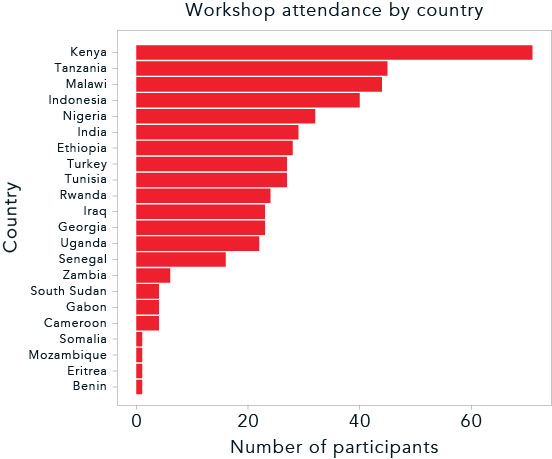
From Ethiopia to Iraq and Indonesia, hundreds of individuals have benefited from the DF training programs. Testimonials speak volumes, with learners expressing newfound confidence in their forecasting skills and capacity to drive change. Notable outcomes include research publications, career advancements and enhanced decision-making capabilities.
“One notable outcome of the training is the research paper I authored on forecasting practices within the Ethiopian pharmaceutical landscape. This achievement would not have been possible without the knowledge and expertise gained from the training sessions.” – Participant from Ethiopia
“Honestly, this workshop made me reset some of my priorities. In fact, I thought that I was determined and that I [had] already chosen the next steps in my career. Then, after this training, I found myself really interested in forecasting, especially forecasting for social good. So, I really welcome any opportunity to create the community that you talked about today, and I would be honoured to be part of it.” – Participant from Tunisia
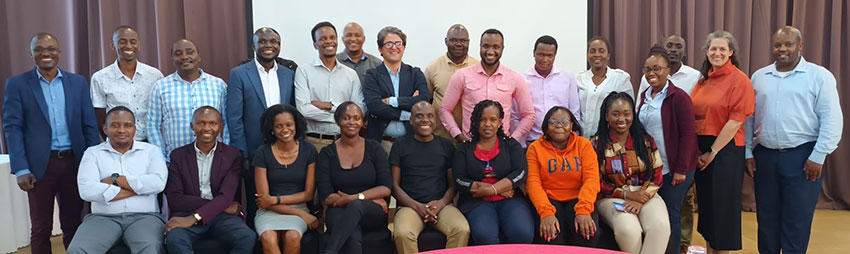
“I have personally applied the knowledge and skills acquired from the training to several projects, witnessing first-hand the positive impact on outcomes.” – Participant from Kenya
“The training has been a catalyst for my professional growth and career advancement. The recognition of my enhanced forecasting capabilities within the organization has led to new opportunities and increased responsibilities.” – Participant from Malawi
“As I progress through the final stages of my master’s studies, including the completion of my dissertation, I continue to draw upon the knowledge and skills acquired during the training.” – Participant from Tanzania
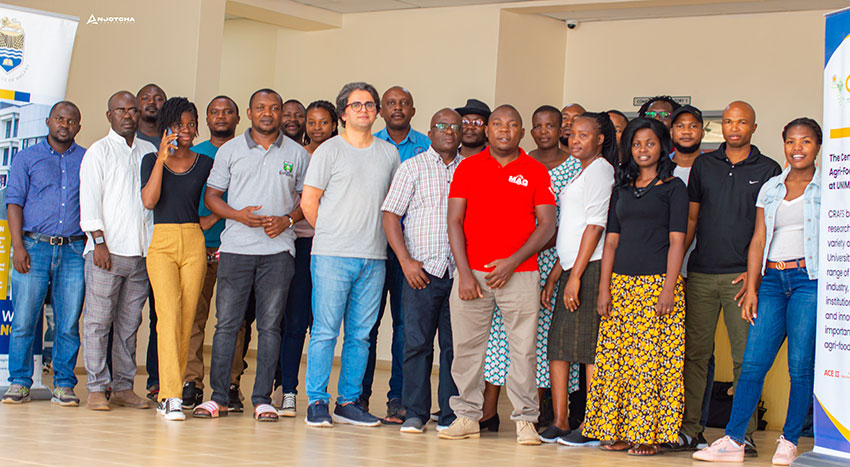
Beyond having an impact in these countries, the initiative has provided me with several benefits! It has allowed me to broaden my personal and professional network, particularly in low- and middle-income countries, as well as connect with individuals from diverse cultures, which is an eye-opening and fascinating learning experience. Furthermore, giving such workshops has created opportunities for collaborative research with many organizations and institutions, including Ph.D. supervision, research funding partnerships, and collaboration in creating research and engagement centers.
The journey has not been without hurdles. One of the most difficult obstacles has been finding partners who are truly dedicated to knowledge dissemination in this field and have the ability and willingness to properly arrange and coordinate workshops to meet the educational objectives of participants. Infrastructure and environmental limitations have also caused difficulties. Workshops can be held in less-than-ideal settings, such as rooms with no windows or insufficient ventilation. Power outages during training sessions have interrupted attention and created unpleasant room temperatures, impeding progress. Furthermore, inconsistent internet access has caused logistical challenges in certain places. In-person training requires substantial planning and travel across many countries, which may be tiresome and hazardous.
When I returned from Senegal in April 2018, my bag, which contained all of my important paperwork, including my passport, vanished at Paris Charles de Gaulle Airport. Because of that (and my passport nationality), I spent four nights in a detention center before being granted permission by a court to leave the airport and acquire a new passport and U.K. visa to return to Cardiff. Furthermore, on several trips to Africa, I became unwell, either while traveling or immediately after coming home, impacting my well-being and performance. In addition, these workshops aren’t included in my university workload; therefore, I had to handle this project on top of my other commitments.
For anyone embarking on a similar journey, it’s critical to first grasp the specific challenges and requirements of the areas you want to support. Working with like-minded organizations and groups may dramatically increase the impact and reach of your work; therefore, relationship-building is critical. Adaptability is essential for traversing varied cultural and institutional environments, requiring a flexible strategy. Regularly evaluating the impact of your initiatives via feedback and assessments is critical for shaping future plans and maintaining effectiveness. Finally, instead of making massive moves right away, think about beginning small and gradually expanding based on feedback and outcome.
My journey toward democratizing forecasting has been both challenging and rewarding. Moving forward, we will continue to provide both in-person and online workshops. We envisage expanding online training programs to include forecasting using Python, as it is now only available in R. Furthermore, since 2018, I have been the only one traveling and delivering the training; however, we have recently expanded the team that I lead to include four or five instructors who are members of the IIF community to also offer training.
Together, we can bridge the gap in forecasting knowledge and pave the way for a more equitable future and better-informed decision-making processes that can support societal transformations toward sustainability.
References
- https://www.weforum.org/agenda/2016/10/top-universities-distributed-world-map/
- Rostami-Tabar, B., 2021, “Business forecasting in developing countries,” Business Forecasting: The Emerging Role of Artificial Intelligence and Machine Learning, 382.
- https://council.science/publications/sdgs-science-agenda/
- https://dfep.netlify.app/sec-forecasting-workflow
- https://otexts.com/fpp3/
- https://workshop.f4sg.org/africast/index.html
Bahman Rostami-Tabar (https://profiles.cardiff.ac.uk/staff/rostami-tabarb) is a professor of data-driven decision science at Cardiff Business School, Cardiff University, U.K. He is the director of the Data Lab for Social Good and is leading a theme on uncertainty and the future at the Digital Transformation Innovation Institute.