September 10, 2024 in Last Word
On Surnames, Symbols and Goals
EURO Gold Medal 2024 awarded to Maria Grazia Speranza
SHARE: PRINT ARTICLE: https://doi.org/10.1287/orms.2024.03.05
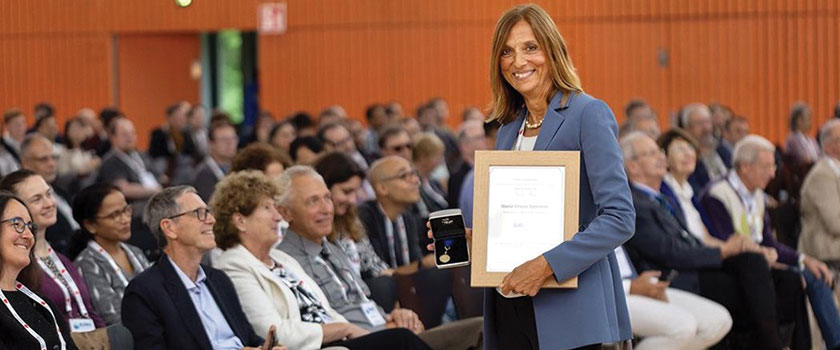
This year, the EURO Gold Medal 2024 – the highest European recognition in the field of operations research – was awarded to Maria Grazia Speranza, full professor at the University of Brescia (Italy) and author of the recent book “Women’s Surname.” She is the third woman in almost 50 years of the European Association of Operations Research (EURO) to receive this designation [1, 2].
Flashback: Spring 2010
I am in my last year of a scientific high school and my favorite subjects are mathematics and physics. Still, I am also interested in various literature and social issues, especially gender equality. Thus, I decide to study the following topic for my final exam essay: women’s role in literature and art from the French Revolution onward. From Olympe de Gouges and Mary Wollstonecraft, I delve into the characters of Jane Eyre in the novel of the same name by Charlotte Brontë and Nora Helmer in “A Doll’s House” by Henrik Ibsen. I then focus on Eliza Doolittle in “Pygmalion” by George Bernard Shaw before moving on to “A Room of One’s Own” by Virginia Woolf. I study the related history up to the present day, adopting a feminist lens. The final title of my essay included the phrase, “In Search of a New Identity.” I am satisfied with my work. But, exam day comes, and my science teacher, Prof. Maria Lucia Di Peppe, asks, sibylline, Didn’t you know any women of science to include? Maybe those were not her exact words, but that was the meaning. I told her that I wanted to focus exclusively on the humanities. So, in the oral exam, I spoke about Marie Curie and Henrietta Leavitt. But Prof. Di Peppe’s words remained persistent in my head for a long time, becoming more introspective over the years: Why didn’t I include women of science?
Present Day: June 30, 2024
Fourteen years later, I find myself in Copenhagen at the Technical University of Denmark (DTU) attending EURO 2024 – no, not the European Football Championship, but the 33rd European Association of Operational Research Conference. Roughly 3,000 people attended, not only from Europe but from all over the world. I missed the opening ceremony because I was late checking in at my hotel. That evening, I was in a corridor of Building 101 when a message arrived on the WhatsApp group of EURO WISDOM, a forum dedicated to women in our scientific community: It is a picture, taken by Martina Fischetti, of the announcement of the winner of the EURO Gold Medal 2024, the highest European recognition in the field of operations research (O.R.). It is Maria Grazia Speranza, full professor in the Department of Economics and Management at the University of Brescia. She is the third woman ever – after Martine Labbé in 2019 and Ailsa Land in 2021 – to be awarded this prize in almost 50 years of EURO’s existence. This is a symbolic event, especially for those of us in the Italian Association of Operations Research.
Grazia Speranza herself speaks about symbols in her latest book (published in April 2024), entitled “Women’s Surname” (for now available only in Italian) [3]. In this essay, she does not delve into problems of vehicle routing and portfolio management or the latest trends in the logistics and transport sectors, some of the areas in which she is an expert. Instead, she begins by explaining the choice of the title, exposing the desire to pass on her maiden name. This desire was realized by her daughters when she turned 60, following a long bureaucracy to add their mother’s surname to their father’s, which they already had by law. In 2022, Italian law on the passage of surnames to children was updated after a ruling by the Constitutional Court and Circular of the Ministry of the Interior no. 63 (June 1, 2022), which made part of art. 262 of the Italian Civil Code and communicated to the municipal offices that the child assumes the parents’ surnames in the order they agreed, without prejudice to the agreement, at the time of recognition, to attribute the surname of only one of them [4]. Few people are aware of this possibility, and even fewer apply it because there are loopholes in the law; for example, what happens to the second generation? A complete law on surnames would be needed to close the gap.
An Uphill Battle
Grazia Speranza decided to use her story to show how transferring your surname is just the tip of the iceberg in terms of feminist battles. In her essay, she retraces the fundamental passages of her life by intertwining personal developments with career advancements and the common thread of gender inequality – a thread that is unraveled, chapter after chapter, in collaboration with other international female researchers. With Rosiane De Freitas Rodrigues (Federal University of Amazonas), Grazia Speranza analyzes what it means to have a double surname. They reflect on gender stereotypes such as associating the color pink with females and blue with males. Ola Jabali (Politecnico di Milano), of Palestinian origin, and Grazia Speranza discuss the glass ceiling [5] and the differences between some countries, such as Italy, Canada and the Netherlands, on the policies of family support and female employees, such as childcare services. In a dialogue with Elena Fernández (Universidad de Cádiz), the fourth woman to be president of EURO, Grazia Speranza highlights how economic independence is a necessary condition for freedom, recalling Virginia Woolf’s “five hundred pounds” [6], and discusses the delicate connection between motherhood and female unemployment.
“Having a child would have interrupted that condition of equality between me and my husband that I aspired to, inexorably and heavily. I would have wanted equal tasks, responsibilities, career opportunities, and success. I had managed it, with difficulty, in the phase of cohabitation without children, but genetics made having a child too asymmetrical. … Once I was over thirty, another consideration was added to the reflections that had accompanied me up to that point: I couldn’t wait too long to decide because time would decide for me. Not deciding at a certain point would become equivalent to deciding not to have children because biology would decide for me, for us” [6].
It should be essential that women are able to make decisions freely without being influenced or pressured simply because of their gender. There are laws to help overcome normative discrimination, but there is room for improvement: Large-scale application is missing (e.g., the mandatory paternity leave in Italy, which is only 10 days). There have been some steps forward in recent decades; however, we still live in a male-dominated society with gender stereotypes, whether it is about one’s surname, interest in STEM subjects, clothing and aesthetics, the right to women’s healthcare and much more.
In cases in which being judged is required, such as a job interview, a competition to advance one’s career, or simply the submission of a scientific article, one should not pretend to be a man (as has been done in the past, even not too long ago). One should be evaluated only on merit. It is a much bigger and more complex issue than it seems. Overcoming gender stereotypes requires a support network, as underlined by Sunity Shrestha (Tribhuvan University): To allow everyone the ability to choose or be evaluated fairly, a diverse, compact, informed community is needed, with a creative collaboration similar to that described in Michela Murgia’s book “Noi Siamo Tempesta.”
“I have wondered a lot about freedom of choice. As a teenager, I tirelessly discussed this concept with friends, schoolmates, and anyone who wanted to talk to me. I wanted to understand how much my history and society would condition me and how free my choices could be” (p. 39).
Imagining a Positive Future
In formulating her model, Grazia Speranza believed that some decision variables were actually free, without restrictions in their domain. In contrast, others were set from the outside, sometimes with positive outcomes.
“I have often thought about my parents’ positions. My mother could not imagine a future different from hers for me. I never blamed her for that. ... Perhaps my father also imagined that I would get married and take care of the house and family, but he believed in studying and knowledge. I don't think he thought a degree would help me have a profession and a career, but only that studying was good. Graduating was an opportunity he wanted to offer all his children, starting with his firstborn. As always, it was my father who decided. Luckily for me, in this case. And so I was able to go to university. The choice of what to study was all mine. And I chose mathematics, my passion” (pp. 44-45).
Imagining “different futures” can be easier to do when you have examples (“Massimo had no prejudices about the roles of males and females, because his mother had always worked,” p. 90). During the closing ceremony of EURO 2024, when asked who her role model was, Grazia Speranza replied that, unfortunately, it was not a woman because there were none to base herself on. Instead, she was inspired by the figure of Paolo Toth (now professor emeritus at the University of Bologna and the 1998 EURO Gold Medal winner) and his work to bring and grow the discipline of operations research in Italy.
“Of course, conditioning has an impact. Textbooks that portray women in the kitchen or busy washing and ironing. Films and advertisements that show women in these roles. In addition to real-life examples of women engaged in housework and men who, in the best of cases, help women. And men are also conditioned. [...] I had to realize that, despite all my efforts not to become like my mother, to avoid learning to do what she did and what other women did, to be free to be different, my instinct pushed me to do what she did, what other women did” (pp. 65).
The EURO Gold Medal was always been a dream for Grazia Speranza; receiving it confirmed that she had done well to trust herself and her strengths, to believe in what she could do, even – and above all – in moments of her career when her self-esteem was low. For this reason, the medal for her represents a result that other women can now achieve in the years to come. Because, as much as we talk about them, as much as we consider them realistic and formulable, we often need to see role models with our own eyes to overcome the stereotypical image of the scientist that Karen Smilowitz (Northwestern University) also talks about in the book and to truly integrate within ourselves the idea that doing what we set out to do is possible, and not being afraid, as Kathy Kotiadis (University of Kent) points out.
Now, I can easily answer the question that kept me pondering since 2010: I did not include women in science because I did not think there were enough of them for a high school thesis. Instead, simply and with some bitterness, I could not go “beyond Marie” [7, 8] because I did not know enough women in science, partly due to a personal lack of depth but mostly because at school or in society, there was not enough space dedicated to them (I use an optimistic past tense to recognize some of the progress made). In recent years, we’ve seen many outreach activities available from a young age, and several international days on women and girls in science are celebrated – for example, on February 11 and May 12 [9, 10]. The road is still long, and we must consider the possible discussions and risks by proposing, for example, exclusive activities for girls, scholarships only for university students, etc. The topic is delicate and would go beyond this review. However, I will note that the term “scientist” was coined in 1834 specifically for a woman, Mary Somerville, a multifaceted Scottish mathematician, astronomer and writer [11]. This has now become a gender-neutral word, independent of gender, a concept also shared in the book by Elise del Rosario, the first female president of the International Federation of Operations Research Societies (IFORS). Ideally, there should be no prejudice, and merit should be taken into account without considering anything else.
If “Women’s Surname” starts from the emblem of the surname, precisely, to offer these and many other considerations on gender equality in the academic field and in society, the surname of a particular woman who wins the EURO Gold Medal also represents a sign for the entire Italian O.R. community and beyond. Slightly varying a famous Latin expression, we could say that, in the case of Maria Grazia Speranza, “cognome est omen” (i.e., the surname is a sign). Etymologically, indeed, the word “speranza” (“hope” in English) is derived from the Latin “spes” and the Sanskrit root “spa-” [12], which means “to tend towards a goal” – something that is not yet there, to be created with movements, actions and energies. Therefore, it is up to us to identify our personal and collective goals and decide how to direct ourselves on this path toward achieving gender equality.
Notes and References
- The original version of this column (in Italian) was published on “MaddMaths!” https://maddmaths.simai.eu/comunicare/pari-opportunita/euro-gold-medal-2024-a-maria-grazia-speranza-di-cognomi-simboli-e-mete/
- All excerpts from “Il Cognome delle Donne” have been unofficially translated by Alice Raffaele.
- Speranza, M.G., 2024, “Il cognome delle donne”, E-sordisco, https://www.amazon.com/cognome-delle-donne-sordisco-Italian/dp/B0D274LTPW.
- Circolare DAIT n.63 del 1° giugno 2022, https://dait.interno.gov.it/servizi-demografici/circolari/circolare-dait-n63-del-1deg-giugno-2022.
- Wikipedia, “Glass ceiling,” https://en.wikipedia.org/wiki/Glass_ceiling.
- Woolf, V., 2015, “A Room of One’s Own and Three Guineas,” Oxford, U.K.: Oxford University Press.
- Pezzulli, E. and Cipriani, N., 2023, “oltre marie”, le plurali editrice, https://lepluralieditrice.net/prodotto/oltre-marie/.
- Phingbodhipakkiya, A., 2017, “Beyond Curie,” https://www.beyondcurie.com/.
- UNESCO, “International Day of Women and Girls in Science,” https://www.unesco.org/en/days/women-girls-science.
- May 12, “Celebrating Women in Maths,” https://may12.womeninmaths.org/.
- Somerville University of Oxford, “Mary Somerville (1780-1872) – Scientist and polymath,” https://www.some.ox.ac.uk/eminent/mary-somerville/.
- ProLingua, “Speranza,” https://www.prolingua.it/post/speranza.
Alice Raffaele is a postdoctoral researcher at the University of Padova in Italy. From 2021-2024, she was one of the two joint coordinators of AIROYoung, the Young Chapter of the Italian Association of Operations Research. She is one of the organizers of the ROAR project and collaborates with “MaddMaths!,” the main Italian website of mathematics divulgation.