March 14, 2025 in Subject to ... Beginnings
The Story Behind the “Subject to” (s.t.) Podcast: Celebrating 100 Episodes
SHARE: PRINT ARTICLE: https://doi.org/10.1287/orms.2025.01.03

When I became an associate professor at Universidade Federal da Paraíba (UFPB) in March 2020, my colleague Teobaldo Bulhões said to me, “Anand, you should do something besides publishing papers!” He was clearly joking, but it made me realize that it was time to try a new endeavor. Later that year, during the COVID-19 pandemic, I began teaching online to first-year students and was strongly encouraged to record my classes. As usual, on the first day, I asked about my students’ backgrounds, using standard questions and reacting to unexpected answers in a relaxed manner to ease any tension. After the class, I went to check the recording, joined by my wife, who had unexpectedly entered the room. She then made a witty comment after enjoying the short interviews with the students: “Anand, you should have a talk show!” She was obviously joking (yes, there’s a trend here), but what if she was right? I should also add that my dad often teased me because I tend to ask too many specific questions, a characteristic I inherited from my mom. However, I was never sure if he was just joking. “Here comes the journalist,” he used to say when I tried to interrogate him about his past. He also used to call me “an amateur psychologist,” not so much as a compliment, but that is an entirely different story.
I am also a very biographical person, always taking an interest in people’s lives, from musicians and athletes to scientists and historical figures. It is no secret that we can learn a lot from others’ experiences, avoiding the same mistakes and drawing inspiration from their exemplary attitudes. This was no different when it came to operations research (O.R.). Over the years, I have watched several fascinating oral history interviews with legendary O.R. personalities, professionally conducted and produced by INFORMS [1]. Nevertheless, in this era of podcasts, I thought that an alternative initiative, keeping the oral history format but with a broader and more informal scope, could complement this existing successful project. I shared the idea with close colleagues, who were all very supportive and enthusiastic, which boosted my confidence for what was to come: a life-changing experience.
Getting Started with a Little Help from my Friends
Things really started to get serious when my wife gifted me a boom arm microphone stand for my birthday in October 2020, which compelled me to take action. Because I like to think of myself as an amateur musician (being an amateur is yet another trend of mine), I already owned a cardioid condenser microphone (Audio-Technica AT2035) suitable for podcasting, as well as a pop filter and an audio interface (M-Audio M-Track II). For the video setup, because I had a decent webcam (Logitech C920 Pro Full HD), all I needed was a ring light to enhance the lighting in my home office. In December 2020, with the help of my student Bruno Passeti, I learned how to use the OBS Studio open-source software to record the podcasts. I was ready to start.
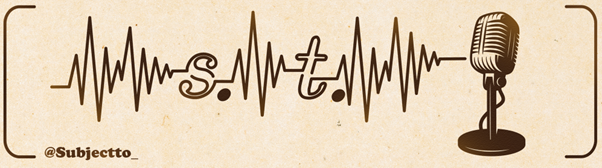
In the meantime, I was discussing the podcast name with my former student Eduardo Queiroga. During the brainstorming session, he suggested many O.R.-related names, and “Subject to” was one of them. That immediately caught my attention and received unanimous approval from those aware of the project. After creating the YouTube channel [2], I realized I needed a logo, which was a no-brainer (s.t.), and a banner. For the latter, I had the conceptual idea, which was quickly drafted by my colleague Luciano Santos and then polished and digitized by former student Ana Beatriz “Bia” Herthel, as displayed in Figure 1.
At that point, I needed to convince someone to be the very first guest. My great friend and first international research collaborator, Maria Battarra (University of Bath), who had been closely following my podcast preparation over the months, fully embraced the cause and bravely accepted the role of guinea pig for the pilot episode [3]. We recorded the episode in the final week of 2020. Maria became the godmother of the s.t. project, and I am very grateful for her unconditional support. For the second and third episodes, I invited two other courageous friends, Rafael Martinelli (PUC-Rio) [4] and Claudio Contardo (Concordia University) [5], who promptly agreed to participate in the podcast. Armed with these three episodes, the s.t. podcast was officially launched in January 2021.
Moreover, my colleague Bruno Bruck insisted that I add a customized thumbnail to the videos, for which I came up with a minimalistic design. Meanwhile, my former student and now colleague Luciano Costa recommended that I create an account on Anchor.fm (now Spotify for Creators [6]) so I could make the audio of the interviews available on a variety of platforms, such as Spotify and Apple Podcasts. I then realized I needed a copyright-free opening theme, so I borrowed one from the intro of a song I had composed and recorded years earlier with the assistance of another former student, Vitor Nesello, in which I play all the instruments. Finally, I received support from others, including Manuel Iori (UNIMORE) and Luciana Buriol (Amazon), the fourth and fifth s.t. guests, respectively [7, 8], who put me in contact with other potential guests. This trend of former guests connecting me with future ones continues to this day, forming a true chain of suppORt.
The s.t. Algorithm
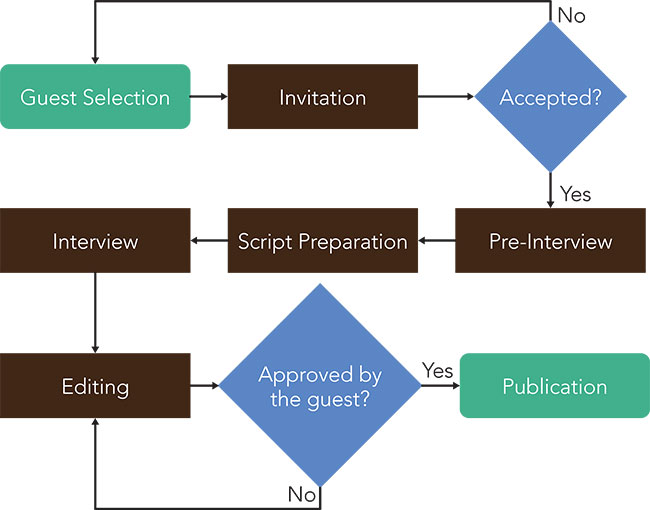
The first seven episodes featured friends of mine whose backgrounds I more or less already knew, and the interviews were conducted in a freestyle manner, without any formal preparation. Things began to change when I invited Helena Ramalhinho Lourenço [9], whose work I had cited many times but had never met, and about whom I knew very little personally. For that episode, I conducted a pre-interview to gather the necessary information and prepare a script for the podcast. This proved crucial when I unexpectedly found myself interviewing renowned figures, such as Mauricio Resende (formerly at Amazon and AT&T) [10], who connected me with Panos Pardalos (University of Florida) [11], and he, in turn, introduced me to Anna Nagurney (UMass) [12]. I also became progressively more attentive to the editing process, which I initially managed using YouTube Studio before transitioning to the free version of DaVinci Resolve later in 2021. Figure 2 shows the flowchart of the s.t. algorithm. It is worth mentioning that producing each episode takes between 11 and 17 hours.
Impact
By the end of Season 1 in mid-2021, the reception from the O.R. community was quite positive. At that stage, I interviewed 21 guests, including several INFORMS Fellows, as well as a few heroes of mine such as David Pisinger [13] and Eduardo Uchoa [14]. The last episode of the season was a Father’s Day special [15]. I also later interviewed my mom for a Mother’s Day special [16]. They are not O.R. people (both actually hold Ph.D.s in chemistry), but these two episodes were interesting for learning about their fascinating life stories and why my Indian parents came to Brazil after living in Canada for seven years.
I was told by many people that the podcast helped fill the void resulting from the cancellation of many conferences that year due to COVID-19. “Your podcast saved me during the pandemic” was the first thing a respected O.R. scholar told me when we exchanged words for the first time at the IFORS conference in Santiago, Chile, in 2023.
However, the turning point really came after the publication of the episode featuring Dimitris Bertsimas (MIT) [17] in the middle of Season 2, which came out in late 2021. That episode took the podcast to another level in terms of impact and reach. With more than 6,500 views, I received significant positive feedback, including an emotional message from an enthusiastic student based in Auckland, New Zealand, in 2023, after he was admitted as a graduate student at the MIT Operations Research Center: “If you hadn’t done the interview, I wouldn’t have been inspired to apply at all. Your series humanizes the academics and shows them as they are – smart, passionate and nice people – rather than intimidating and unreachable figures. Without exaggerating, your series changed my life.” This very generous comment basically wraps up what the series is about and the impact I’d hoped to achieve.
After the conclusion of Season 2 in December 2021, there were a total of 40 episodes available. In the following years, as the pandemic came to an end, the pace naturally slowed, and I began producing one season per year with an average of 20 episodes, featuring guests from around the world. I had the honor of interviewing several past presidents of IFORS, INFORMS and EURO, as well as living legends, distinguished figures and rising stars from both academia and industry within the O.R. community. Episode No. 100 was released in November 2024, marking the end of Season 5, and featured Artur Pessoa (UFF) [18], undoubtedly one of the most unsung heroes in the field.
The first 100 episodes (see Figure 3) total 133 hours and feature 65 men and 35 women from approximately 25 nations. So far, the podcast has garnered more than 115,000 plays (YouTube and podcast platforms) from people in around 85 countries. In the U.S., it has been accessed from 47 states. On YouTube, the videos have accumulated 11,400 hours of watch time and reached 1.2 million impressions.

In the last couple of years, the s.t. podcast has been highlighted and recommended in blog posts [19-25], journal papers [26, 27], magazine articles [28, 29], books [30], conference talks and panels [31, 32] and open forums [33, 34], and by several organizations, including, for example, Carnegie Mellon University, UC Berkeley and Gurobi Optimization [35-40].
Subject to ... Columns
In 2023, I began collaborating with OR/MS Today by (co-)authoring periodic columns related to the s.t. podcast, such as this one. These columns are directly derived from the episode contents and cover a variety of topics, including technical insights, such as the interplay between O.R. and machine learning [41], and broader topics like how some of the guests discovered O.R. [42], gender issues [43], historical anecdotes and fun facts [44], and academic issues [45]. The columns have been well received by the community, with some of these articles featuring among the most read in the magazine.
The Story Continues
As Anna Nagurney kindly wrote on social media, “[Anand has] brought us all closer by illuminating the journeys that we have taken, thus far, and have shown different possibilities for others.” Moreover, in a recent LinkedIn post about the s.t. podcast, Victor Zavala (UW - Madison) emphasized that “disseminating the life stories of scientists is a highly effective mechanism to promote science among young people.” He also added that the “[s.t.] podcast format is really accessible; I have been listening to these podcasts while driving to work.”
For me, having the unique opportunity to create an accessible format for prominent O.R. figures to share their distinct paths and stories has illuminated my own journey. Producing 100 episodes over four years has been incredibly challenging yet deeply rewarding. I have learned so much from this enriching experience, and now my life has changed in oh so many ways. I am deeply grateful to all 100 guests and the viewers and listeners for supporting the s.t. project. I hope to continue this story of helping the O.R. community share its memories, anecdotes and insights in a relaxed and enjoyable way while inspiring young people to develop an even greater passion for our discipline.
References
- Oral Histories – INFORMS, https://www.informs.org/Explore/History-of-O.R.-Excellence/Oral-Histories.
- Subject to YouTube channel, https://www.youtube.com/@Subjectto_/videos.
- Maria Battarra, s.t. episode, https://www.youtube.com/watch?v=qq4N74ELyfQ.
- Rafael Martinelli, s.t. episode, https://www.youtube.com/watch?v=HnygAo6XTtY.
- Claudio Contardo, s.t. episode, https://www.youtube.com/watch?v=AYjkimudB-w.
- Subject to podcast, https://podcasters.spotify.com/pod/show/subject-to.
- Manuel Iori, s.t. episode, https://www.youtube.com/watch?v=smQTIlUdvdU.
- Luciana Buriol, s.t. episode, https://www.youtube.com/watch?v=nzberhT-7c8.
- Helena Ramalhinho Lourenço, s.t. episode, https://www.youtube.com/watch?v=yrt5AO-Rx1A.
- Mauricio Resende, s.t. episode, https://www.youtube.com/watch?v=8Lrq-iIixp0.
- Panos Pardalos, s.t. episode, https://www.youtube.com/watch?v=O0jeR3HgknI.
- Anna Nagurney, s.t. episode, https://www.youtube.com/watch?v=fa29HSlAR0o.
- David Pisinger, s.t. episode, https://www.youtube.com/watch?v=vz9VZViVYtg.
- Eduardo Uchoa, s.t. episode, https://www.youtube.com/watch?v=9mNjqkUIZRk.
- Natarajan Subramanian, s.t. episode, https://www.youtube.com/watch?v=Upq3VC4C5PA.
- Shylaja Subramanian, s.t. episode, https://www.youtube.com/watch?v=ADy2_Brm8V8.
- Dimitris Bertsimas, s.t. episode, https://www.youtube.com/watch?v=cifspW4gLwA.
- Artur Pessoa, s.t. episode, https://www.youtube.com/watch?v=xWU3GCuy6FI.
- Michael Watson, 2023, “550 Educational Podcast Episodes Since Jan 1, 2021 – My Habits and Top 16 Podcasts,” Mike Talks AI, May 5, https://miketalksai.substack.com/p/550-educational-podcast-episodes.
- Michael Watson, 2023, “Using 5-Minute Personal Talks to Build Stronger Professional Relationships,” Mike Talks AI, August 18, https://miketalksai.substack.com/p/using-5-minute-personal-talks-to.
- Michael Watson, 2023, “Five Ideas I’ll use in my optimization class after listening to Gurobi’s Tobias Achterberg,” Mike Talks AI, October 5, https://miketalksai.substack.com/p/five-ideas-ill-use-in-my-optimization.
- Michael Watson, 2023, “Great s.t. interview with Bob Bixby and Inspiration for a Book Someone Should Write,” Mike Talks AI, December 14, https://miketalksai.substack.com/p/great-st-interview-with-bob-bixby.
- Laura Albert, 2023, “A recap of IFORS 2023,” Punk Rock OR, July 19, https://punkrockor.com/2023/07/19/a-recap-of-ifors-2023/.
- Anna Nagurney, 2023, “The Amazing IFORS Conference in Santiago, Chile,” RENeW, July 17, https://annanagurney.blogspot.com/2023/07/the-amazing-ifors-conference-in.html
- Oliver Bastert, 2024, “FICO’s Leadership in Optimization – Interview with Timo Berthold,” FICO Blog, October 9, https://www.fico.com/blogs/fico-s-leadership-optimization-interview-timo-berthold.
- Laura A. Albert, et al., 2024, “Commentary on Carroll & Esposito Amideo ‘Gender Equality: Opportunities and challenges for the OR community,’” Journal of the Operational Research Society, Vol. 75, No. 6, pp. 1030-1042.
- Brohi, R. & Heinold, A., 2024, “Breaking Barriers and Building Bridges: Women in Operations Research,” Operations Research Forum, Vol. 5, Art. no. 90.
- Desrosiers, J., Lübbecke, M., Desaulniers, G. & Gauthier, J. B., 2024, “Branch-and-price,” Les Cahiers du GERAD, G-2024-36, https://www.gerad.ca/en/papers/G-2024-36.
- Tucker, K., 2023, “From Embracing Equity to Championing Change,” OR/MS Today, June.
- Camm, J. & Watson, M., 2023, “Distinguishing the Profession of Operations Research in the Age of Analytics, Big Data, Data Science and AI,” OR/MS Today, December.
- Grötschel, M., 2024, “Optimization and OR: A Sketch of Historical Developments,” Lecture at CO@Work 2024, https://co-at-work.zib.de/slides/COatWork2024_Groetschel_History.pdf.
- Nagurney, A., 2024, History & Traditions - Herstory & The Future, Committee's Choice Panel: What Does Our Past Tell About Our Future, INFORMS Annual Meeting, https://supernet.isenberg.umass.edu/visuals/INFORMS2024-Panel-Nagurney.pdf.
- Why care about LP – linear programming?, 2024, INFORMS Open Forum, https://connect.informs.org/discussion/why-care-about-lp-linear-programming.
- Subject to: podcasts with OR researchers by Anand Subramanian, 2021, Reddit, https://www.reddit.com/r/OperationsResearch/comments/qi6grp/subject_to_podcasts_with_or_researchers_by_anand/.
- AIROYoung Resources, YouTube Channels, https://airoyoung.airo.org/resources/.
- CNRS, 2024, “L’optimisation : au cœur des défis des sciences informatiques,” Ressources, June 5, https://www.ins2i.cnrs.fr/fr/loptimisation-au-coeur-des-defis-des-sciences-informatiques.
- Grossmann on Subject to podcast, 2024, Carnegie Mellon University, Center for Advanced Process Decision-making, https://capd.cheme.cmu.edu/news/mentions.html.
- “El profesor Andrés Medaglia es invitado al podcast ‘Subject to,’” 2022, Universidad de Los Andes, https://industrial.uniandes.edu.co/es/andres-medaglia-invitado-al-podcast-subject-to.
- “Berkeley IEOR Professor Candi Yano Shares Insights on Research and Career in ‘Subject To’ YouTube Series,” 2024, Industrial Engineering & Operations Research College of Engineering, https://ieor.berkeley.edu/berkeley-ieor-professor-candi-yano-shares-insights-on-research-and-career-in-subject-to-youtube-series/.
- Optimization 4 all, https://optimization4all.com/.
- Subramanian, A. & Teichgraeber, H., 2023, “The Interplay between Operations Research and Machine Learning,” OR/MS Today, March.
- Raffaele, A. & Subramanian, A., 2023, “Revealing a Less-Traveled Road,” OR/MS Today, September.
- Raffaele, A. & Subramanian, A., 2024, “If Dantzig Had a Sister,” OR/MS Today, February.
- Subramanian, A., 2024, “10 Moments in the History of O.R.,” OR/MS Today, September.
- Sharif Azadeh, S. & Subramanian, A., 2024, “Corporate Academia: Navigating Waters Through Perks and Pitfalls,” OR/MS Today, December.
Anand Subramanian is a professor at the Universidade Federal da Paraíba in Brazil. He is the organizer and host of the “Subject to” (s.t.) podcast.