
March 3, 2025 in Human-AI Collaboration
The Symbiotic Relationship of Humans and AI
Collaborative Decision-Making Fostered by Engagement, Trust and Learning
SHARE: PRINT ARTICLE: https://doi.org/10.1287/orms.2025.01.09

The recent expansion in artificial intelligence (AI) technologies is enabled by a confluence of human-driven events that were put in motion much earlier. For instance, the transition to and growth in digital information creation, consumption and storage has been underway for decades. The result is an abundance of readily available data that has contributed to the rise of generative AI platforms, such as OpenAI’s ChatGPT, Microsoft Copilot, Google Gemini and Apple Intelligence in Siri. Those and other AI-enabled technologies are increasingly accepted in work and social settings, in which they enhance productivity and reshape how we access and engage with information. As the capabilities, accessibility and availability of AI systems grow, the future of work depends on creating effective collaborations between those systems and humans.
AI is often presented as a channel for job loss and human replacement, or a referendum on whether humans or algorithms are better at a particular task. Instead of replacing human labor, however, AI is more productively viewed as augmenting it [1]. AI excels at analyzing stable historical data, whereas humans bring intuition, innovation and the ability to adjust rapidly to dynamic environments. These complementary skills hint at the potential for human and AI interactions that are not defined by the extremes of full automation versus human supremacy, but instead rest on a collaborative continuum that depends on the strengths of each participant and the needs of the problem at hand. In these collaborations, AI can support data-driven tasks with precision, and humans can contribute with contextual understanding and adaptability.
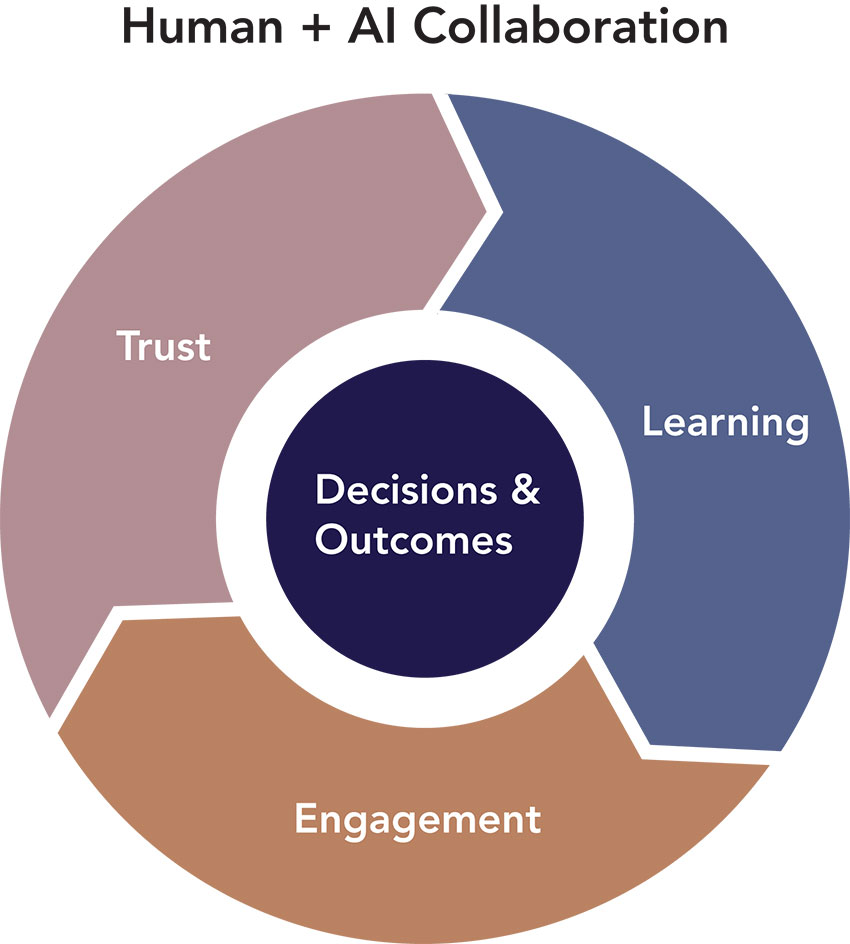
In this article, we offer insights into three factors that can lead to more productive human and AI collaborations: engagement, trust and learning. As summarized in Figure 1, these factors combine in a self-reinforcing loop that provides resiliency to the collaborative relationship and yields sustainably improved outcomes.
Human-AI Engagement: Balancing Productivity and Well-being
Constructive and genuine engagement in human-AI collaborations allows humans to identify how to better leverage their own capabilities and those of AI. Engagement can also lead to greater opportunities and a better experience for humans. Consider a use case of human-AI collaboration within distribution warehouses. Order picking to fulfill customer orders has always been labor intensive, representing 55% of the operational cost. Companies such as Amazon Robotics and Locus Robotics provide AI systems that work alongside human pickers, reducing travel and fatigue, while contributing to human well-being. These companies have adopted a variety of AI support models to augment human needs. Amazon Robotics has developed systems that bring inventory pods to a picker, and Locus Robotics has developed systems that assist the picker by leading them to the pick locations, prompting them to pick the right product from the shelf and carrying the fulfilled order tote to the drop-off station. In addition to improving productivity, workers have indicated that those systems enrich their jobs, allow them to upskill and foster feelings of empowerment [2].
Promoting engagement in human-AI collaborations also involves balancing productivity improvements with human well-being. In some settings, the theoretically optimal solution based on a mathematical model may not be the best solution when faced with the operational realities of the work environment. Worker activities that are optimized by AI systems (task ordering, process steps, route selection) may produce better performance in an idealized setting. However, human workers may have important real-time information that is not available to the AI system or may simply resist losing so much decision autonomy. If interactions with AI are sufficiently flexible, it could allow humans to contribute their own expertise to improve performance and lead to greater empowerment and job satisfaction. To explore this, De Lombaert et al. conducted a field experiment on order pick choice systems where the workers have autonomy in decision-making, such as pick task selection, and another where the workers do not [3]. They found that including humans in operational decisions can improve job satisfaction and motivation without compromising productivity. Engagement can also be fostered if AI is attuned to the preferences of the worker. Using a series of field experiments at Alibaba, Sun et al. demonstrated that AI could identify and incorporate worker packaging preferences, adjust its recommendations to account for those preferences and continue to improve system performance [4].
Determining the right balance of autonomy and decision authority across the participants in a human-AI collaboration can be complex. The level of AI involvement should account for the capabilities of the available human decision-makers and the AI system, the implications of an incorrect decision and the evolution of all these factors. As the participants in this collaboration engage, the boundaries of what problems the collaboration can reliably handle will expand. For instance, as humans expand how they employ AI in their decision-making, their capabilities will expand due to, among other things, their increased proficiency using AI tools, interpreting AI output, recognizing AI limits and anticipating how to effectively insert their own expertise.
Human-AI Trust: Evolving AI with Humans
Human-AI collaborations cannot flourish unless the human participants trust the role of AI in the collaboration. This can take time, education and understanding of the system, its benefits and limits. When AI systems are introduced, humans initially activate the deliberate, thoughtful side of the brain – what Kahneman refers to as System 2 mode of thinking [5]. This is the thought process that steps in when facing complex decisions and moves humans away from the automatic, intuitive System 1. But as humans acclimate to using AI tools, they incorporate AI insights into their System 1 thinking. Thus, decisions that once required careful thought can become automatic, making choices more accurate at adopting insights or ignoring triggers. Consider recent research on AI-enabled driving assistance and notification systems. Initially, these systems operated based on fixed rules. However, as drivers interact and build trust with the systems, their behavior evolves. Through multiple field tests, research found that drivers responded less effectively to AI notifications over time, suggesting that the AI notifications were encapsulated into the automatic cognitive processing of System 1 [6]. This evolution of behavior implies that for the AI to remain useful and relevant, it needs to adapt to the acceptance of human users and the accompanying changes in behavior.
Trust is not limited to confidence in AI capabilities; it also relates to confidence in the organization’s objectives behind including AI in a work process. If a company intends to employ AI to eliminate jobs, management must be prepared for the resulting loss of trust. Distrust of AI has recently manifested in disruptive worker strikes in industries such as entertainment [7] and logistics [8]. Even if a company intends to employ AI to empower workers and positively impact their livelihoods, management must still earn worker trust. This can be achieved by carefully considering worker feedback and the impacts of AI on worker career trajectories. Fortunately, there are success stories from other companies that can help management confidently convey how their own employees can benefit from human-AI collaborations. For instance, retailers such as Walmart and Target have successfully rolled out generative AI tools to their employees to help them more effectively and confidently address questions from customers and colleagues [9]. Seeing how human-AI collaborations benefit workers in other companies can go a long way toward convincing workers to trust in their own collaborations.
Human-AI Learning: A Symbiotic Relationship
A sustainable human-AI collaboration should account for the impact of learning on both sides. In most practical settings, relationships in the data change over time, a phenomenon known as data set shift. AI systems, which are trained on historical data, may be less flexible in adapting to settings with rapidly changing relationships in the data. Learning the new data relationships can take time for an AI system, not because of processing speed but because such systems tend to require a significant amount of new data for retraining. Although humans must also learn as data relationships change, they can make inferences on new relationships faster by understanding the larger context that may be driving the changes. For instance, a human may recognize that sudden changes in demand are occurring because of competitive entry and not because of an underlying erosion in consumer discretionary spending or willingness to pay.
The presence of human-AI collaborations will also change the relationships in the resulting data. As human-AI collaborations allow an incumbent to recognize and develop faster and more effective responses to demand changes in the face of competitive entry, those faster responses will go on to change the opportunities available to the competitor. This, in turn, will pressure the competitor to change its entry strategy, which is then felt by the incumbent, setting the stage for another round of change, learning and response. This creates a perpetual loop in which humans and AI strive to learn in a landscape that is ever-changing, partly as a result of their own actions. The prospect of using AI to automate decisions in a fast and changing landscape can be a limiting strategy. The AI system, trained on historical data, is ill prepared to fully understand the dynamics of the changed system. Automation would yield decisions based on historical (and less relevant) data relationships, limit the human’s involvement and opportunity for learning, and erode AI’s ability to learn from the human. But the outlook need not be so bleak. Recent research reveals that decision processes that subordinate the short-term benefits of automation with the long-term value of human and AI learning can improve decision outcomes, lower costs and materially reduce the negative effects of lost learning [10]. The authors find that humans and AI are dependent on each other for learning, and collaborations that account for this dependency produce superior results [10].
Assuming the value of mutual learning is respected when designing a human-AI collaboration, there are boundless opportunities to innovate. For instance, it may be possible to improve decision outcomes by having multiple humans or AI systems weigh in on a single decision. Although gathering data across multiple inputs may be more resource intensive, it can also diversify the human’s learning, accelerate the AI’s learning and improve the predictive accuracy of the collaboration effort. Flexible collaborations can also be structured to call on resources based on their relative expertise, strengths or availability. For instance, a decision process could rely less on humans when those resources are capacity constrained or when a human is less likely to add substantive value. Collaboration processes may also be designed to improve human satisfaction; for example, by reducing work on less engaging tasks and allowing humans to devote more time to tasks that require intuition and innovation.
From Collaboration to Improved Outcomes
Although AI can, in aggregate, meet or exceed the performance of humans in some settings, removing humans from a process can overlook opportunities for productive coordination. In this article, we argue that human-AI decision-making is more productively thought of as a continuum that is bounded by, but not limited to, no automation (i.e., only human involvement) and full automation (i.e., only AI involvement). Between these extremes lie various forms of collaboration in which humans and AI combine to unlock more value than either could in isolation. This may include decision processes that involve escalation paths to a specialized AI model or human, much like a general medical practitioner may refer a patient to a doctor with specific expertise on an illness or treatment.
Understandably, it will take time to build confidence in human-AI collaborations. Ultimately, organizations and societies must find their own paths forward in leveraging AI to improve outcomes in a way that aligns with their culture and priorities. Humans and AI are complementary in their respective skills, but complementarities alone are not sufficient. With proper engagement, earned trust and shared learning, human-AI collaboration is more likely to bring improved outcomes. As AI-enabled platforms evolve, the collaboration between humans and AI will become a cornerstone of decision-making in both everyday tasks and larger strategic processes.
References
- Garg, R., 2022, “AI-Enabled Future of Work,” OR/MS Today, https://pubsonline.informs.org/do/10.1287/orms.2022.06.03/full.
- De Koster, R. and Roy, D., 2024, “Research: Warehouse and Logistics Automation Works Better with Human Partners,” Harvard Business Review, June 21, https://hbr.org/2024/06/research-warehouse-and-logistics-automation-works-better-with-human-partners.
- De Lombaert, T., Braekers, K., De Koster, R. and Ramaekers, K., 2024, “Is it Good to Have a Choice? The Value of Participatory Order Assignments in Warehousing,” International Journal of Operations & Production Management, https://doi.org/10.1108/IJOPM-11-2023-0882.
- Sun, J., Zhang, D.J., Hu, H. and Jan Mieghem, J.A., 2022, “Predicting Human Discretion to Adjust Algorithmic Prescription: A Large-Scale Field Experiment in Warehouse Operations,” Management Science, Vol. 68, No. 2, pp. 846-865, https://doi.org/10.1287/mnsc.2021.3990.
- Kahneman, D., 2011, “Thinking, Fast and Slow,” New York: Farrar, Straus and Giroux.
- Garg, R., Roy, D. and Kumar, A., 2024, “Accounting for Human Behavioral Changes in an AI-Enabled Driving Assistance System,” POMS Annual Conference, Minneapolis, MN.
- Scheiber, N. and Koblin, J., 2023, “As Artificial Intelligence Evolves, Screenwriters and Actors See a Threat,” The New York Times, September 12.
- Eavis, P., 2024, “Automation at Ports? Strike on Table,” The New York Times, September 12.
- Holman, J., 2024, “Target Workers to Carry A.I., Emulating E-Commerce,” The New York Times, June 21.
- Imdahl, C., Schmidt, W. and Hoberg, K., 2024, “Targeted Automation and Sustaining Human-AI Learning,” Working Paper, https://papers.ssrn.com/sol3/papers.cfm?abstract_id=4292438.
Rajiv Garg is an associate professor of information systems and operations management in the Goizueta Business School at Emory University. His research explores the economic and social implications of digital technologies and human-machine interactions. His research has attracted over $1 million in funding and has been published in journals such as Management Science, Information Systems Research, MIS Quarterly and Production and Operations Management. Debjit Roy is a professor of operations and decision sciences at the Indian Institute of Management Ahmedabad, India. His research focuses on improving system performance (such as human-robot collaborative systems) using stochastic models and optimization. He has received several research awards and published in leading international journals, such as Operations Research, Transportation Science, Journal of Operations Management, Production and Operations Management, IISE Transactions and INFORMS Journal on Applied Analytics. Bill Schmidt is an associate professor of information systems and operations management at Emory University, Goizueta Business School. His research involves collaborating with manufacturing companies to explore applications of machine learning in operational decision-making and operational disruptions. His research has received multiple awards, including the Ford Motor Company’s Engineering Excellence Award and Daniel H. Wagner Prize for Excellence in Operations Research Practice. He has published in Management Science, Strategy Science, Manufacturing & Service Operations Management and Production and Operations Management.