


March 3, 2025 in In Memoriam
Tribute to John D.C. Little
SHARE: PRINT ARTICLE: https://doi.org/10.1287/orms.2025.01.10
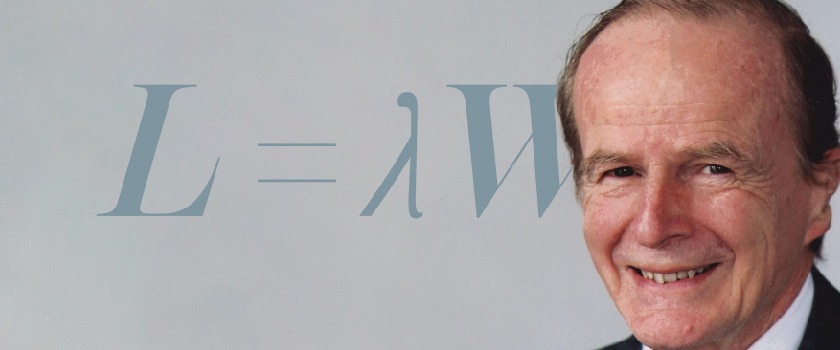
John D.C. Little was a giant in the field of operations research (O.R.) and marketing science. A vast amount of bibliographic material, remembrances and video content exists. The purpose of this In Memoriam is to review his contributions to the field, highlight critical links to the historical documentation and draw out his lessons for us in the future.
Timeline
John died on Sept. 27, 2024, at the age of 96. Here are a few critical dates from his life:
- 1945: Enrolled at Massachusetts Institute of Technology (MIT)
- 1948: Graduated from MIT with SB degree in physics
- 1955: Earned the first Ph.D. in operations research granted by MIT
- 1957: Became an assistant professor at Case Western Reserve University
- 1961: Published Little’s law
- 1962: Returned to MIT at the Sloan School of Management as Associate Professor of Operations Research
- 2017: Retired from MIT at the rank of Institute Professor (MIT’s highest rank for a faculty member)
His life and times at MIT are vividly portrayed in the first 20 pages of the book “From Little’s Law to Marketing Science” (edited by John Hauser and Glen Urban) compiled for his Festschrift. John Little was a virtual co-author on this piece, so it is very autobiographical [1].
Operations Research and Little’s Law
John is best known for his proof relating the average number in a queue (L) to the average waiting time (W) and arrival rate (λ) for the queue, in a relationship that is now known as Little’s law: L = λW. The result had been a folk theorem, having been demonstrated with probabilistic steady-state analyses for special cases; many thought it to be true more broadly, but there was no proof. While teaching at Case Institute of Technology, a student challenged John to prove it. He took on the challenge over his family’s summer vacation in Nantucket, armed with books on stationary stochastic processes. By the end of the summer, John finished the paper and submitted it for publication in Operations Research, where it was accepted on the first round [2].
John succinctly motivates the paper with the observation that the relationship “is of interest because it is sometimes easier to find L than W (or vice versa) in solving a queuing model.” The paper is important for both establishing the result under very general conditions and offering a completely new perspective on how to prove the result. John had a novel insight based on the physics of a queuing system: In his words, “at the same time that a customer is standing in line and so can be counted, he or she is also accumulating minutes waiting …” [3]. John used this insight to develop his arguments for the proof, and his approach has evolved into the sample path methods, which have become a fundamental tool in probabilistic analyses [4].
Shortly after the Little’s law paper, John tackled the infamous traveling salesman problem (TSP) [5]. In Little et al. (1963), he developed a novel implicit enumeration search procedure for solving the TSP. At the time, the best methods were based on deterministic dynamic programming and could solve TSPs with up to 13 cities. John’s algorithm allowed for solving much larger problems (25-40 cities). Furthermore, the paper introduced the terminology “branch and bound” (B&B) as a description of the methodology and was one of the first implementations of the B&B methodology to solve binary integer programs.
Marketing Science
John’s research transition into marketing began with wondering how much a brand should allocate to advertising and led to his work with Mars candy company on advertising budgeting. His first paper was about adaptive control of advertising expenditure, and after contacts with Nabisco growing out of an MIT summer session on marketing models, John developed ADBUG for budgeting and Mediac (with his Ph.D. student Len Lodish) for media allocation [6, 7]. This body of work and his consulting with Coca-Cola led to his groundbreaking paper on decision calculus [8]. He proposed a revolutionary idea to marketing (and management) scientists: to build models that are actually used and not just interesting publishable academic work. He proposed six criteria for a model:
- Simple
- Robust
- Easy to control
- Adaptive
- Complete
- Easy to communicate with
He was willing to let managers use judgments as inputs and used an online conversational interface to provide easy use.
This body of work was fundamental in the founding of the field of marketing science. A full expression of decision calculus and market response was the basis for a marketing mix planning model called BRANDAID [9, 10]. His next marketing paper established logit modeling as a cornerstone of understanding market response and spawned literature on probabilistic modeling of market response [11, 12]. John wanted to use data as well as judgment in his models, so he imbedded them in a decision support system. A good example of this is his work on CoverStory, in which model recommendation, market responses and decisions were comprehensively tracked [13].
John’s work is of the highest quality and represents the gold standard for marketing modeling. He was so careful in his work that he once told Glen, “I often work a whole day to get one final sentence for a paper.” John spent months and sometimes years making sure everything was just right. Most of his papers were accepted by the journal on first submission with only minor revisions. The rigor and managerial relevance of his work were his trademark.
This research work continues to provide lessons for current model builders. Fred Feinberg, John Hauser, John Roberts and Juanjuan Zhang are currently preparing a paper titled “The Legacy of John Little,” which distills John’s methodology into three principles: (1) Start with users’ needs and add complexity only if justified by the raison d‘etre to be insightful and used; (2) use as many diverse data sources as possible; and (3) measure the model against Little’s six desiderata [14, 15].
Leadership
John made extraordinary contributions to his professional communities. He served as president of both ORSA (1979-1980) and TIMS (1984-1985). John led the effort to merge the two organizations with incredible skill and vision. He deservedly was elected the first president of the newly combined professional association named INFORMS in 1995. The merger would not have happened without John’s leadership, diplomacy and behind-the-scenes actions.
Within MIT, John served as director of the Operations Research Center (1969-1975). In 1972, he was the first head of the Management Science area in the Sloan School (1972-1982), which was composed of the faculty groups in operations research, statistics, operations management, marketing and information technology. In 1982, the Sloan School dean, Abe Siegel, asked John to organize and lead a third area of the school, to comprise the faculty that fit within neither Management Science nor economics, finance and accounting (the second area). This was a particularly challenging assignment because he had to work with faculty from disparate groups and disciplines to create a cohesive academic unit, which was far afield from OR/MS. This became the Behavioral and Policy Sciences area, of which John served as head, from 1982 to 1988.
John co-founded a consulting firm called Management Decision Systems in 1974. This firm grew to more than 250 people offering global services in brand management, new products and marketing decision support systems. In 1982, it successfully merged with Information Resources to offer model and Universal Product Code analytics. In addition to this entrepreneurial leadership, John was also a successful business consultant and board member.
Teaching
John was an innovator for teaching marketing models at the MIT Sloan School. His teaching style was to start with a few concise lectures and quickly switch to project mode – students would do hands-on projects with John as the mentor and advisor. In the 1980s, he pioneered a program called “Fast Track” for a select set of MBA students, who took an advanced track of analytic classes and engaged in real-world applied modeling projects.
John was also committed to undergraduate students. He led the undergraduate program committee for 20 years and helped lead MIT undergraduate management to its regular top ranking. Over many years, John would invite undergraduate students to his home for Thanksgiving, which included traditional dinner, a visit to Concord’s North Bridge and contra dancing.
John was highly devoted to his Ph.D. students, as reflected in their comments. Fred Feinberg (University of Michigan) comments, “John not only made me a better scholar, but a better human being, partly by intuition about how each of his students would best develop. John was the person in my life I’ve most admired.”
Majid Abraham notes, “He was perceptive, always positive and incredibly encouraging. I quickly learned to listen carefully to every word he spoke – his thoughts were always meticulously considered and insightful.” Pete Fader (Wharton School) says, “I would not be in this field (and would have not pursued a Ph.D. at all) if not for John. I thank him every day for helping to steer me in such a fruitful direction.”
Many other Ph.D. students and co-authors have similar remembrances of John’s influence on their careers. Glen Urban (MIT) says, “John was not my Ph.D. advisor, but I learned from him over my 50+ years at MIT. He was my role model and mentor. I would not have obtained tenure or become Dean without him.” John Hauser (MIT) says, “John was a mentor throughout my career, from the first time I came to him to discuss new directions in my career, through graduate school and for many decades as a colleague at MIT Sloan. His insights were deep and valuable. His integrity was contagious. His playfulness refreshing.”
After being away from the world of queuing since the early 1960s, John was recruited, along with Steve, to write a chapter on Little’s law for an introductory operations management book [16]. He followed this up with a new course at MIT called “Applications of Little’s Law” in 2012. This course, along with a subsequent course on singularity, completed John’s influential years as a teacher.
Awards and Humility
As expected, based on his academic record, John received many awards from professional organizations: in marketing, Converse, Parlin and Buck Weaver awards; and in operations research, the first Philip McCord Morse Lecturer, Kimball Medal and O.R. Hall of Fame. John was an elected member of the National Academy of Engineering and received honorary degrees from the University of Liege, Belgium; Catholic University of Mons, Belgium; and University of London.

As a famous figure in O.R. and marketing, John is remembered as being humble and very approachable. Professor Preyas Desai (Duke University) said, “I was always struck by his humility and gentle behavior. It was such an inspiration to see him at Marketing Science conferences.” Professor Roland Rust said, “As one of the true giants in the field, John had every excuse to be arrogant and dismissive of us lesser people (which would be just about everybody else), but he never was.” According to Professor Tulin Edem (NYU), “John was an extremely kind person and a genuine ‘Mensch.’”
Professor Ganesh Iyer (Berkeley) said, “He [was] so incredibly humble and kind especially to junior faculty and students. As an assistant professor, I still remember his kindness and how approachable John was to me.”
John had a marketing science award named after him – the John D.C. Little Award for the best paper published in the previous year in the INFORMS journal Marketing Science – and he especially enjoyed presenting this award in person at the INFORMS Annual Meeting.
Lessons and Rememberance
We end this tribute by drawing important lessons from his incredible career:
- Model builders should always be mindful that their models are intended to be used and have impact. Aim for rigor and relevance. Interact with the real world of management practice. Use Little’s decision calculus criteria for guidance.
- Concentrate on quality, not quantity, in academic research. Aim for breakthroughs, not small extensions to past work.
- Be diplomatic and work relentlessly for organizational improvement. Be honest and transparent. Focus on always doing the right thing.
- Create change by helping students and young members in your profession.
- Be humble and listen to everyone – especially those with different points of view.
We ask that you remember John Little and his work. We certainly will not forget him.
References and Notes
- https://mitsloan.mit.edu/shared/ods/documents?PublicationDocumentID=5593
- Little, John D.C., 1961, “A proof for the queuing formula: L= λ W,” Operations Research, Vol. 9, No. 3, pp. 383-387.
- Little, John D.C., 2011, “OR FORUM—Little's Law as viewed on its 50th anniversary,” Operations Research, Vol. 59, No. 3, pp. 536-549.
- See https://www.youtube.com/watch?v=2TsFXgu4s7k for a 2015 video of John talking about Little’s law.
- Little, J. D. C., Murty, K. G., Sweeney, D. W. & Karel, C., 1963, “An algorithm for the traveling salesman problem,” Operations Research, Vol. 11, No. 6, pp. 972-989.
- Little, John D.C., 1966, “A model of adaptive control of promotional spending,” Operations Research, Vol. 14, No. 6, pp. 1075-1097.
- Little, John D.C. & Lodish, Leonard M., 1969, “A media planning calculus,” Operations Research, Vol. 17, No. 1, pp. 1-35.
- Little, John D.C., 2004, “Models and managers: The concept of a decision calculus,” Management Science, Vol. 50, No. 12, pp. 1841-1853.
- Little, John D.C., 1975, “BRANDAID: A marketing-mix model, part 1: Structure,” Operations Research, Vol. 23, No. 4, pp. 628-655.
- Little, John D.C., 1975, “BRANDAID: A marketing-mix model, Part 2: Implementation, calibration, and case study,” Operations Research, Vol. 23, No. 4, pp. 656-673.
- Guadagni, Peter M, & Little, John D.C., 1983, “A logit model of brand choice calibrated on scanner data,” Marketing Science, Vol. 2, No. 3, pp. 203-238.
- Fader, Peter S., Lattin, James M. & Little, John D.C., 1992, “Estimating nonlinear parameters in the multinomial logit model,” Marketing Science, Vol. 11, No. 4, pp. 372-385.
- Schmitz, John D., Armstrong, Gordon D. & Little, John D.C., 1990, “CoverStory—automated news finding in marketing,” Interfaces, Vol. 20, No. 6, pp. 29-38.
- Feinberg, F., Hauser, J., Roberts, J. & Zhang, J., 2025, “The Legacy of John Little,” Marketing Science, Forthcoming.
- Also see a two-hour INFORMS 2015 video interview of John exploring his research: https://www.youtube.com/watch?v=2TsFXgu4s7k.
- Little, John D.C. & Graves, Stephen C., 2008, “Little's law,” Building Intuition: Insights from Basic Operations Management Models and Principles, pp. 81-100.
Glen Urban is the David Austin Professor in Marketing, Emeritus, and Dean, Emeritus at the MIT Sloan School of management. Steve Graves is the Abraham J. Siegel Professor of Management at the MIT Sloan School of Management. He served as the 2021 INFORMS President.

([email protected])