


June 16, 2025 in President’s Desk
The Power of Collaboration
SHARE: PRINT ARTICLE: https://doi.org/10.1287/orms.2025.02.05
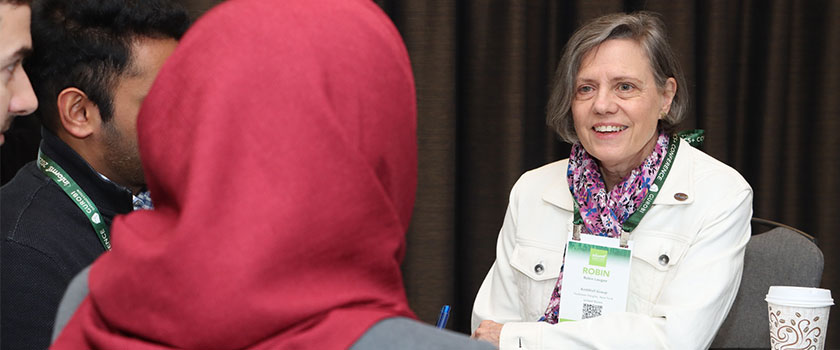
Professional associations provide invaluable services to their members and to society at large. These services include promoting and advancing community interests, disseminating current research, creating educational and certification opportunities, offering career services, and celebrating member achievements. Associations also play a vital role in advocating for their fields, upholding ethical and scientific standards, and fostering inclusive, global communities. However, perhaps none of these services is more critical than fostering collaboration among members and across various sectors.
Having recently returned from a successful INFORMS Analytics+ Conference, I am struck by the multitude of ideas generated and the incredible advancements that emerge through the power of collaboration. The event served as a testament to the innovative potential unlocked when professionals come together to share insights and expertise. I am also acutely aware of the important role that INFORMS plays in facilitating collaboration and the tremendous opportunity – and indeed, the necessity – for INFORMS to enhance its efforts to support collaboration. This need is especially pronounced as the United States, along with many other countries, increasingly prioritizes domestic interests over global cooperation. At the same time, collaboration has taken on heightened significance for our profession in light of ongoing challenges, including mounting threats to academic freedom, punitive actions and restrictions targeting international students and employees, and uncertainty in research funding, among broader economic concerns.
There are numerous opportunities for INFORMS to further support collaboration in its various forms, including fostering collaboration across countries and cultures; among disciplines; through generations; between academia, industry and government; and with other associations.
Collaboration Across Countries and Cultures
INFORMS is based in the United States, but it is important to recognize that more than 30% of our members reside outside the U.S., representing a vast community spread across more than 80 countries. The distribution agreement INFORMS signed with EBSCO extends our journals to over 130 countries, further enhancing our global reach. We are committed to strengthening our ties with global members and building a robust worldwide community because we understand that working together helps the world make smarter decisions. This commitment to international collaboration not only enriches our organization but also enhances the quality of research and practice in operations research (O.R.) and analytics. INFORMS has enjoyed a strong global presence at our U.S.-based meetings and is committed to hosting more meetings in other countries, including the meeting last year in Medellín, Colombia, and the upcoming meeting in Singapore.
One specific example was raised by 2025 Analytics+ keynote speaker Dick den Hertog from the University of Amsterdam. Professor Hertog estimates that there are 3.5 million data professionals focused on social impact projects in low- and middle-income countries (LMICs), many of whom work in isolation. He asked if INFORMS could play a role in connecting this group to support better collaboration efforts. This need is especially pressing, as some government funding for these initiatives has been cut. We are actively exploring how INFORMS can contribute to this cause and support collaboration among this growing O.R. and analytics community. Please reach out to me if you would like to be involved.
Collaboration Across Disciplines
Operations research at its core, to paraphrase two of its founders, is a “scientific method of making decisions regarding operations” [1]. Achieving this requires embracing a wide array of disciplines. As outlined in our Strategic Plan, INFORMS encompasses and values the full breadth of disciplines represented in our community [2]. These include operations research, management science, analytics, artificial intelligence, data science, industrial and systems engineering, statistics, applied mathematics, economics, behavioral science, quantum computing and many other related fields.
INFORMS is uniquely positioned to connect the best ideas from this broad range of disciplines to drive innovation and solve complex problems more effectively. We will continue to nurture these relationships and build cross-disciplinary collaborations, as we have done through recent activities jointly undertaken with the Association for the Advancement of Artificial Intelligence (AAAI).
Collaboration Across and Among Generations
Mentoring is consistently highlighted by early-career members as beneficial for their professional growth. INFORMS currently offers a Mentor Match program pairing an early-career member with a more senior member, and there are opportunities to expand this initiative. This concept, expanding Mentor Match to serve more early-career members, was a recommendation from a 2024 ad hoc committee on early-career professionals.
Equally important is the support for peer collaborations, enabling members – whether they are across the globe or just across town – who are facing similar challenges to share ideas, experiences and solutions or, at the very least, to find a sympathetic ear. Another recommendation from the 2024 ad hoc committee on Early Career Professionals was to expand local and regional meetings to create more opportunities for collaboration, especially for early-career members who may be unable to secure funding or spare the time to attend national meetings.
Collaboration Between Academia and Industry
With ongoing uncertainty surrounding U.S. federal funding, the ability to bring together industry and academia to tackle real-world, pressing problems is fundamental to the mission of INFORMS. However, this collaboration is only effective if we maintain a good balance of academic and industry members within INFORMS. Expanding local and regional meetings can help maintain a good balance and build these collaborations.
Currently, there is an ad hoc committee looking at expanding regional meetings, and the INFORMS Chapters and Forums Committee is exploring how to better support local chapters. Creating more opportunities for academic and industry members to meet will spur more collaboration and innovation.
Collaboration Among Associations
INFORMS also has opportunities to collaborate with other STEM-based associations to advocate for topics of mutual interest. Earlier this year, INFORMS signed a joint letter calling for the reinstatement of government databases that had been removed. We are also working with the American Statistical Association and others to promote the Data Science and Literacy Act [3]. Discussions are ongoing to identify potential advocacy efforts and actions of common interest that will benefit both INFORMS members and the broader scientific community.
O.R. Founded on Collaboration
It is no coincidence that the field of operations research was born out of international collaboration. During World War II, the Nobel Prize-winning physicist Patrick Blackett was appointed director of British Naval Operational Research and, along with his colleagues in England, began pioneering efforts that would lay the groundwork for our field. Similarly, Philip Morse – who was Blackett’s friend and colleague – organized a group of scientists to assist the U.S. Navy during the war [4]. The origins of O.R. owe their success to the power of collaboration, demonstrating the potential that can be harnessed by bringing together unique perspectives from across the globe, different generations and a variety of backgrounds to work toward common goals.
Conclusion
These ideas are not new, but their importance has grown significantly in the current political climate. My focus remains on making informed decisions on behalf of INFORMS that best support the interests of our members and the general public. By fostering a strong community and encouraging collaboration across countries and cultures, disciplines, generations and perspectives, INFORMS strengthens not only our profession but also the communities we serve – advancing smarter decisions for a better world.
References
- Morse, Philip M., and George E. Kimball, 1952, “Methods of Operations Research,” First Edition Revised, The Technology Press of MIT and John Wiley & Sons.
- https://www.informs.org/About-INFORMS/Governance/INFORMS-Strategic-Plan
- H.R. 1050 – Data Science and Literacy Act of 2023
- Kaplan, Edward H., 2011, “Operations Research and Intelligence Analysis,” Intelligence Analysis: Behavioral and Social Scientific Foundations, Washington, D.C.: The National Academies Press.
David Hunt is a vice president at the management consulting firm Oliver Wyman. He is the 2025 INFORMS president. He received the 2017 INFORMS President’s Award and Volunteer Service Award for his leading efforts to create the Pro Bono Analytics program.
([email protected])