June 17, 2025 in Talent Management
Talent Management: “Here Come the Digital Workers!”
SHARE: PRINT ARTICLE: https://doi.org/10.1287/orms.2025.02.15

We need to develop a culture of collaborative intelligence.
Responsible organizations are figuring out how to enable their top talent with smart computers, instead of replacing them. Leading organizations invest in empowering (augmenting) their employees with artificial intelligence (AI) so they can create higher value in better ways, as well as automating processes that are lower value and do not engage employees.
Every business is a talent business, right [1]? To stay ahead of the competition, every organization wants top talent who can learn faster, stay productive longer, use technology more efficiently and invent higher-value offerings more effectively – we call this upskilling. Boosting the creativity, productivity and engagement of employees is a never-ending quest of innovation leaders in organizations as well as the talent management industry.
Nevertheless, too many of today’s employees are distracted, overwhelmed and impatient. In the most competitive industries and geographies, employee annual turnover rate for knowledge workers can be more than 50% [2]. Millennial and Gen Z “job-hopper” turnover costs the U.S. economy $30.5 billion annually [3].
Collaborative intelligence (people, AI and optimized processes) has the potential to improve the efficiency, effectiveness, sustainability and innovativeness of product and service offerings, as well as disrupt business models, and can create new challenges and reasons for high-performing employees to learn and stay with their employers longer.
In this article, we will first discuss the challenges and opportunities surrounding the management of engaged knowledge workers as AI capabilities increase, and then we will provide guidelines to develop a culture of collaborative intelligence by more appropriately enabling automation and augmentation.
Digital Workers: AI at Your Service!
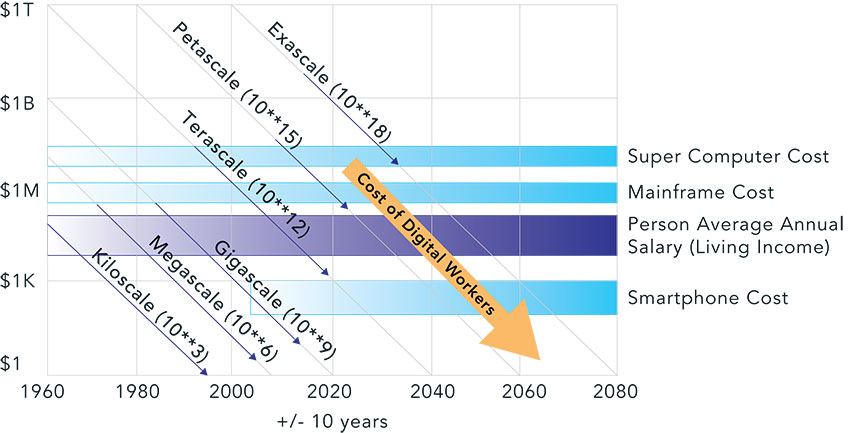
There is no doubt that computers are increasingly capable of doing things that only humans could do in the past. Figure 1 shows the projected cost of digital workers if Moore’s Law continues, in which an exascale is the estimated computing power of the human brain. Advances in deep learning allow the digital workers of today to recognize speech and images as well as process natural language to translate text and answer questions, not to mention advances in self-driving cars, emergency-response robots and robot assistants in stores. As machines become smarter, talent management becomes more challenging for organizations because of the ever-growing range of knowledge-intensive tasks that can be automated and work processes that can be transformed or newly created. Although digital workers can make a wider range of work processes more efficient, they can also create new challenges for organizations that want engaged employees to grow revenue and governments that want upskilled citizens to grow GDP.
As Alfred North Whitehead said, “Civilization progresses based on the number of actions people can do well without thinking about them” [4]. This may be true, but managing the transformation should and can be done in a way that upskills engaged employees, rather than creating fear, uncertainty and doubt. From smartphone assistants to driverless cars, the application areas for applying artificial intelligence are rapidly expanding, touching an ever-widening range of areas of our personal and professional lives. For example, ChatGPT, Apple’s Siri, Google Now, Amazon’s Echo and Q, Microsoft Cortana, Accenture’s Emily, Samsung’s Viv, Salesforce’s Einstein, IBM Watson and other cognitive systems are beginning to reach a level of utility that will provide a foundation for a new generation of digital partners. Over time, digital workers can progress from tool to assistant to collaborator to coach to mediator, augmenting both our own capabilities and interactions with other people, organizations and systems. Advancing capabilities will allow digital workers to become trusted partners taking on routine, tedious tasks and interactions on our behalf. This will lead responsible organizations to race to find durable competitive advantage that engages and upskills employees [5]. Conversational AI is a great example of these interactions using voice [6].
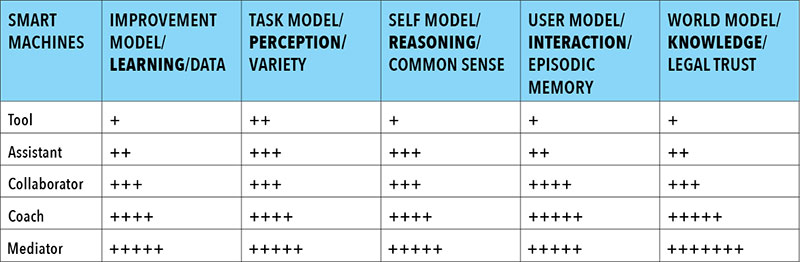
Each of us will be on a personal upskilling journey with a growing number of digital workers and their sophisticated models operating on our behalf. In fact, by 2035, digital workers are expected to possess humanlike episodic memory systems – something no such system possesses today. Indeed, many engineers predict that by 2055, each person may have 100 digital workers that “work for them” [7]. While this may seem strange at first, consider farmers throughout history increasing the number of biological workers (plants and animals) working for them. Upskilled employees will be learning to responsibly manage more and more digital workers that operate on their behalf.
As Moore’s Law continues and the number of digital workers per person increases, our expectations will increase, including boosting measures of interaction, creativity and productivity for both customers (users) and providers (employees). In fact, because everyone using digital workers will be on a personal upskilling journey, responsible firms operating platforms will see less distinction between customers and employees. Both will have opportunities to earn more using the platform as they upskill to better harness the power of digital workers. Both customers and employees are co-creators of value on the firm’s platform, and platform-enabled firms that take responsibility for upskilling customers and employees will see a merging of marketing/communications (aimed at upskilling customers) and human resources functions (aimed at upskilling employees). Almost all knowledge-intensive occupations, including doctors, lawyers, investment bankers and policymakers, will need more digital workers built from increasing capable and trusted cognition-as-a-service building blocks – personal tools, assistants, collaborators, coaches and mediators – that help augment and scale expertise (see Figure 2).
Based on the current rate of progress, digital workers will be used by individuals on their personal upskilling journeys as (l)earners on more and more diverse platforms. In these scenarios, individual employees will need to co-work with the distributed intelligence of people, machines and organizations. Disruptive changes to business models that responsibly monetize employee and customer experience data will have a profound impact on the employment landscape over the coming years. Given these dynamics, how should talent management be transformed to create a culture of collaboration intelligence that appropriately balances augmentation and automation?
Guidelines: Toward a Culture of Collaborative Intelligence
The starting point is to understand task automation via artificial intelligence (smarter machines – digital workers) as well as interaction augmentation via cognitive computing (smarter people and organizations – upskillers growing their eminence).
Don’t forget that cognitive computers do not “automate jobs” – they “automate tasks”! Here are some guidelines for creating a culture of collaborative intelligence.
- An organization’s primary goal should not be eliminating large numbers of jobs with cognitive technology. People and machines will work best in a relationship of augmentation (human in the loop) rather than full automation. AI addresses problems that can be neatly handled by digital workers – problems that are or can become reasonably well defined and ultimately narrow in scope. People excel at defining new problems that need to be solved and coordinating with other people to solve complex problems with social dimensions.
- Substitution of digital workers for human labor will be at the task level rather than the job level for jobs that have complex social dimensions. For socially complex jobs, we have been seeing more out-tasking of individual activities than outsourcing processes. Many jobs include structured, codified, routine and predictable tasks that can be effectively performed by computers, as well as tasks in which people excel that involve emotions, creativity, judgment, trust, empathy, ethics and human intuition 8]. Finding the right balance of cognitive computing and human skills is important.
Identify Non-value-adding Activities
- Organizations need to be able to systematically scan entire portfolios of activities, workflows and processes and categorize them according to the business purpose, system interdependencies and level of manual intervention required based on value. They should be able to assess which tasks can be automated to reduce bottlenecks and cost and also increase decision quality and compliance.
- Organizations must focus on enabling employees – individuals on their upskilling journey – to accomplish more value co-creating interactions with digital workers and encourage constant learning, driving relentless change. This will require them to adopt agile methodologies, service design, system thinking and open-source community skills to enable employees to become adaptive innovators.
- Upskillers (talent with digital-age skills who are constantly upskilling) are in great demand. Winning and keeping them requires a concerted effort to build the values, beliefs, skills and behaviors to support them. The change in approach must extend to hiring practices and accountability standards as well. New success measures must be developed to reflect the values of collaborating with digital workers. Organizations need to signal a culture of experimentation with the license to make mistakes.
Embrace Value Co-creating Interactions
Upskillers are sought after because of problem complexity and the pace of change. Complexity means the number of areas of knowledge that must be combined to solve problems is growing. Almost every unsolved problem today requires engineers, managers, behavioral and social scientists, communications experts, and policymakers to work together. For example, consider driverless cars and what just one incident of a malfunction can create in terms of a problem to be solved. The pace of change is driven largely by rapid technological changes, but demographic, social, economic, environmental and regulation changes also contribute. For example, storm surges along the coastline and flows of migrants that result from environmental change can dramatically impact regions and the work that people do from one year to the next.
Today’s upskillers are evidence-based complex problem solvers with social-emotional intelligence and cognitive flexibility. Agility, collaboration and skill sharing are also needed. Intelligent spaces are needed for ubiquitous access and provision of information among potentially unbounded networks of upskillers and their digital workers. Unstructured collaboration promotes creativity, while structured collaboration promotes operational efficiency. Most work will be done in project form with adaptable workforces with an increased number of formal contractors and crowd platforms. It is extremely important to remember that the highest-performing employees look for new challenges to intrigue their intellectual capabilities. Smart technologies will learn how these people work and can create new challenges for their learning and further development. There are always newer and better ways to address problems, and solutions to a problem can create new problems.
Develop a Culture of Lifelong Learning
Upskillers need to become analytical thinkers and adaptive innovators. Research shows that digital technologies change rapidly, but organizations and skills aren’t keeping pace. As a result, millions of people are being left behind. Individuals need to familiarize themselves and learn the latest capabilities of digital workers so they can become close collaborators and value co-creators. For a range of tasks, children can still outperform digital workers, but for a growing number of tasks, digital workers are faster, are more accurate and have a lower cost than hiring employees. People have the edge in commonsense reasoning tasks and social intelligence, but digital workers are rapidly improving and upskillers are exploring what is possible.
Training and education must be the core competency of organizations. The new breed of upskillers need to be lifelong learners in responsible organizations that empower them to use the platforms of their choice. Upskillers should also be encouraged to join professional development associations such as the International Society of Service Innovation Professionals (ISSIP.org), Project Management Institute, IEEE, INFORMS, ACM and many others. We learn best when we share our knowledge with others, which is one reason why open-source projects attract upskillers, and more and more organizations encourage their employees to work on open-source projects like the Linux Foundation AI and Data.
We learn best when we teach others. Organizations need to encourage their employees to contribute to others’ learning via mentoring or participating in programs that include other employees, students, faculty and industry mentors who are working on grand challenges as part of their lifelong professional development and intellectual stimulation.
The move toward automation and augmentation with digital workers is a journey, requiring changes in both mindsets and behaviors. Succeeding in such a journey requires building the community to support it. Individuals who are upskilling have the abilities and interests to make organizations successful in this journey. They are broad, empathetic communicators and challenge seekers with intuition, as well as deeply engaged critical thinkers with collaboration and teamwork skills. They are entrepreneurial with a growth mindset, opportunity finders with imagination, who learn quickly from failure. We call them “T- or Pi-shaped analytical thinkers and adaptive innovators.” It is also extremely important to define the right processes, metrics and measures, and to capture, calculate, monitor and incentivize incremental productivity, efficiency and effectiveness of individuals, teams and organizations to enable adoption of AI for augmentation, automation and speed.
References and Notes
- https://time.com/charter/6247615/why-managing-talent-is-now-finally-a-core-business-function/
- https://www.bls.gov/jlt/home.htm
- https://www.businessnewsdaily.com/7012-millennial-job-hopping.html
- https://en.wikiquote.org/wiki/Alfred_North_Whitehead
- Bradford C. Johnson, James M. Manyika and Lareina A. Yee, 2005, “The next revolution in interactions,” McKinsey Quarterly, November 1, https://www.mckinsey.com/capabilities/people-and-organizational-performance/our-insights/the-next-revolution-in-interactions.
- Ankush Sabharwal, 2023, “The next revolution in tech: What to know before implementing conversational AI,” Forbes, February 27, https://www.forbes.com/councils/forbestechcouncil/2023/02/27/the-next-revolution-in-tech-what-to-know-before-implementing-conversational-ai/.
- Jim Spohrer, Md Abul Kalam Siddike and Youji Kohda, 2017, “Rebuilding evolution: A service science perspective,” Proceedings of the 50th Hawaii International Conference on System Sciences, https://scholarspace.manoa.hawaii.edu/bitstream/10125/41354/1/paper0205.pdf.
- Zhou, L., Paul, S., Demirkan, H., Yuan, L., Spohrer, J., Zhou, M. & Basu, J., 2021, “Intelligence augmentation: Towards building human-machine symbiotic relationship,” AIS Transactions on Human-Computer Interaction, Vol. 13, No. 2, pp. 243-264.
Haluk Demirkan is a Milgard Endowed Professor of Service Innovation & Business Analytics, University of Washington Tacoma, and a head of cognitive science at Amazon Devices & Services Organization. He is the co-founder and board director of the International Society of Service Innovation Professionals. He is a Distinguished Applied Research Scientist with nearly 25 years of expertise in advanced analytics, machine learning and artificial intelligence. Haluk has a Ph.D. in information systems and supply chain management from University of Florida. Connect with him on LinkedIn. Jim Spohrer is a board director of ISSIP & ServCollab and retired director, Cognitive Opentech Group, IBM Research – Almaden, San Jose, California. Previously, Jim helped to found IBM’s first Service Research group, the global Service Science community, and was founding CTO of IBM’s Venture Capital Relations Group in Silicon Valley. Jim has a Ph.D. in computer science/artificial intelligence from Yale University and a B.S. in physics from MIT.
([email protected])