


July 16, 2025 in Viewpoint
Combining Generative AI with Six Sigma to Create New Smart Quality Management Systems
SHARE: PRINT ARTICLE: https://doi.org/10.1287/orms.2025.03.03

For a long time, Six Sigma has been a reliable way to make processes better and less variable. The development of generative artificial intelligence (GenAI) now gives us a chance to think about what Six Sigma can do in new ways. This article discusses how combining the framework of Six Sigma with the flexibility of GenAI can make systems that improve quality more intelligently, quickly and responsively. We look at what this integration means for operations in different industries, from practical uses to real-world instances.
How AI Has Changed the Way We Improve Processes
Six Sigma was created in the 1980s and helped companies like Motorola and General Electric lower costs, improve efficiency and eliminate process variation. It made operational problems more statistically sound and disciplined. Today, businesses have to deal with a fresh set of difficulties, such as overwhelming amounts of data, rapid technological changes and complicated global supply chains. GenAI helps solve these problems by making smart systems that learn from data, automate insights and assist in faster decision-making.
Six Sigma and GenAI make a strong team – one based on accuracy and the other on prediction. This alliance could change how we think about quality improvement, moving from fixing problems after they occur to proactively and adaptively optimizing them.
Combining GenAI with the DMAIC Framework
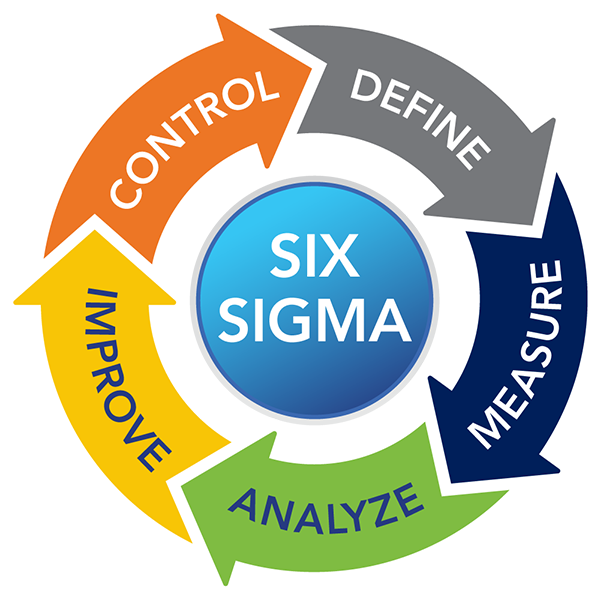
Structured problem-solving and statistical thinking are at the heart of each step of the DMAIC cycle (Define, Measure, Analyze, Improve, Control). When combined with GenAI, these steps are changed by automation, powerful analytics and real-time learning.
-
Define. Voice of the Customer (VoC) and Critical to Quality (CTQ) analyses are typically used in this step. GenAI improves this by using natural language processing (NLP) algorithms to analyze tons of consumer feedback, survey data and support interactions. For instance, a generative model can group complaint stories into useful groups, which can help make project goals clearer and find systemic problems sooner.
-
Measure. In this step, operational metrics and data collection plans are used to measure the existing state. GenAI constantly takes in and compares real-time data sources, including IoT sensor inputs or enterprise resource planning (ERP) logs. AI algorithms find outliers, fill in missing values using imputation methods and standardize data for quick viewing, which makes measuring systems more reliable.
-
Analyze. GenAI’s pattern recognition and anomaly detection skills are at their best when it comes to root cause analysis. Teams can use GenAI to find process bottlenecks, link input variables to outputs, and model cause-and-effect relationships using Bayesian networks or SHAP (SHapley Additive exPlanations) values instead of doing fishbone diagrams or Pareto charts by hand.
-
Improve. GenAI lets you use reinforcement learning and design of experiments (DOE) to simulate many different solution scenarios. Engineers can give the AI limits including cost, time and materials, and it will make a matrix of possible solutions, ranked by how likely they are to have an effect. This speeds up the decision-making process while maximizing process yield and minimizing rework.
-
Control. In this last step, GenAI’s capacity to learn from ongoing operations makes traditional control charts better. AI can identify process drift before it goes beyond control boundaries, which can automatically send out alarms or suggest changes. These systems also change over time, learning from feedback loops and making processes more stable in the long run.
What GenAI-Enhanced Six Sigma Means in the Real World
 When companies use both the framework of Six Sigma and the flexibility of GenAI, they get faster results and more people involved in quality projects. One electronics manufacturer used GenAI to find small flaws in the design of its products. This lowered the danger of recalls and sped up the time it took to get the products to market. Using GenAI, a logistics company automated the process of analyzing delays. This helped Six Sigma teams restructure routes and cut travel time by 17%.
But this integration changes the ethos of improvement in ways other than speed and accuracy. Data analysis is no longer exclusive for Black Belts because AI tools are available to all teams. Frontline workers can come up with new ideas and test them out, which makes quality improvement more open and flexible.
Also, Six Sigma is easy to train. Instead of spending weeks in class, employees can work with AI systems that help them with every step of a project, which shortens the learning curve and allows more employees to be involved in better decision-making.
Last, but not least, speed is important. GenAI speeds up analysis and solution design (i.e., projects that used to take months are now done in weeks using Six Sigma). In markets that move quickly, this flexibility can make the difference between being ahead or behind.
Use Case: Making Cars
Six Sigma has been around for a long time in the car industry, in which accuracy and rule-following are quite important and are getting much better with GenAI. One company that makes parts for electric vehicles used GenAI tools to look for early signals of flaws, such as bonding problems or structural stress, using sensor data from the production line before the pieces were put together.
Engineers used AI simulations to test new materials and design changes, which cut the design cycle from three months to less than four weeks. GenAI also powered vision systems that found alignment problems in real time, which cut down on errors later. The company has fewer defects and better compliance with quality standards such as IATF 16949 overall.
This example shows that GenAI doesn’t replace Six Sigma; it makes it even better. They work together to make continuous development faster, more data-driven and stronger.
Ethical and Technical Issues
GenAI, like any other technology, comes with its own set of problems. AI systems are strong, but they aren’t perfect. They sometimes provide incorrect suggestions, especially when the training data is small or skewed, which is why it is still important to keep humans in the loop.
Companies need to review things at every level to make sure the findings are reliable and clear – check the outputs and any decisions made by machines. These controls are much more critical in industries that are regulated.
Six Sigma methods such as FMEA (Failure Mode and Effects Analysis) can help find places where AI might fail (e.g., data changes), the model isn’t accurate or new inputs come in. Companies may make their systems stronger and more responsible by adding AI-specific features to these risk analyses.
Future Directions: Moving Toward Six Sigma 2.0
As AI technologies get better, Six Sigma will change along with them. We can already see indications of what some people are calling “Six Sigma 2.0,” which is a smarter, more connected version of the process with:
-
Dashboards that change in real time based on GenAI’s forecasts
-
Smart control charts that change limits on their own
-
AI agents that complete tests overnight and suggest ways to make things better by morning
The essential idea is still the same: Get rid of waste and make things better. But the ways in which we do this are changing. GenAI helps these goals get done faster, on a larger scale and in a way that works better in today’s complicated settings.
Conclusion
When we combine generative AI with Six Sigma, it changes the way we think about improving processes. It’s not just about numbers and addressing problems one step at a time anymore. It’s about putting intelligence into every step of the process, from figuring out problems to keeping gains.
The benefits are evident for companies who are willing to use both Six Sigma and GenAI: shorter cycles, more people involved and better results.
Quality in the future won’t only be leaner or smarter; it will be both. And it’s already here.
Gautham Vedanthi is a consultant and operations leader with deep expertise in automotive manufacturing strategy, new product launches and lean transformation. He is a certified Lean Six Sigma Black Belt and a Fellow at the Royal Society for the Encouragement of Arts, Manufactures and Commerce (UK) with over a decade experience working across digital health, automotive and energy industries.