
September 3, 2025 in Modern Supply Chains
GenAI Revolution in Modern Consumer Supply Chains
SHARE: PRINT ARTICLE: https://doi.org/10.1287/orms.2025.03.07

Have you ever wondered how your favorite bag of potato chips ends up on the grocery shelf, or why you feel a stitch of annoyance when your preferred pasta brand is missing? Behind each of those everyday moments is an intricate network of people, data and processes working hard to keep products flowing with minimal disruption. In today’s consumer world, complex supply chains shepherd every consumer packaged good (CPG) through a series of upstream-to-downstream stages until it finally lands in your grocery cart. The CPG supply chain is the journey a product takes from creation to purchase. It includes every step and person involved in making, moving and selling a product. Think of it as a relay race, in which the product is the baton passed from one stage to the next [1].
In recent years, shifting consumer behaviors and shocks such as the COVID-19 pandemic have exposed vulnerabilities ranging from sudden material shortages to production slowdowns. Although many companies appear to have recovered, aftereffects still ripple through supply networks worldwide. The World Economic Forum’s Global Risks Report 2024 warns that the risk landscape will keep evolving across economic, environmental, geopolitical and technological dimensions, even as digital adoption in supply chains lags behind expectations [2].
Against this backdrop, organizations must simultaneously maintain cost efficiency, accelerate time to market, more accurately forecast demand, meet environmental, social and governance (ESG) commitments, absorb new technologies and clear operational bottlenecks. Artificial intelligence (AI) promises relief, and industries from autonomous driving to content creation have already woven it into their workflows. However, a Forbes Advisor survey shows that only 40% of companies apply AI to inventory management and just 30% to broader supply chain operations, which is hardly a wholesale transformation [3].
To unlock AI’s full value, businesses need more than bolt-on features; they require holistic, end-to-end integration that replaces fragmented legacy tools with intelligent, connected ecosystems. Only then can supply chain networks evolve from reactive cost centers into resilient, data-driven engines of growth.
What Is Supply Chain AI (and GenAI)?
Before diving into practical uses, let’s pin down the terminology. According to IBM, AI is a technology that enables computers and machines to simulate human learning, comprehension, problem-solving, decision-making, creativity and autonomy [4].
This broad umbrella covers many models that emulate human thinking to uncover patterns, surface insights and guide decision-making- capabilities now essential for efficient, resilient supply chains.
Generative AI (GenAI) is a newer, fast-growing branch. MIT News defines it as “a machine-learning model that is trained to create new data, rather than making a prediction about a specific dataset. A generative AI system is one that learns to generate more objects that look like the data it was trained on” [5].
Put simply, traditional AI predicts; GenAI invents, such as drafting text, designing images or proposing optimized supply chain scenarios that never existed before. The era of big data ushered in advanced analytics. Companies like Amazon and Walmart leveraged sophisticated data engineering and predictive algorithms to streamline fulfillment and inventory, reducing risk while boosting responsiveness. Descriptive, predictive and prescriptive analytics have already elevated everyday decisions.
What’s next? To move beyond forecasting demand or prescribing reorder points, supply chain leaders need technology that anticipates disruptions before they surface and adapts autonomously when they do. GenAI brings that edge: By generating synthetic “what-if” scenarios, it lets planners detect weak signals, model cascading effects and design responses in hours instead of weeks. Applied end to end, from demand planning through post-sale service, GenAI promises not only economic upside but also better resource stewardship, lower risk and greater stability across the entire value chain.
End-to-End Inclusion of GenAI
Any product you buy as a consumer flows through a series of steps. A fundamental supply chain for a consumer good, such as a T-shirt, involves the following key stages:
- Demand forecasting and supply planning
- Sourcing and procurement
- Manufacturing and operations
- Distribution and logistics
Let’s explore how AI, especially GenAI, can be applied across these stages to build a smarter, more efficient supply chain using predictive models and advanced analytics.
Traditionally, demand forecasting has relied on statistical methods like moving average and exponential smoothing, using historical sales data and a limited set of variables. With machine learning, models such as random forests and neural networks improved accuracy by learning complex patterns from a wider set of inputs. Yet even these approaches still treat demand as a single, fixed number extrapolated from past behavior.
Generative AI introduces a new paradigm: dynamic, contextual demand intelligence. Consider a fashion brand planning a summer drop of graphic tees. Traditional forecasts would lean on last year’s sales and seasonality, but a GenAI model that combines retrieval-augmented generation (RAG) with generative adversarial networks (GANs) can crawl social platforms, detect viral trends and simulate shifting demand curves. It might discover that vintage-style tees are surging after celebrities wore them on a major concert tour. The model could then recommend launching a retro collection in specific regions, timed to local tour dates and supported by synthetic demand scenarios that account for weather forecasts, disposable income and influencer impact. This isn’t merely predicting demand; it’s blending data, cultural signals and business foresight into a real-time, adaptive strategy.
Sourcing raw materials and equipment involves far more than ticking a risk-assessment box or haggling over price. Large language models (LLMs) trained on both structured and unstructured data surface critical insights: They can identify potential suppliers and evaluate them across dozens of variables and “what-if” scenarios. When these models are paired with automation, chatbots for intake, AI-driven market-intelligence feeds and real-time dashboards, they continually monitor supplier performance, adjust negotiation strategies and stress-test contingency plans. As highlighted by Cui, Li and Zhang (2022), “AI delivers the most value when buyers adopt automation and smartness simultaneously in procurement,” because this pairing lets teams swiftly react to market shifts, strengthen leverage at the bargaining table and make data-backed sourcing decisions that align cost, quality and ESG goals [6].
Generative AI takes sourcing a step further by weaving intelligence directly into every decision. In the case of our fashion brand, which needs premium, sustainable cotton and eco-friendly inks for its T-shirts, a GenAI agent can draft tailored requests for proposals (RFPs), run automated ESG compliance checks and simulate supplier performance under potential disruptions like port congestion or severe weather. Rather than manually filtering bids, the system can score responses, flag cost variances and recommend options such as supplier consolidation or volume discounts. It can validate purchase orders in real time, suggest optimal quantities based on lead times and order thresholds, and surface contract terms or supplier histories through a conversational assistant. The result is not just automation, but a smarter, more resilient approach to sourcing that aligns with cost, sustainability and speed.
In most factories, materials planners juggle vendor deliveries, operators battle line bottlenecks, and quality engineers chase defects with Six Sigma and statistical process control, often from spreadsheets and aging ERP (Enterprise Resource Planning) dashboards. GenAI injects intelligence at every layer, shifting the plant from reactive to predictive. On the manufacturing front, GenAI can unlock untapped productivity during production, leveraging root cause analysis to predict failures and reduce defects, and draft easy-to-follow dynamic work instructions. It can also augment operator stations by offering live, AI-supported troubleshooting and operating guidelines [7].
Unlike traditional AI that mainly classifies or predicts, generative models are designed to create new data instances, such as designs, materials or even production schedules, that meet predefined objectives such as GANs and variational autoencoder (VAE) [8].
Building upon the T-shirt journey, imagine the brand has production facilities across different U.S. locations, running a digitally simulated schedule for three variants of a new T-shirt. Using transformer and reinforcement learning models, GenAI can identify that a minor screen-printing queue overlap could lead to a 12-hour production delay and then instantly propose alternate machine configurations, retrain the layout in real time and update the MRP (Materials Requirements Planning) system via APIs. In parallel, computer vision models built with VAEs can scan early batches for issues such as faded prints or misaligned graphics. And, when a new operator clocks in, a conversational GenAI assistant can walk them through the SOPs, troubleshooting and safety checks, step by step, personalized and in real time.
Postproduction, distribution and logistics become the next arena for GenAI. An integrated solution can autonomously balance inventory, optimize material flow and decide when to use centralized versus decentralized nodes. This can create significant value for distributors, including reductions of 20%-30% in inventory, 5%-20% in logistics costs and 5%-15% in procurement spend [9].
Embedded in the MRP, GenAI can constantly read stock levels, lead times and reorder points against minimum-order quantities; simulate network-wide flows; and via transformer models, send messages to the warehouse teams in plain language to schedule picks, generate shipping documents and assign loads.
Concluding the story of the T-shirt, the brand’s system can run a graph neural network to model warehouse capacity, returns, weather and carrier reliability. It can recommend splitting inventory between Ohio and California to speed coastal deliveries, auto-create pick lists, book dock slots and file packing slips or customs forms. During last-mile service, a chatbot can watch live order data; instead of merely answering, “Where’s my order?,” it can flag likely delays, send proactive updates and even trigger apology coupons. In short, GenAI can turn distribution and logistics into a responsive, customer-centric engine that learns and adapts on the fly.
Transition to GenAI-Powered Supply Chain Solutions
Just as the internet transformed industries in the late 1990s and early 2000s, generative AI is now reshaping how businesses operate, from planning to execution. Tools such as email, online search and digital storefronts started as novel innovations but soon became essential to communication, commerce and collaboration. The same pattern is now unfolding with GenAI.
The key difference? Whereas the internet took years to mature, GenAI is advancing at lightning speed, powered by large pretrained models, cloud accessibility and API-first integration. What once seemed experimental- AI-generated reports, conversational assistants, real-time decision copilots- is rapidly becoming standard in modern supply chain and business operations. Those who recognize this shift early and act decisively won’t just keep up; they’ll lead.
But how do we prepare for this shift? What does a successful transition actually look like? Supply chain AI adoption is now closely associated with business innovation. It involves a significant change in operating norms as well as the incorporation of new technologies [10].
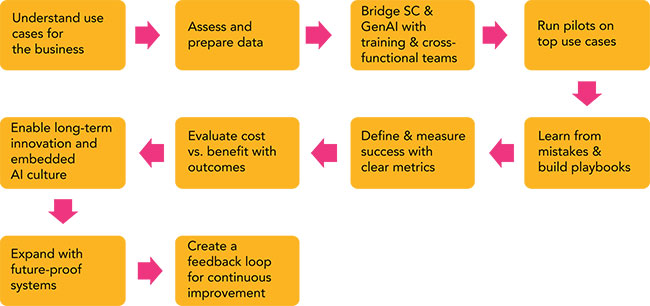
A structured road map is essential, starting from identifying use cases to embedding an AI-driven culture. In addition to model selection or data preparation, the transition involves rethinking how teams operate, how success is measured and how feedback fuels continuous improvement. Figure 1 illustrates a typical path organizations can follow to adopt GenAI in their supply chain, beginning with understanding business-specific use cases and preparing data. From there, supply chain teams must work alongside GenAI experts to codesign training, run pilots and define clear success metrics. Learning from early mistakes, building playbooks and evaluating ROI help mature the strategy. Long-term success depends on embedding AI into everyday operations and expanding with future-proof systems, supported by continuous feedback loops for improvement.
Challenges from GenAI Adoption
Even with the enormous potential of generative AI, a lot of challenges and risks need to be considered. AI implementation in supply chain management comes with obstacles that prevent a smooth integration. At the same time, there are promising opportunities for supply chain AI technology development in the future [11].
Although the potential of GenAI in supply chain management is vast, organizations often face several real-world hurdles during implementation, especially when transitioning from traditional or machine learning-based systems. These challenges can slow progress or even derail adoption without proper planning and cross-functional alignment.
Some of the most common obstacles include:
- Limited availability of high-quality data for training GenAI models
- Difficulty integrating GenAI with existing legacy systems
- Complexity in embedding GenAI into ERP, MRP and WMS (Warehouse Management System) platforms in real time
- Lack of internal expertise and clearly defined GenAI use cases
- Ineffective change-management strategies during large-scale transformation
- Overreliance on GenAI, which can lead to poor or unsupported decision-making
- Risks of model hallucinations, training biases and factually incorrect outputs
- Concerns around data privacy, security and regulatory compliance
- Difficulty mapping ROI and measurable benefits against implementation costs
- Uncertainty in identifying the right use cases to prioritize
- Ambiguity around long-term impacts across various supply chain functions
Successfully navigating these challenges requires technical readiness, organizational alignment, education, governance and a well-defined road map tailored to business-specific needs.
Future Steps
As generative AI rapidly reshapes the supply chain landscape, its potential to transform forecasting, sourcing, operations and logistics is no longer a distant promise- it’s already unfolding. From dynamic demand sensing to intelligent distribution, businesses that embrace GenAI can unlock new levels of agility, efficiency and resilience. But adoption isn’t without its challenges. Success requires more than the right tools; it calls for strategic vision, cross-functional collaboration and a willingness to rethink legacy processes.
For supply chain leaders, the message is clear: GenAI is not simply a trend to observe- it’s a capability to build. Start by identifying high-impact use cases, invest in foundational data readiness, and foster a culture open to experimentation and learning. Those who act today will define the next era of intelligent, adaptive supply chains.
References
- https://www.thesterlingchoice.com/blog/understanding-the-cpg-supply-chain/
- https://www.weforum.org/stories/2025/01/supply-chain-disruption-digital-winners-losers/
- https://www.forbes.com/advisor/business/software/ai-in-business/#how_businesses_are_using_artificial_intelligence_section
- https://www.ibm.com/think/topics/artificial-intelligence
- https://news.mit.edu/2023/explained-generative-ai-1109
- https://pubsonline.informs.org/doi/10.1287/msom.2021.0989?utm
- https://www.mckinsey.com/capabilities/operations/our-insights/operations-blog/harnessing-generative-ai-in-manufacturing-and-supply-chains
- https://urfjournals.org/open-access/generative-ai-in-manufacturing-a-review-of-innovations-challenges-and-future-prospects.pdf
- https://www.mckinsey.com/industries/industrials-and-electronics/our-insights/distribution-blog/harnessing-the-power-of-ai-in-distribution-operations?utm
- https://www.researchgate.net/publication/378140419_Generative_AI_in_Supply_Chain_Management
Sara Lodha is a senior data analyst focusing on supply chain and operations. She holds a master’s degree in business analytics from UC San Diego and has experience in supply chain strategy and manufacturing operations. She is passionate about solving business problems using data-driven solutions.