
August 27, 2025 in Industry-Academia Collaboration
Commercializing Optimization Research
SHARE: PRINT ARTICLE: https://doi.org/10.1287/orms.2025.03.10

In this article, we discuss the experience of Opturion, a university spinoff and its ongoing collaboration with academia.
Opturion was formed to commercialize the results of approximately 8 years of research in constraint programming (CP) and other technologies. Opturion was formed in 2012 and has been further developing and applying artificial intelligence (AI)-based optimization to problems in transport, logistics and supply chain. It has also created standardized platforms to support vertical industry problems such as routing, scheduling and load planning. AI-based optimization has proven itself to be flexible, reliable, powerful and scalable in practical applications.
In our experience, a spinoff is not the end of the collaboration with academia; it is just the beginning. The benefits of ongoing collaboration are manifold. The spinoff can call on the assistance of researchers to solve practical problems, and the researchers gain valuable experience outside of academia. The Opturion story is one of tackling difficult problems and finding innovative solutions; we didn’t do this alone!
Background
The Opturion spinoff was managed by NICTA (National ICT Australia). Its purpose was to conduct high-impact, world-class research; deliver information and communications technologies (ICT); and create economic, social and environmental benefits for Australia. NICTA has now been absorbed by the Commonwealth Scientific and Industrial Research Organisation (CSIRO).
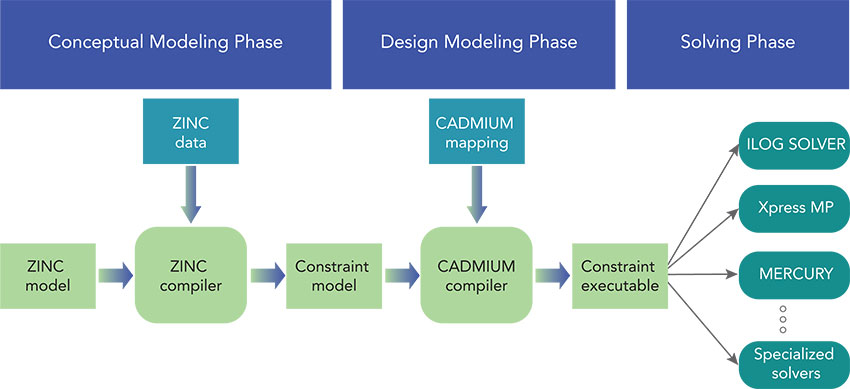
The G12 research project [1] at Monash and Melbourne Universities, in collaboration with NICTA, created a platform in which different solvers, such as mixed-integer linear programming (MILP) and CP, could be combined with various models to solve diverse problems. The G12 project developed a software platform for solving large-scale industrial combinatorial optimization problems. G12 includes a declarative modeling language, independent of any solving methodology and a mapping language for mapping models to underlying solvers. New and more powerful solvers were also part of the G12 project.
Business Perspective
In reality, some of the capabilities of G12 were unnecessary and overcomplicated for commercial software, and the two most valuable outcomes were the modeling language and powerful new solvers. The solvers have proven themselves to be robust, scalable and efficient, and the modeling language can express a wide range of complex problems. Opturion has used these to create industry vertical sectors and problem-specific platform instances, such as vehicle routing and scheduling, load planning, production scheduling and supply chain optimization.
The collaboration with Monash did not end with the Opturion spinoff; it has continued in several forms:
- Professor Mark Wallace was initially seconded to run Opturion and, after his replacement, continues to work part time. Other researchers from Monash also came over.
- Monash and Opturion have collaborated on two Cooperative Research Centres: Alertness CRC, focusing on safety and productivity, and RACE (Reliable, Affordable, Clean Energy), exploring new energy solutions.
- Opturion has developed a software platform for staff rostering, drawing on its work with the Alertness CRC.
- Opturion and Monash have collaborated on a major project for Woodside Energy, optimizing potential investments in green energy and developing tools to enhance engineering design and construction.
- Opturion has employed interns from Monash in IT and optimization.
Since the spinoff, Opturion has created optimization technology that has been deployed in Australia, Singapore, the U.K. and Latin America. Based on this success, Opturion has opened offices in the U.K. and Chile, aiming to serve the North American market in due course. Based on our experience, we have focused on detailed and comprehensive supply chain optimization in industries in which transport and logistics costs are complex or a significant proportion of overall costs, such as mining, forestry, bulk materials and bulk liquids. We have successfully replaced legacy supply chain optimization applications with new technology that provides finer-grain scheduling and solutions that require no further adjustment to implement.
One of Opturion’s key differentiators is its focus on CP and other solvers from the AI optimization branch. This approach contrasts with that of many established players, where the default, or indeed the only option, is MILP. CP works very differently from MILP. Its key focus is constraint satisfaction or feasibility, and it doesn’t impose any conditions on the objective function, constraints or rules. Customers find it easy to understand because it works like a human: find a feasible (or legal) solution and then make it better. No surprise that CP is in the AI branch!
When we examined the market opportunity, we found that the most successful optimization applications were in tactical planning, such as transport planning, supply chain planning, production planning and staff rostering (also known as workforce planning). This outcome is no coincidence; MILP works well for this sort of application, which is relatively easy to simplify and linearize and is strongly influenced by the objective function. However, many other unsolved problems exist where MILP does not perform well. These include:
- Detailed scheduling with complex rules and nonlinearities
- Problems in which the solution is time-critical, such as reoptimization
- Large-scale strategic optimization problems, such as investment decisions over prolonged time scales
Opturion has leveraged the advantages of CP and other AI solvers to build applications, such as:
- Detailed production scheduling for complex processes, such as multicolor printing or the assembly of intricate products in aerospace. Traditional approaches struggle to optimize more than a handful of jobs. Opturion can schedule two weeks’ worth of production, significantly reducing labor costs and machine idle time.
- Courier dispatch, in which new jobs are optimally assigned to the correct driver, taking into account efficiency, workload, compatibility, capacity and customer service constraints. Working over a fleet of more than 1,000 trucks, the optimizer makes a decision in a matter of seconds.
- Integrated optimization for bulk liquid supply chains with demand forecasting, vendor-managed inventory, routing and scheduling, and load optimization.
- Optimizing selection and investment in energy projects, considering capital and revenue expenditure, energy costs, process technology, government incentives and scale over the life of the assets. Compared with a more traditional approach, Opturion reduced the optimization execution time by several orders of magnitude.
Opturion’s success has not all been smooth sailing, and there are some lessons to learn from what went well and what didn’t.
So, what worked?
- The links to Monash University were strong for two main reasons: the secondment and continuing employment of Prof. Wallace and Monash University being a shareholder in Opturion.
- Monash University recognized that Opturion is its vehicle for commercializing optimization research and acted accordingly. We have had very little competition from their team, even though customers often look to universities to solve their problems, seeking a lower-cost solution.
- Monash has actively promoted Opturion and invited Opturion to join its flagship project with Woodside Energy.
- Monash was very supportive and recommended Opturion for projects in which (1) it could not provide a commercial solution or (2) there was no research content. In my experience, this is somewhat unique.
- Opturion and Monash have worked together closely on the two CRCs, solving problems, creating new technology and acting as a bridge between researchers and industry.
- Opturion has collaborated with Monash to investigate the case for commercializing other technologies based on or similar to optimization, using its experience and market knowledge.
- Having Monash (and CSIRO) as partners and shareholders gives Opturion credibility, particularly with large organizations.
What didn’t work?
- The G12 platform was ambitious in scope, overcomplicated and immature. Opturion invested several years in simplifying and improving the performance of the underlying algorithms.
- Like many university spinoffs, Opturion was initially undercapitalized, and the founders underestimated the work required to bring products to market.
- Although Monash as an organization understands the demarcation between Opturion and its optimization research team, there are differences. We have examples of researchers reinventing the wheel, and they could have referred the project to Opturion.
- In retrospect, we should have broadened the scope of our initial collaboration with Monash to include other complementary technologies, such as machine learning. We have since developed this capability independently, but it may have been cheaper and quicker to follow the same path as G12.
- Monash and CSIRO have enviable communications departments. We have had some assistance, but they haven’t conveyed a (potentially) strong message that a win for Opturion is a win for Monash and CSIRO.
- The Woodside project is a good example of Monash and Opturion collaborating on large-scale problems in which a solution exists for some elements, and others require further research. We haven’t been able to develop this approach more strategically, which is a lost opportunity.
Research Perspective
Monash is Australia’s largest research-intensive university, consistently ranked in the world’s top 50 universities. Monash published more than 350,000 research papers in 2024 but is also focused on the practical impact of its research. Opturion is one of 30 spinoff companies productizing the result of this research. We briefly summarize the research in optimization algorithms and software that has been productized by Opturion.
The research on optimization at Monash emerged from earlier research on logic programming and constraint programming. Logic programming is highly elegant. It was designed and well suited for natural language analysis. However, its computation model lacks scalability. CP addressed this drawback by using novel AI techniques, including constraint propagation, to achieve spectacularly efficient performance even on industrial-scale NP-hard optimization problems.
Despite performing well on some problem types, CP is not as scalable as mathematical (mixed-integer linear) programming on other problems. Indeed, researchers have recognized that many industrial optimization problems include some subproblems that are solvable in constraint programming and others that are solvable in mathematical programming.
Another advantage of CP is the natural and compact way of expressing (modeling) problems, which is much easier than mapping the problem into integer-linear constraints for mathematical programming.
Accordingly, Monash collaborated with NICTA to build a novel system (G12) that supported a high-level (natural and compact) modeling language, which could be mapped down onto a combination of constraint and mathematical programming. The G12 system supported problem decomposition methods that allowed large-scale problems to be decomposed into smaller problems, whose solvers could intercommunicate to reach optimal solutions.
Fundamental and Applied Research
The research teams who developed G12 were supported by academic and industrial funding, emphasizing fundamental and applied research. Although the industrial funding had benefits for the G12 system, it also had some drawbacks for the researchers. Tackling industrial applications benefited G12 by revealing shortcomings in its design and errors and bugs in its implementation. However, for the researchers, it proved much harder to publish academic papers about tackling the applications than it was to publish papers about the design of G12, showing nice examples where its advantages were highlighted.
It also became clear that the power and flexibility of G12 meant that users of the system had to grasp aspects of problem decomposition and mapping to underlying solvers that required considerable expertise and sophistication.
Interestingly, this issue led to subsequent developments in the research in two directions.
In the academic direction, the G12 system was followed by another smaller general-purpose system called MiniZinc [2]. Over the last decade, MiniZinc has gradually acquired more and more features and underlying solvers.
In the industrial direction, G12 was productized by Opturion. As mentioned earlier, Opturion employed expert software engineers and optimization modelers to build a number of vertical software products that could optimize specific optimization application areas, such as production scheduling (e.g., printing); workforce allocation to tasks and locations (e.g., courier dispatch); logistics planning, control and optimization (e.g., bulk liquids); and industrial plant design, simulation and optimization (e.g., strategic energy projects).
Technology Transfer – Transferring the Researchers Themselves
The founding of Opturion introduced a plethora of challenges for the researchers involved.
The first and fundamental requirement is to set up the business – understanding and meeting the regulations that govern business operations and establishing an office, office infrastructure, financial controls and governance. For Opturion, these issues were handled by partnering with an existing company, Genix.
For the researchers who moved to Opturion, a stark change of emphasis was needed.
There is a broad set of activities in deploying (optimization) technology for applications in industry and government: identifying use cases; quantifying benefits; recognizing and supporting the process changes in the customers’ business necessary for the success of the optimization solution; productizing (“idiot-proofing”) the solution; documentation; and providing support and maintenance.
For the success of an optimization application, novelty is not essential: If the next application involves nothing that Opturion hasn’t done before, that’s a good thing!
However, industrial novelty is important. Consider planning and scheduling applications, for example. Opturion aims to eliminate repetitive deskwork so that the scheduler is only required when exceptional events occur. In current generation solutions all the following activities require desk workers:
- Scheduling customer orders
- Allocating resources
- Rescheduling on-the-day
- Sharing complete, up-to-date information with stakeholders
- Performance measurement
Opturion targets applications in which all these activities can be automated and optimized, until an exception occurs, which is recognized and flagged to the schedulers. Clearly, this is novel, but it does not require novel algorithms, which have been recently developed in Monash and other research institutions. Indeed, much of the novelty in this example is not in optimization but rather in data management, coordination and automated control.
Discussing the scope of an application with the customer and considering options that conflict with long-held customer practices was, and is, a completely new activity for someone previously involved in academic research. Indeed, implementing a solution to a well-specified optimization problem is typically the easiest part of application delivery.
Perhaps the biggest change when moving into industry comes before any implementation commences. When customers come with their application requirements, these are often only roughly formed in their minds. Opturion’s role is to extract a precise definition of a problem and help customers understand their practical business needs. Often, the full sophisticated optimization problem that a researcher would elicit is not the best for Opturion or the customer. A simpler solution would often be cleaner and more reliable if the customer modified some of the requirements. For example, the customer, rather than agreeing to deliver an order at 9 a.m. (peak hour), could offer a later delivery at a cheaper price. This would save customer resources and enables a more efficient fleet allocation.
Finally, a surprising difference for academics is the importance of marketing and the impact of the product’s appearance. For developers, this means that the functionality of an optimization solution is, very often, less important than the look and feel of the user interface.
Opturion Stages of Development
In the context of all these challenges, Opturion matured in two stages. During the first stage, the Opturion team focused on enhancing the G12 technology. The software was rationalized and consolidated, and a software development and maintenance environment were set up. Opturion had one initial customer for which a fleet optimization solution was developed. Happily, the customer was satisfied enough with Opturion to be with us after 14 years! During these years, the optimizer was designed to interface with data in spreadsheets and generate results in spreadsheets.
In the second stage, the focus shifted from the underlying optimization technology – now reliable and scalable – to applications related to chosen industry verticals. The development work addressed interfaces for users, customers’ data sources and ERP systems. The former researchers on the Opturion team spent much time communicating with customers. This was perhaps an unexpected direction for people who were used to a research environment, but after 14 years, more than half of the original team who joined Opturion at the start have remained with the company.
Conclusions
In our view, Opturion has been successful because of a few key reasons:
- of the technology and the team
- A deep connection with Monash University
- A (necessarily) pragmatic and flexible approach
- Customer engagement and development
The outcome would have been different if we had more resources and had been able to be more strategic. However, the knowledge we gained by applying our technology to many other applications has served us well.
Finally, for anyone contemplating a spinoff, we would suggest reading “The Lean Startup” [3] and “Crossing the Chasm” [4] and consider what it would be like if everything took twice as long as expected!
References
- Stuckey, P. J., De La Banda, M. G., Maher, M., Marriott, K., Slaney, J., Somogyi, Z., Wallace, M. and Walsh, T., 2005, “The G12 project: Mapping solver independent models to efficient solutions,” Logic Programming, ICLP 2005, Lecture Notes in Computer Science, Vol. 3668, pp. 9-13, Berlin: Springer.
- Nethercote, N., Stuckey, P. J., Becket, R., Brand, S., Duck, G. J. and Tack, G., 2007, “MiniZinc: Towards a standard CP modelling language,” Principles and Practice of Constraint Programming – CP 2007. CP 2007. Lecture Notes in Computer Science, Vol. 4741. 529-543, Berlin: Springer.
- E., 2011, “The Lean Startup: How Today’s Entrepreneurs Use Continuous Innovation to Create Radially Successful Businesses,” New York: Crown Publishing.
- Moore, G. A., 1991, “Crossing the Chasm,” New York: HarperCollins.
Alan Dormer is the managing director at Opturion Pty Ltd. Mark Wallace is a professor in the Department of Data Science & AI at Monash University.