


August 27, 2025 in Innovative Education
Forecasting Social Impact
How Georgia Tech Students are Helping Comfama Predict the Future of the Middle Class in Colombia
SHARE: PRINT ARTICLE: https://doi.org/10.1287/orms.2025.03.11

At the Scheller College of Business at Georgia Tech, classroom theory regularly meets real-world impact. Each semester, through the Business Analytics Practicum course, students transform data into action, partnering with organizations across the globe to solve pressing problems. For spring 2025, that mission brought a team of undergraduate students to the heart of Latin America’s most dynamic social innovation hub: Comfama, a nonprofit compensation fund in Colombia.
Comfama serves about 2.8 million people across Antioquia, a region in northwest Colombia, through a network of services ranging from healthcare to education to housing support. As one of 42 compensation funds in Colombia, Comfama operates on a model in which affiliated employers contribute 4% of their payroll to provide benefits for workers and their families. With 125,000 companies on their roster, forecasting population needs isn’t just an academic exercise – it’s a social imperative.
But how do you predict the needs of a population that’s constantly shifting? This is the question Comfama brought to Georgia Tech’s Business Analytics Center (BAC). The answer: data-driven insight, powered by students.
The Business Analytics Practicum: Learning by Doing
The Practicum course isn’t your average classroom experience. It’s a semester-long consulting-style collaboration between students and industry partners. Every spring, undergraduates tackle these projects, and then every fall, MBA and Master of Science in Analytics (MSA) students take the reins. Regardless of level, the goal remains the same: help organizations make better decisions through analytics.
“Learning is often described as absorbing new concepts. But the Practicum showed me it’s also about adaptability,” one student shared. “Working on a live project with real stakeholders demanded flexibility and critical thinking every week.”
That adaptability was key for the Comfama engagement. Students were tasked with building predictive models to forecast Comfama’s affiliated population – a group that includes not only current employees but their families, with ripple effects across regional planning.
The Collaboration
The collaboration with Comfama officially began in fall 2024, when Georgia Tech partnered with the organization on a project focused on predicting Comfama’s affiliated population using macroeconomic and demographic variables. This foundational engagement laid the groundwork for continued partnership into spring 2025 and beyond. It marked a significant milestone for the Practicum program by demonstrating how applied analytics can support forward-thinking public service organizations.
With the fall 2024 MBA Practicum cohort leading the initial charge, students explored how external forces – inflation, employment shifts and migration – impacted Comfama’s population forecasts. Their models provided early insights that Comfama could use to anticipate changing service needs, particularly as Antioquia continued to evolve demographically.
Importantly, this collaboration was made possible through strong support from Santiago García Rivera, head of the Information and Analytics Laboratory at Comfama; his team members Wbeimar Ossa Giraldo, Alejandra Bernal and Susanna Londoño; and Andrés Santiago Alzate Salazar from the Digital Capacities Team. Their expertise and ongoing guidance helped shape the success of the partnership.
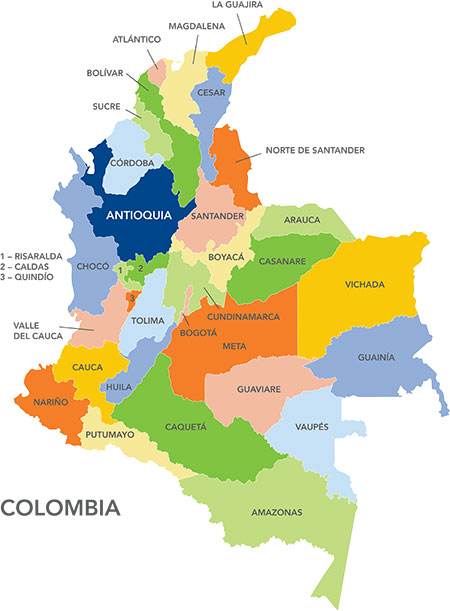 Antioquia: A Region on the Move
In recent years, Antioquia has undergone a major transformation. Medellín, its capital, has attracted migrants from across Colombia and the globe, drawn by economic opportunity and a vibrant cultural scene. Although this growth has boosted the region’s economy, it has also led to challenges: rising living costs, uneven development and a strain on public services.
For Comfama, this meant that traditional forecasting methods were no longer sufficient. According to García Rivera, “Economic and demographic shifts have made it harder to predict how many people will use our services. Recognizing these challenges, we want to build a robust prediction model to help us forecast what will happen to our affiliated population in the future.”
The Georgia Tech Connection
The collaboration began when Juan David Penagos, Comfama’s head of Ventures and New Business Development, reached out to the Georgia Tech Enterprise Innovation Institute’s Medellín Center. That contact led to Sara Araujo Santos, who then connected with Sherri Von Behren, the BAC’s corporate engagement manager. From there, Jonathan Fan, faculty in Information Technology Management and lead instructor for the Practicum, stepped in to design a project that could meet Comfama’s needs and challenge his students.
The students dove into a dataset rich with time series, economic indicators and demographic variables. Over the semester, they experimented with various modeling techniques, evaluating factors such as employment rates, internal migration trends and inflation. The result? A working model that Comfama can use to anticipate service demand and allocate resources more effectively.
Mutual Learning and Long-Term Value
These projects are as much about student growth as they are about business solutions. “One of the most valuable lessons for students,” Fan notes, “is seeing how messy real-world data can be – and learning how to clean, interpret and use it in ways that support decision-making.”
But the learning doesn’t stop at the campus gates. For Comfama, the engagement was a chance to rethink how analytics can help them evolve. “We’re proud to be building a culture of data-driven decision-making,” García Rivera said. “Georgia Tech helped us take a big step forward.”
Beyond Comfama: A Global Network of Impact
The Comfama partnership is one of the most recent, but it’s far from the only one. The Business Analytics Practicum has helped a wide range of companies and nonprofits tackle data challenges, from retail giants to healthcare systems.
In each case, the model is the same: Students gain real-world skills, companies gain actionable insights and the community benefits from smarter decisions.
And the experience leaves a lasting impact. “This project pushed me to think not just as a student, but as a consultant,” said one participant. “I now understand how analytics can truly influence organizational strategy.”
Looking Ahead
The BAC plans to continue expanding its Practicum portfolio, exploring new international partnerships and deeper engagements with returning collaborators like Comfama. For students, it’s a chance to contribute to meaningful work. For partners, it’s a chance to harness fresh perspectives and analytic rigor.
In a world increasingly shaped by data, Georgia Tech is making sure the next generation of business leaders knows how to use it – for insight, innovation and impact.
Zhaohu (Jonathan) Fan is a lecturer of information technology management at the Scheller College of Business, Georgia Tech. Sherri Von Behren is the corporate engagement manager at the Scheller College of Business, Georgia Tech. Sri Narasimhan is professor of IT Management and co-director of the Business Analytics Center (BAC) at the Scheller College of Business, Georgia Tech. Santiago García Rivera is the head of the Information and Analytics Laboratory at Comfama. 

([email protected])

([email protected])

([email protected])